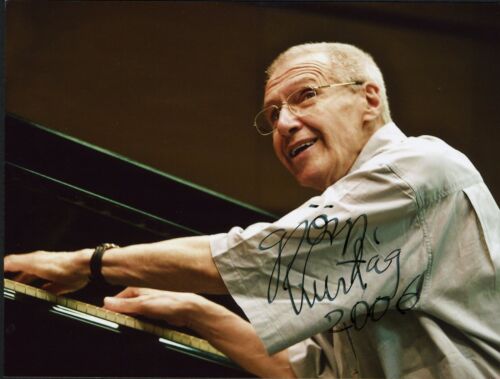
It is fortunate that György Kurtág has been so long-lived, since it wasn’t until his 60s, an age when most people contemplate retirement, that his international reputation really began to take off. But Kurtág was in it for the long haul. The aphoristic Hungarian master, still with us, was born on this date 100 years ago.
Kurtág forged a lifelong friendship with György Ligeti, while studying at Budapest’s Franz Liszt Academy, where he also met the woman who would become his wife. Márta, a pianist, died in 2019 at the age of 92.
Following the Hungarian uprising of 1956, Kurtág spent an extended period in Paris, where he studied with Olivier Messiaen, Darius Milhaud, and Schoenberg pupil Max Deutsch. It was also during this time that he was introduced to the music of Anton Webern and the plays of Samuel Beckett. When Ligeti directed him to a performance of Beckett’s “Endgame,” Kurtág described it as one of the strongest experiences of his life.
He returned to Budapest, where eventually he wound up teaching at his alma mater for 26 years. Gradually, he built a reputation as one of the most respected composers of his time. A meticulous artist, Kurtág’s works are like finely honed miniatures. But these are not pieces for display in the curio cabinet. Rather they are exquisitely crafted microcosms, notable for their poetry and flashes of expressive intensity.
It was surprising that a composer renowned for his work in smaller forms should turn to opera, especially at such a venerable age. Even so, “Fin de partie,” after “Endgame,” was enthusiastically received following its debut at La Scala in 2018.
Sadly, the U.S. premiere, which was to have taken place with the New York Philharmonic in 2021, was cancelled because of Covid. To my knowledge, it has yet to be performed in this country. Hopefully it will be rescheduled soon.
For now, raise a glass of pálinka to György Kurtág on his 100th birthday!
———
Zoltán Kocsis playing Kurtág in recital
https://www.youtube.com/watch?v=KHN58vAf3Y8
Wind Quintet, Op. 2
https://www.youtube.com/watch?v=FIFSR-1Af38
Six Short Pieces for Guitar
https://www.youtube.com/watch?v=9ZseIPZPFro
Interview with Kurtág
https://www.youtube.com/watch?v=F2p_R2m67Ys
“Fin de partie” (click closed caption for English titles)
https://www.youtube.com/watch?v=Bel9Sjfe2MA&t
Kurtág plays Mozart
https://www.youtube.com/watch?v=O5j9I4CauN0
Playing Bach with Márta
https://www.youtube.com/watch?v=Z8lTh58jhA8
Alas, some delectable videos have slipped away since the composer’s 95th birthday, including one of a performance of “Játékok” (“Games”), with Kurtág, Márta, and Kocsis, and another of “Seven Songs for Soprano and Cimbalom,” with Barbara Hannigan.
Tag: Hungary
-

Farewell to Tamás Vásáry
When the Hungarian pianist Tamás Vásáry died last week, I had too many other obligations to honor him properly.
Vásáry was a child prodigy who entered the Debrecen Conservatory at the age of 6. At 10, he became a student of Ernő Dohnányi. He was personally supervised by Zoltán Kodály at the Franz Liszt Academy. He graduated in 1953. In 1956, the year of the Hungarian Uprising, Vásáry fled to Switzerland. Later, he made his home in London.
In the U.K., he diversified. With Iván Fischer, he shared the title of joint principal conductor of the Northern Sinfonia from 1972 to 1982. He was principal conductor of the Bournemouth Sinfonietta from 1989 to 1997. Beginning in 1993, he also served as principal conductor of the Hungarian Radio Symphony Orchestra.
As a pianist, he toured widely. His international fame was bolstered by a recording contract with Deutsche Grammophon.
I remember in the 1970s and ’80s, Vásáry’s early recordings were already being reissued at budget price, making them very affordable. It was the heyday of soft-focus, Elvira Madigan-type cover art. His performances were further disseminated on grab-and-go cassettes.
Chopin and Liszt were always central to his repertoire.
Performing Debussy, Chopin, and Liszt on the French television series “Les grands interprètes”
At the age of 80, playing the last movement of Chopin’s Piano Sonata No. 3
An interview from 2021
https://press.agency/our-existence-in-this-world-is-only-a-small-part-of-our-lives/
Vásáry died on February 5 at the age of 93. R.I.P. -

György Pauk Violinist Dies at 88
The violinist György Pauk has died.
Pauk, who lost both his parents in the Holocaust, was haunted by memories of lean times, marked by hunger, cold, and fear, living with his grandmother in the Budapest ghetto. For many years after, he always traveled with emergency food.
Early promise on the violin earned him admission to the Franz Liszt Academy at the age of 9. There, Zoltán Kodály was among his teachers. In 1956, at the age of 22, he defected from his Soviet-controlled homeland. It was Yehudi Menuhin who encouraged him to settle in the U.K, which he did three years later. Pauk became a British citizen in 1967.
An important interpreter of contemporary music, he gave first performances of works by Witold Lutoslawski, Peter Maxwell Davies, Krzysztof Penderecki, Alfred Schnittke, and Michael Tippett. He was also a master interpreter of the music of Béla Bartók.
With pianist Peter Frankl, he recorded the complete violin sonatas of Mozart. Pauk and Frankl had played together since they were children, studying chamber music in Hungary with Leo Weiner. In maturity, they frequently performed trios with cellist Ralph Kirschbaum.
Pauk returned to Budapest for the first time, at the invitation of Annie Fischer, to perform in 1973.
In 1987, he was appointed professor at the Royal Academy of Music. He was a renowned teacher, regarded as the foremost living exemplar of the Hungarian violin school, with a direct connection to Joseph Joachim, one of the most significant violinists of the 19th century. Joachim, also born in Hungary, collaborated with Johannes Brahms and his circle. (He gave the first performance of Brahms’ Violin Concerto in 1879, with the composer conducting.)
Pauk was still teaching as recently as two weeks ago. Reportedly, he took a fall within the past ten days. He died yesterday, in Budapest, at the age of 88.
His instrument was a 1714 Stradivarius, previously owned by the Belgian violinist Lambert Massart. His autobiography, “A Life in Music,” was published in 2021.
R.I.P.
A literal masterclass in how to play Bartók
From a recording of Bartok’s Violin Concerto No. 2
Brahms’ Violin Concerto from 1959
Pauk talks about his life, with musical interludes
-
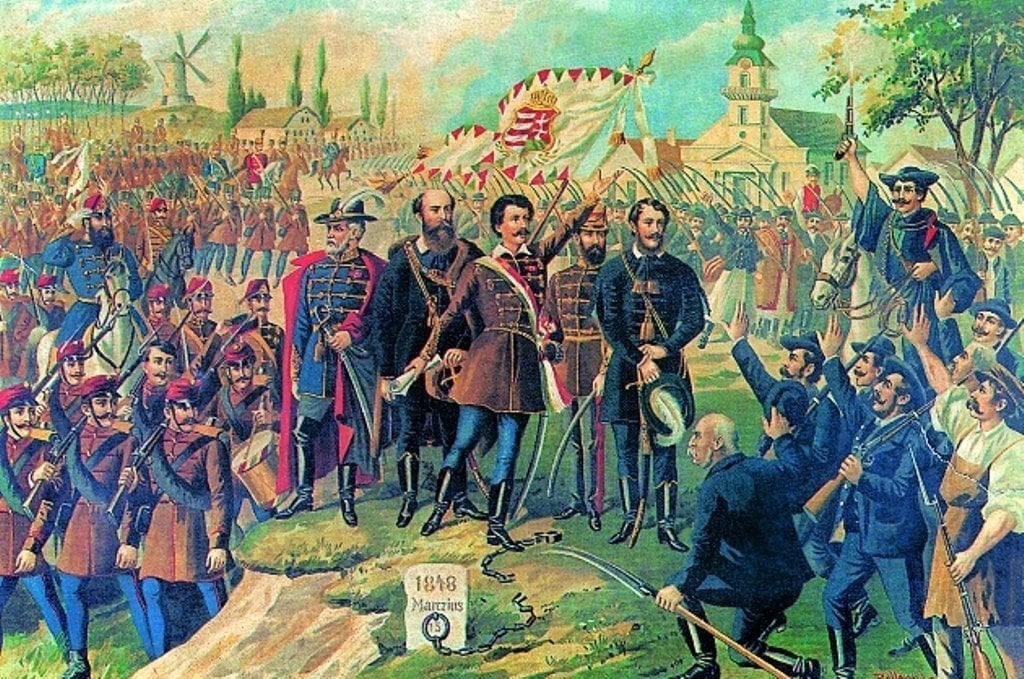
Hungary’s 1848 Revolution in Music
March 15 may not have worked out so well for Julius Caesar, but it is a festive day in Hungary. It is the day Hungarians mark the Revolution of 1848 and the subsequent War of Independence from Austrian-Habsburg rule. It is one of the most prominent of Hungarian national holidays, though this year, because of coronavirus concerns, public celebration is understandably muted.
The uprising began as a peaceful demonstration in Pest-Buda. It wasn’t until autumn that armies clashed. Official secession didn’t take place until March 1849, when Franz Joseph moved to subdivide the Kingdom of Hungary. In April, an independent government was formed, with firebrand Lajos Kossuth elected as governor and president. Unfortunately, the new government would be short-lived.
Here’s Liszt’s symphonic poem “Hungaria.” While Liszt offered no overt program to the piece, its patriotic intent is right there in the title. Listeners at its first performance would have associated the funeral march, based on the work’s B-theme, to the defeat of Kossuth’s revolt. Liszt conducted the piece for the first time at the Hungarian National Theater in what is now Budapest in 1856. At the end, he reported, the audience was in tears.
Béla Bartók began his symphonic poem “Kossuth,” his first mature orchestral work, in 1903. He had only just attended the Budapest premiere of Richard Strauss’ “Also sprach Zarathustra,” which he found electrifying.
Broadly speaking, the difference between Liszt’s “symphonic poems” and Strauss’ “tone poems” is that Liszt more often than not attempts to convey the ideas behind the music’s inspiration, while Strauss frequently ties moments in his scores to specific actions. At his best, Strauss can be understood without knowing the program. At his worst (and I still love him at his worst), his music is so closely tied to the action that his tone poems are like precursors to movie music.
Here is Bartók’s stab at the Straussian tone poem. The work begins with a character portrait of its subject. The Austrian national anthem is parodied to convey the approach of enemy troops. Then comes the battle and Hungarian defeat. In common with Liszt, toward the end, there is a funeral march. Again, the work caused a stir when it was given its first performance by the Budapest Philharmonic Society in 1904.
Despite the funereal overtones, Kossuth himself escaped. He toured Britain and the United States where he was received as a revolutionary hero, though there were some who bristled at his perceived arrogance and ambition. He died in Turin in 1894. His body was sent home to Pest, where it was interred, amid national mourning, and a bronze statue erected in his honor.
It’s so easy to accept music, even music that has meant so much to so many, with a degree of complacency, as an abstraction, or as mere entertainment. A broad awareness of the back story to pieces such as these imbues them with something extramusical. It allows a listener to leap across time and distance to truly empathize with the dreams, struggles, and spirit of the Hungarian people.

Tag Cloud
Aaron Copland (94) Beethoven (95) Composer (114) Film Music (150) Film Score (143) Film Scores (255) Halloween (102) John Williams (198) KWAX (233) Leonard Bernstein (105) Marlboro Music Festival (125) Movie Music (165) Mozart (91) Opera (215) Philadelphia Orchestra (90) Picture Perfect (174) Princeton Symphony Orchestra (110) Radio (90) Ross Amico (244) Roy's Tie-Dye Sci-Fi Corner (290) The Classical Network (101) The Lost Chord (269) Vaughan Williams (107) WPRB (397) WWFM (881)