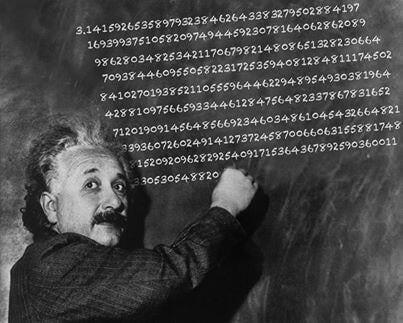
Because of Einstein’s longtime association with Princeton, International Pi Day (3.14, get it?) is usually a pretty big deal here, or at least it was until the pandemic. Understandably, things have been a little subdued since then. The Einstein look-alike contest, the Pi Day tours, the pie-throwing, the Pi memorization and recitation, all were conducted online on Saturday. Today, some of the fooderies are offering deals on pie. That’s mostly what I care about anyway.
In case you’re not an Archimedes fan, Pi, represented by the Greek letter “p” (“π”), is the ratio of the circumference of a circle to its diameter, commonly approximated as 3.14159 – though you could take it a good deal further, since the number is wholly irrational and refuses to fall into a repeating pattern. This is clearly known by Mr. Spock when he uses it to confound an evil computer.
Einstein lived in Princeton for the last 21 ½ years of his life, during his residency at the Institute for Advanced Study, which, in its early days, was located temporarily on Princeton University campus. Einstein’s house still stands at 112 Mercer Street. In accordance with his wishes, the house was not turned into a museum after his death in 1955. A lot of his furniture and a number of his belongings are on display at the Historical Society of Princeton’s Updike Farmstead, located at 354 Quaker Road.
Though Einstein’s house continues to be owned by IAS, it remains a private residence, as is made abundantly clear from signage posted about the property. The house was registered as a U.S. National Historic Landmark in 1976, but there is no marker to advertise the fact. Its significance, however, remains an open secret, and rare is the time I drive past that there’s not someone standing out front, taking a selfie.
According to Google Maps, I can walk there in about 40 minutes. I bet I could do it quicker. Maybe I will – and see if I can get someone to take a picture of me, standing next to the “Private Residence” sign on the front gate, eating pie.
https://en.wikipedia.org/wiki/Albert_Einstein_House
Einstein was a great music lover. “Life without playing music was inconceivable for me,” he’s been quoted as saying. “I live my daydreams in music. I see my life in terms of music… I get most joy in life out of music.”
In 2018, Einstein’s violin sold at auction at Bonhams New York for $516,500 – five times the auction house’s estimate. The instrument was made in 1933 by Oscar H. Steger, a member of the Harrisburg (PA) Symphony Orchestra. Einstein gave the violin to Lawrence Wilson Hibbs, the son of Princeton janitor Sylas Hibbs. It remained in the Hibbs family until the time of its auctioning.
https://www.bonhams.com/press_release/25709/
There’s a recording that has been circulated around the internet of Einstein playing a Mozart sonata, but don’t believe it. It’s a hoax, like too many other things on social media, shared without question, everyone so wanting to believe it’s Einstein playing the violin.
Is there an authentic recording somewhere? Maybe. But if it’s discovered, don’t count on Einstein playing as well as Carl Flesch or Arthur Grumiaux.
By cosmic coincidence, Einstein was born on this date in 1879. He once observed, “The difference between genius and stupidity is that genius has its limits.” Is Pi, then, as a numerical sequence without limit, stupid? I guess it’s all relative.
When Walter Matthau played Einstein in the film “I.Q.,” a goofy romantic comedy starring Meg Ryan and Tim Robbins, shot in Princeton in 1994, a neighbor’s house, at 108 Mercer Street, was substituted for Einstein’s actual residence.
Only one of many reasons to roll your eyes at “I.Q.,” which not even Jerry Goldsmith could save.
Still worth seeing it for Matthau, though. And for Princeton, of course.
https://www.youtube.com/watch?v=ihhHk6awueU
All together now, as we sing the Albert Einstein Pi Day song!
The tyranny of Pi
Face it, YouTube is crazy for Pi
Scariest Pi song?
What does Pi actually sound like?
This way madness lies. Clearly, the possibilities are endless.