“A symphony must be like the world,” Gustav Mahler once famously declared, “It must embrace everything.”
Turning that on its head, “the world” becomes a useful metaphor for classical music itself, since the realm music occupies is so broad, so deep, and so varied, it’s impossible for any one of us to possess more than a passing familiarity with even the tiniest fraction of its immeasurable mysteries. That’s part of what I find so appealing. The frontiers are limitless; the content inexhaustible. You can travel as far outside the standard repertoire as your legs or ears will carry you, or you can dig deeply into a symphony by Mozart or Beethoven to marvel at the tiniest cells of their creation.
It’s fortuitous, perhaps, that Mahler made his observation while on a walk with Jean Sibelius, the All-Father of Nordic music.
Every once in a while I’ll note the obituary of some vaguely familiar musician, and it will spur me to check out what I can of his or her recorded output. In the case of Danish composer Ib Nørholm, who died on Sunday at the age of 88, his was a name I distantly recollected, probably from a rich vein of LPs, numbering in the hundreds, I inherited back in the days when I ran a used book business in Philadelphia.
I was remiss in not exploring any of his works, that I can recall, until only this past week. A pupil of Vagn Holmboe, Nørholm composed 13 symphonies. So far, I have listened to Numbers 4, 5 & 9. Number 4, subtitled “Decreation,” is interesting, in that its avant-garde gloss – complete with quasi-sprechtstimme, possibly aleatoric chorus – can’t obscure the work’s Sibelian pedal tones. The recording, on the Kontrapunkt label, also features the composer reciting poetry (in Danish) in the symphony’s final movement.
Number 5, subtitled “The Elements,” is twelve-tone, and I suppose a little on the severe side, but for anyone with a predilection for the austerity of a certain vein of Nordic music, surprisingly listenable.
But it is Number 9 that hits the sweet spot for me. Here Nørholm has settled in with a new lyricism, and he feels totally comfortable in his own skin. Not being familiar (as yet) with the rest of his output, this is what I would recommend as a good starting point.
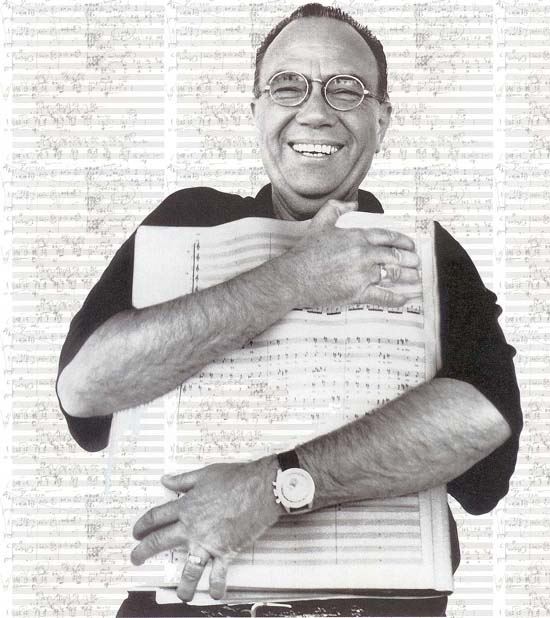
On the same day, the music world lost Swedish composer Sven-David Sandström. I gather he is mostly known for his works for voice. Perhaps this would be more to your liking:
Sandström was 76 years-old.
Neither of these works may be your cup of vodka. But if you clear your head, close your eyes, and just go with them, you may be surprised to discover that you actually find the music rewarding. As a certain quotable Dane once remarked, “There are more things in heaven and Earth, Horatio, than are dreamt of in your philosophy.”
PHOTO: Sven-David Sandström embraces music