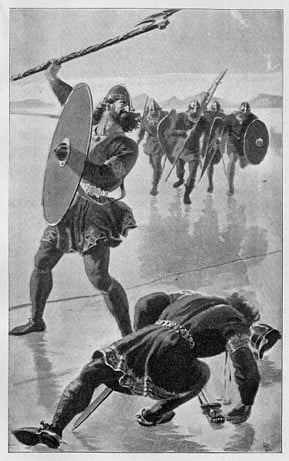
This week on “The Lost Chord,” brace yourself for Icelandic composer Jon Leif’s “Saga Symphony.” Scored for tuned anvils, stones, whip, shields of iron, leather, and wood, great wooden casks played by large hammers, and six ancient long horns, or lurs, the work is an intriguing blend of extravagance and austerity.
Leifs studied in Leipzig and wound up stranded in Nazi Germany for much of World War II. You’d think the National Socialists would have gone ape for this musical advocate of Norse heroism, but two things worked against him: the modernist language of much of his output, and the fact that his wife and children were Jewish. Also, he found Wagner repellent, asserting that Wagner completely misunderstood the essence and artistic tradition of the North. Public performances of Leif’s works were discouraged (and would have been impractical anyway). Under the circumstances, he preferred to attract as little attention to himself as possible. He found escape in rereading the Icelandic sagas, even as he was used for propaganda purposes to strengthen Germany’s relations with Scandinavia.
Leifs finally managed to obtain permission to leave Germany in 1944. Unfortunately, suspicion of Nazi associations further hindered acceptance of his music abroad. It was only with a series of compact disc recordings released on the Swedish label BIS, beginning in the 1990s, that Leifs – who died in 1968 – was revealed to be Iceland’s most important composer, with a voice as distinctive as any of his time.
Iceland of a hundred years ago was a very different place than it is now. Leifs didn’t hear his first orchestra until he traveled to Leipzig. The “Saga Symphony” is a direct response to Franz Liszt’s “A Faust Symphony,” a performance of which sent the young composer into ecstasies. He went home and immediately began work on the piece we’ll hear tonight. However, his own approach is quite different from Liszt’s. In terms of symphonic development, there is none to speak of. In its place are evocative fields of static harmonies.
Each of the work’s five movements is a character portrait of a hero from the Norse sagas: the vitriolic warrior Skarphéðinn Njálsson (Njál’s Saga), who hacks and hews with his battle axe; the strong-willed Guðrún Ósvífsdóttir (Saga of the Laxardals), who avenges herself against her husband’s killer; the latently heroic comic braggart and coward Björn of Mörk, who takes shelter behind the swashbuckler Kári Sölmundarson, as Kári avenges the deaths of Njál and his sons; Grettir Ásmundarson, who vanquishes the ghost of Glámr in a wrestling match, only to be haunted ever after; and the warrior-poet Tormod Kolbrunarskald (The Foster Brother’s Saga), who pulls an arrow from his heart and even in the throes of death formulates an intricate poem.
Greet your fate with courage and stoicism. Join me for “Liking the Viking,” on “The Lost Chord,” now in syndication on KWAX Classical Oregon!
——–
Clip and save the start times for all three of my recorded shows:
PICTURE PERFECT, the movie music show – Friday at 8:00 PM EST/5:00 PM PST
SWEETNESS AND LIGHT, the light music program – Saturday at 11:00 AM EST/8:00 AM PST
THE LOST CHORD, unusual and neglected rep – Saturday at 7:00 PM EST/4:00 PM PST
Stream them, wherever you are, at the link!
https://kwax.uoregon.edu
Tag: Iceland
-

Vladimir Ashkenazy at 85 A Musical Life
Vladimir Ashkenazy is 85 today. One of the great pianists, he was born in Gorky, now Nizhny Novgorod, Russia. He left the Soviet Union for London in 1963. From there, he and his wife, Dódý, moved to her native Iceland. The two met as students at the Moscow Conservatory. Ashkenazy has held Icelandic citizenship since 1972. In 1978, the couple relocated to Lucerne, Switzerland, where they remain.
In concert, Ashkenazy has been known to eschew neckties in favor of turtlenecks, and for running, as opposed to walking, on and off stage. Midway through his career, he decided to diversify and picked up the baton. He was principal conductor of the Royal Philharmonic Orchestra from 1987 to 1994, chief conductor and music director of the Deutsches Symphonie-Orchestre Berlin from 1988 and 1996, and principal conductor of the Czech Philharmonic from 1998 to 2003. He is conductor laureate of the Philharmonia Orchestra and the Iceland Symphony Orchestra. He was music director of the European Union Youth Orchestra. Outside Europe, he served as music director of the NHK Symphony Orchestra from 2004 to 2007 and chief conductor of the Sydney Symphony Orchestra from 2009 to 2013.
From 1987 to 1994, he was principal guest conductor of the Cleveland Orchestra. The only time I ever saw him live was as a conductor, leading the Cleveland Orchestra at Philadelphia’s Academy of Music in works by Barber, Korngold, and Brahms. Perhaps a decade later, he was scheduled to conduct the Philadelphia Orchestra in Liszt’s rarely-heard, 30-minute symphonic poem “Ce qu’on entend sur la montagne,” but at the last minute, the program changed, so I didn’t go. I’m sorry to say, I never saw him as a pianist.
On January 17, 2020, he retired without warning, effective immediately. No explanation was given. As far as I know, he is still healthy and enjoying his retirement. Happy birthday, Vladimir Ashkenazy.
Mussorgsky, “Pictures at an Exhibition” in concert
Rachmaninoff, “Etudes Tableaux” in concert
Rachmaninoff, “Corelli Variations” in concert
Mozart with Barenboim
Live Prokofiev, Piano Concerto No. 2
Conducting Sibelius, “En Saga”
As soloist in Einojuhani Rautavaara’s Piano Concerto No. 3
1987 documentary, “Ashkenazy Observed”
-
Icelandic Yule Lads Folklore
Where does the time go?
Gävle, Sweden, has already constructed its 40-foot Yule Goat. Krampus has hurled all the wicked children into hellfire. Black Peter has stirred the ire of Dutch protesters. The holidays are just flying by.
But, no time to be wistful. It’s December the 12th! Here come the Yule Lads!
Not the modern-day mob of affable, ersatz-Santas, mind you – the ones who reward the good with gifts and penalize the naughty with rotten potatoes – but rather the amoral pranksters and homicidal trolls who devour children.
Mostly the Lads bedevil and steal from Icelandic farmers. They descend from the mountains, staggering their arrivals and departures, beginning thirteen nights before Christmas.
Each has his own exasperating speciality, whether it be harassing sheep, stealing milk, eating crust out of pans, licking spoons, stealing leftovers, licking bowls, slamming doors, eating skyr (a kind of Icelandic yogurt), stealing sausages, peeping through windows, sniffing for bread, stealing meat with a hook, or eating candles.
For Tolkien fans, surely the Lads are the basis for the thirteen Dwarves [sic] who visit Bilbo Baggins, in the process eating him out of house and home and imperiling his dishes.
Their mother is the ogress Grýla, who seeks children to boil in her cauldron. If you happen to find yourself in her gnarled claws, remember, she has to release you if you repent!
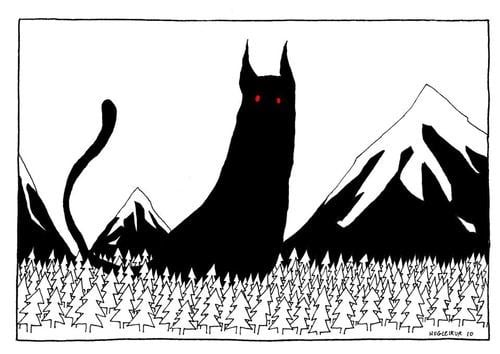
The Yule Lads are frequently accompanied by the Yule Cat. The cat eats those who don’t receive new clothes before Christmas. This is tied in to the Icelandic work ethic. In the old days, if farm hands processed their autumn wool in a timely fashion, they were rewarded with new garments. If not, they received nothing, thereby leaving them vulnerable to the Yule Cat. Better sheer them sheep!
In 1746, the practice of parents tormenting their children with Christmas monster stories was officially banned. But it lives on here, with Classic Ross Amico!
To my knowledge, there has been no classical music written about the Yule Lads. As with Krampus, some enterprising composer could make a real killing. All you need is one Christmas hit, and then every year, you can just kick back and collect those sweet holiday royalties.
Here is a selection of Yule Lad songs I found on YouTube. You can see that the bar has been set awfully low. How “My Darling Clementine” got over there is anyone’s guess. Maybe Leif Erikson brought it back with him on his longship.
https://www.youtube.com/watch?v=BJ4nSFe32ys
Get festive in the way only Icelanders can, with these “Icelandic Folk Dances” by Jón Leifs:
Björk sings about the Yule Cat (with thanks to a follower of the page who shared this with me a few years ago):
Remember – only 13 days of folklore and paganism until Christmas!
-
Iceland’s Terrifying Yule Lads & Christmas Monsters
Before people started to pretty much anesthetize themselves with electronics, there must have been little else to fill their time, as the days grew shorter, beyond getting all liquored up and terrorizing the kids. How else to explain the Icelandic Yule Lads?
Not the modern-day bevy of affable, ersatz Santas, mind you – the ones who reward the good with welcome gifts and penalize the naughty with rotten potatoes – but rather the amoral pranksters and homicidal trolls who devour children.
According to Icelandic lore, the Lads are thirteen in number. Mostly they harass and steal from Icelandic farmers. They descend from the mountains, staggering their arrivals and departures, beginning thirteen nights before Christmas. For those who can’t be bothered to do the math, that would be December 12.
Each has his own exasperating speciality, whether it be harassing sheep, stealing milk, eating crust out of pans, licking spoons, stealing leftovers, licking bowls, slamming doors, eating skyr (a kind of Icelandic yogurt), stealing sausages, peeping through windows, sniffing for bread, stealing meat with a hook, or eating candles.
For Tolkien fans, surely the Lads are the basis for the thirteen Dwarves [sic] who visit Bilbo Baggins, in the process eating him out of house and home and imperiling his dishes.
Their mother is the ogress Grýla, who seeks children to boil in her cauldron. If you happen to find yourself in her gnarled claws, remember, she has to release you if you repent!
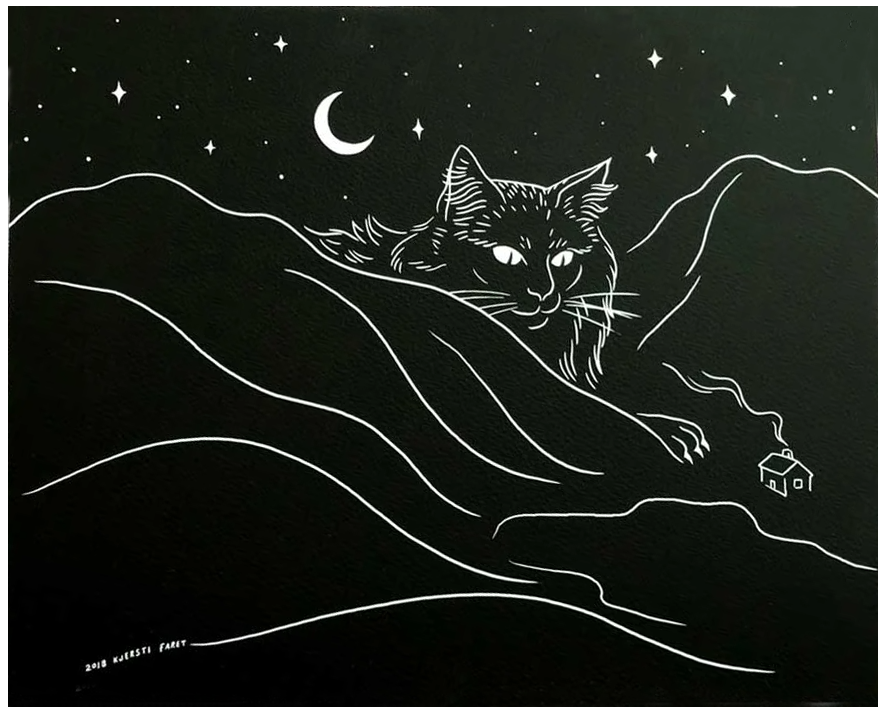
The Yule Lads are frequently accompanied by the Yule Cat. The cat eats those who don’t receive new clothes before Christmas. This is tied in to the Icelandic work ethic. In the old days, if farm hands processed their autumn wool in a timely fashion, they were rewarded with new garments. If not, they received nothing, thereby leaving them vulnerable to the Yule Cat. Better sheer them sheep!
In 1746, the practice of parents tormenting their children with Christmas monster stories was officially banned.
Get festive in the way only Icelanders can, with these “Icelandic Folk Dances” by Jón Leifs.
And remember – only 13 days of folklore and paganism until Christmas!
-

More Sibelius Guitar Christmas Iceland
Just when you thought that was all for Sibelius…
Over the weekend, Norman Lebrecht shared this transcription for guitar of the composer’s “Ekloge,” from his “Four Lyric Pieces,” Op. 74, originally for piano.
While we’re on the topic, ‘tis the season – here are Sibelius’ “Five Christmas Songs,” Op. 1. The fourth of them, “Give me no splendor, gold or pomp,” is the most famous.
https://www.youtube.com/watch?v=eklDX_VHTl4
More about the Christmas songs and Christmas with the Sibelius family here:
http://finland.fi/christmas/christmas-with-the-sibelius-family/
If you hunger for something a little more substantial from the Nordic countries, I wrote a lengthy appreciation of the Icelandic Yule Lads over the weekend, but since I didn’t post it until 9:00 on Saturday night, it went largely unnoticed. I didn’t want to hold it until Sunday morning, since the Lads descend from the mountains to commence their holiday torments on the night of December 12. Scroll down my Facebook page to learn more. It’s a real time-killer and certain to brighten your workday.
Here’s a direct link:
PHOTO: Joulupukki, the Finnish Santa
Tag Cloud
Aaron Copland (94) Beethoven (95) Composer (114) Film Music (150) Film Score (143) Film Scores (255) Halloween (102) John Williams (198) KWAX (233) Leonard Bernstein (105) Marlboro Music Festival (125) Movie Music (165) Mozart (91) Opera (215) Philadelphia Orchestra (90) Picture Perfect (174) Princeton Symphony Orchestra (110) Radio (90) Ross Amico (244) Roy's Tie-Dye Sci-Fi Corner (290) The Classical Network (101) The Lost Chord (269) Vaughan Williams (107) WPRB (397) WWFM (881)