Tag: John Adams

  • Nicolas Slonimsky: Savage Invective & Genius

    Nicolas Slonimsky: Savage Invective & Genius

    For the birthday of Nicolas Slonimsky (1894-1995), here a few favorites from his sidesplitting 1953 compendium of critical vitriol, “Lexicon of Musical Invective”:

    “We recoil in horror before this rotting odor which rushes into our nostrils from the disharmonies of this putrefactive counterpoint. His imagination is so incurably sick and warped that anything like regularity in chord progressions and period structure simply do not exist for him. Bruckner composes like a drunkard!”

    (Gustav Dompke, The German Times of Vienna, 1886)

    “Heartless sterility, obliteration of all melody, all tonal charm, all music… This reveling in the destruction of all tonal essence, raging satanic fury in the orchestra, this demoniacal, lewd caterwauling, scandal-mongering, gun-toting music, with an orchestral accompaniment slapping you in the face… Hence, the secret fascination that makes it the darling of feeble-minded royalty… of the court monkeys covered with reptilian slime, and of the blasé hysterical female court parasites who need this galvanic stimulation by massive instrumental treatment to throw their pleasure-weary frog-legs into violent convulsion… the diabolical din of this pig-headed man, stuffed with brass and sawdust, inflated, in an insanely destructive self-aggrandizement, by Mephistopheles’ mephitic and most venomous hellish miasma, into Beelzebub’s Court Composer and General Director of Hell’s Music – Wagner!”

    (J.L. Klein, “History of the Drama,” 1871)

    And of course, who could forget:

    “The violin is no longer played; it is pulled, torn, drubbed…. We see plainly the savage vulgar faces, we hear curses, we smell vodka.… Tchaikovsky’s Violin Concerto gives us for the first time the hideous notion that there can be music that stinks to the ear.”

    (Eduard Hanslick, New Free Press, Vienna, 1881)

    Tchaikovsky could recite from memory every word of Hanslick’s sustained screed, from which this is but an excerpt.

    The “Lexicon” is just the tip of the Slonimsky iceberg. Slonimsky conducted first performances of works by Ives and Varèse. He edited “Baker’s Biographical Dictionary of Musicians” from 1940 to 1992. His “Thesaurus of Scales and Melodic Patterns” influenced musicians from John Coltrane to Frank Zappa to John Adams. His sly wit made him a favorite guest on radio and television programs, including “The Tonight Show.” The man had so much vitality, it’s hardly surprising that he lived to be 101.

    Happy birthday, Nicolas Slonimsky.


    MUST SEE: Slonimsky on “The Tonight Show” with Johnny Carson in 1986, at the age of 92. It was a different world.

    His pioneering recording of Varèse’s “Ionisation,” from 1934

    Piano improvisation with Frank Zappa in 1981. Zappa introduces him at around 1:50.

    “Children Cry for Castoria”

    Documentary, “Nicolas Slonimsky: A Touch of Genius,” narrated by Michael York:

    “In my lifetime, when I was in the conservatory, in order to hear a Brahms symphony, I had to study the score or actually hear the symphony, because there was no other way! Now, a good Juilliard School student probably knows more about music history than a specialist 100 years ago, because of the availability of recordings and publication of miniature scores. In my time, I would have to go to the library and get a contemporary edition of whatever score I wanted to consult, and the scores were very difficult to obtain. Now, if you want the Haydn Symphony No. 74, it is produced immediately, as are any others!”

    A reminder of how fortunate we are, in this modern age, to have so much at our fingertips. And this was before YouTube! Read the rest in Bruce Duffie’s interview, transcribed here:

    http://www.bruceduffie.com/slonimsky.html

    John Adams’ “Slonimsky’s Earbox,” composed in 1996, after Slonimsky’s death, an attempt to “memorialize his wit and hyper-energetic activity” and to acknowledge Adams’ debt to the scales and harmonies gleaned from Slonimsky’s “Thesaurus.”


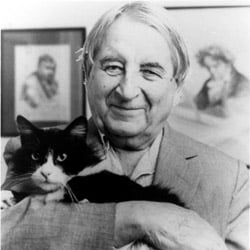
    PHOTO: Slonimsky with his cat, Grody-to-the-Max!

  • John Adams at 75 A Composer’s Reflections

    John Adams at 75 A Composer’s Reflections

    To me, John Adams has always embodied the spirit of youth. How the heck, then, did he get to be 75???

    Adams is considered by some to be America’s preeminent living composer. Of the generation that emerged from the haze of Minimalism, he is perhaps the one representative least likely to repeat. Arguably the most versatile and substantial of the early proponents of the style, he was awarded the Pulitzer Prize for Music in 2003 for his 9/11 memorial “On the Transmigration of Souls.”

    Personally, I’ve never found all of his music convincing, and I would include among that his Pulitzer winner. Some of it I find fun (“Short Ride in a Fast Machine,” “Grand Pianola Music”), some of it I find to be quite good (“Shaker Loops,” “El Niño”), some of it I find to be boring, clumsy, or downright embarrassing (“Harmonium”). But undoubtedly everyone will have their own reactions (“Grand Pianola Music” was booed at its premiere), and all are free to assess for themselves.

    A new opera is imminent, Adams’ take on Shakespeare’s “Antony and Cleopatra” – a departure for a composer whose stage works have been rooted in modernity – scheduled for a Los Angeles debut. Samuel Barber notoriously went down in flames for tackling the same subject for the grand re-opening of the Metropolitan Opera House at its current location at Lincoln Center in 1966 (though some would argue, in Barber’s case, it was not for wholly musical reasons).

    In common with another illustrious predecessor, Aaron Copland, Adams in his maturity has expanded his activities as a conductor. While wondering what new I could possibly add to the 75th birthday encomiums, I stumbled across this substantial interview, in which he talks about, among other things, the challenges and rewards of conducting Sibelius. As a great admirer of Sibelius’ music myself, I found it to be of interest, even if I’m not sure I entirely agree with all of his assessments.

    From a new opera to old synthesizers – Interview with John Adams

    Regardless of my own mixed reaction to Adams’ body of work, there’s no arguing against his influence or his standing. Happy birthday on his 75th. Congratulations on his long-term success, and may he enjoy many more!

    “Short Ride in a Fast Machine”

    “Shaker Loops”

    “Nixon in China”

    John Adams on conducting

  • John Adams’ El Niño A Modern Nativity Masterpiece

    John Adams’ El Niño A Modern Nativity Masterpiece

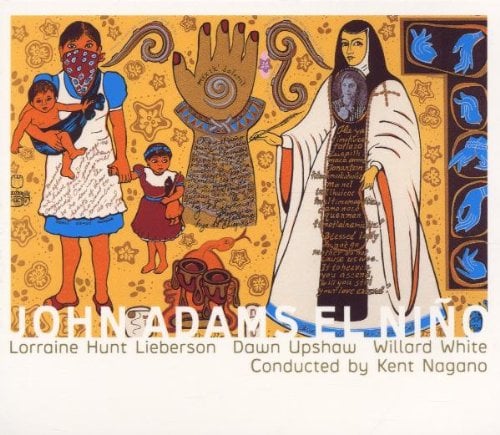
    I’ve run hot and cold on John Adams over the years. I think “Shaker Loops” and “Nixon in China” are brilliant. So many of his other things, not so much. But this Nativity oratorio must be one of his most successful pieces.

    “El Niño” was given its world premiere at the Théâtre du Châtelet in Paris on this date in the year 2000. The American premiere followed, in San Francisco, on January 11, 2001. Kent Nagano conducted on both occasions, and the dream team soloists included Dawn Upshaw, Lorraine Hunt Lieberson, and Willard White.

    “El Niño” – which has nothing to do with the weather – retells the Christmas story. Part I focuses on Mary’s reflections before giving birth in a stable in Bethlehem. Part II takes place after the birth, and encompasses the Slaughter of the Innocents and other events from the early life of Jesus.

    The texts, in English, Spanish, and Latin, are drawn from the King James Bible, the Wakefield Mystery Plays, Martin Luther’s Christmas Sermon, the Gospel of Luke, and gnostic gospels from the Apocrypha, alongside poems by Rosario Castellanos, Sor Juana Inés de la Cruz, Gabriella Mistral, Vicente Huidobro, Rubén Dario, Hildegard von Bingen, director Peter Sellars, and Adams himself.

    I can’t speak to Sellars’ direction. I’ve never seen it with the visuals. But musically, I was very pleased with it, when I first purchased the Nonesuch Records album 20 years ago. It’s a great tonic after running through multiple versions of “Messiah.”

    Part I

    https://www.youtube.com/watch?v=3hFSuGwl7jU

    Part II

    https://www.youtube.com/watch?v=j7EISGxGhJw

  • Shakers Simple Gifts to Shaker Loops

    Shakers Simple Gifts to Shaker Loops

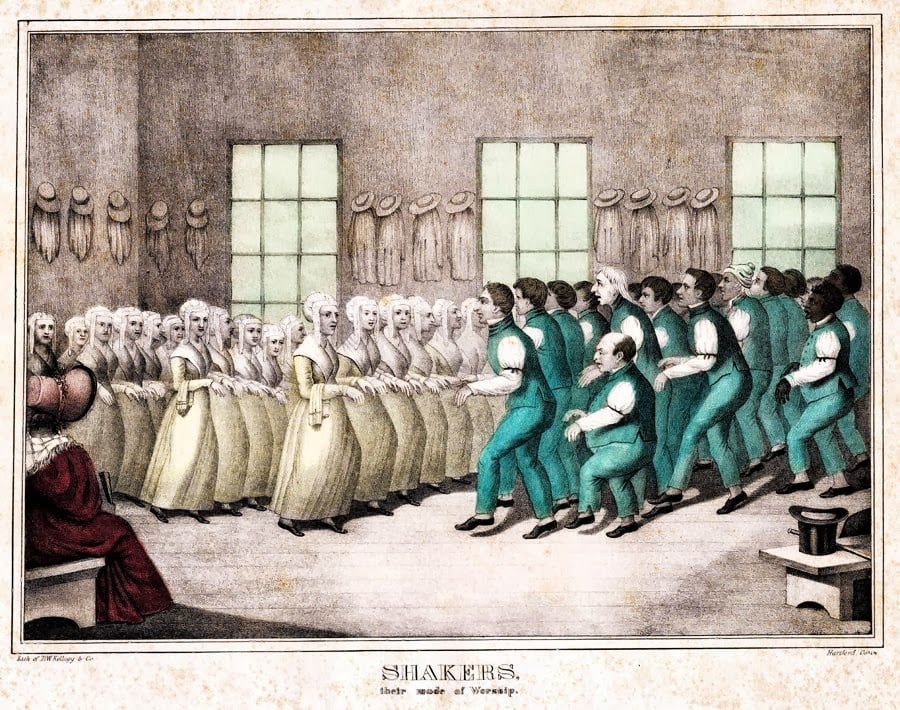
    Classical music lovers are best acquainted with the Shakers by way of the hymn “Simple Gifts,” employed by Aaron Copland, of course, as the basis for a set of variations at the climax of his ballet “Appalachian Spring.” But the Shaker tradition predates Copland by nearly 200 years.

    This Sunday night on “The Lost Chord,” we’ll hear ample selections from “Simple Gifts: Shaker Chants and Spirituals,” an unusual album of traditional Shaker melodies, spearheaded by Joel Cohen in 1995. With this remarkable project, Cohen sought to preserve music of the Shakers in somewhat authentic performances, augmenting his Boston Camerata and Schola Cantorum with members of the actual dwindling population of Sabbathday Lake, Maine, the last active Shaker community, established in 1783.

    Music has always been an integral part of Shaker worship. There are over ten thousand songs extant. In Shaker society, musical revelation is considered a spiritual gift. As such, it was important to document these inspirations as they occurred. Since many of the scribes had no musical education, a system of notation reliant on letters of the alphabet evolved. These were often not positioned on a staff, and simple rhythmic values were employed. Lyrics sometimes involve syllables and words of unknown tongues.

    The second half of tonight’s program will consist of “Shaker Loops,” a modern American classic by John Adams. This kaleidoscopic example of Minimalism was originally composed in 1978, as a four-part work for seven solo strings (three violins, one viola, two cellos, and double bass). It bears the influence of Adams’ early electronic experiments. On its surface, it may seem somewhat repetitive – each instrument assigned a loop of oscillations – but when heard simultaneously, the various strands are continually shifting. The resultant mesmeric quality neatly parallels the ecstatic writhings of the Shakers.

    The work falls into four movements, flowing into one another without break: “Shaking and Trembling;” “Hymning Slews;” “Loops and Verses;” and “A Final Shaking.” Adams arranged the piece for string orchestra in 1983. We’ll hear the world premiere recording, with the San Francisco Symphony conducted by Edo de Waart.

    Time to get shaking! Give thanks for simple gifts, on “All Shook Up,” this Sunday night at 10:00 EST, on WWFM – The Classical Network and wwfm.org.

  • Edo de Waart at 80 A Conducting Celebration

    Edo de Waart at 80 A Conducting Celebration

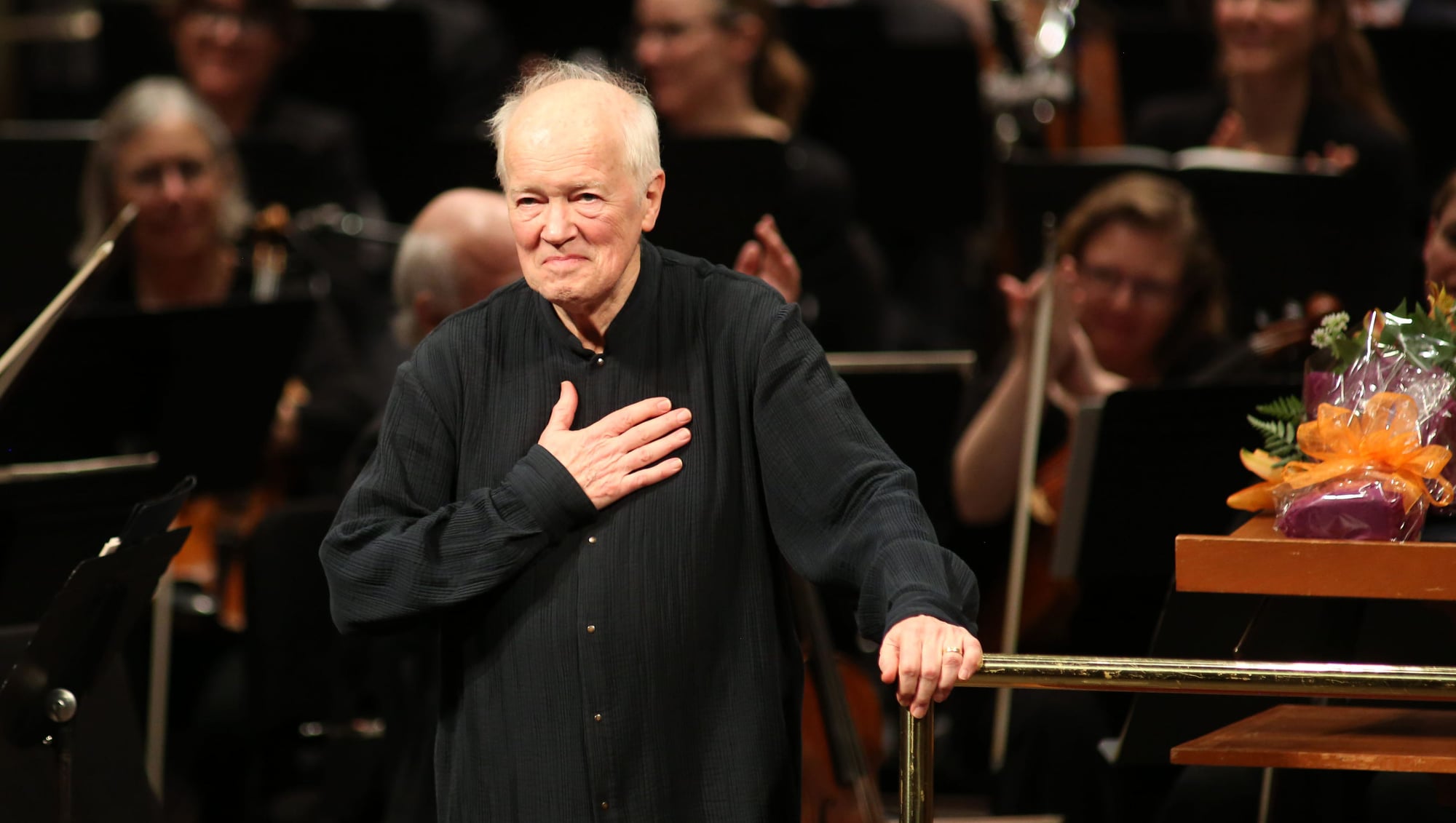
    Today is the day Edo counts to 80.

    Edo de Waart was born in 1941, fourscore years ago today. Once assistant conductor of the Concertgebouw Orchestra under Bernard Haitink (he had originally played as an oboist there), De Waart has gone one to enjoy a long and enviable career himself, both in the concert hall and in the recording studio.

    Of course, he’s had more music directorships than he’s had wives (barely), including positions with the Rotterdam Philharmonic (1973-79), the San Francisco Symphony (1977-85), the Minnesota Orchestra (1986-95), the Netherlands Radio Philharmonic (1989-2004), the Sydney Symphony (1993-2003), the Hong Kong Philharmonic (2004-12), the Milwaukee Symphony (2009-17), the Antwerp Symphony (2011-16), and the New Zealand Symphony (2016-21). He is now principal guest conductor of the San Diego Symphony (2019- ).

    De Waart, who was born in Amsterdam, has made the trip to the altar six times. He currently resides in Maple Bluff, Wisconsin.

    Among his achievements, he has been a notable champion of the music of John Adams and Steve Reich. Ellen Taaffe Zwilich dedicated her Symphony No. 2 to him.

    This disc has always been a favorite:

    De Waart conducting one of Adams’ better pieces:

    A candid interview, with an appearance by Adams:

    De Waart conducting Brahms’ in advance of his 80th birthday:

    Happy birthday, Edo de Waart!

Tag Cloud

Aaron Copland (92) Beethoven (95) Composer (114) Film Music (120) Film Score (143) Film Scores (255) Halloween (94) John Williams (185) KWAX (229) Leonard Bernstein (100) Marlboro Music Festival (125) Movie Music (135) Opera (198) Philadelphia Orchestra (88) Picture Perfect (174) Princeton Symphony Orchestra (106) Radio (87) Ralph Vaughan Williams (85) Ross Amico (244) Roy's Tie-Dye Sci-Fi Corner (290) The Classical Network (101) The Lost Chord (268) Vaughan Williams (103) WPRB (396) WWFM (881)

DON’T MISS A BEAT

Receive a weekly digest every Sunday at noon by signing up here


RECENT POSTS