Tomorrow is Independence Day, so it seems appropriate this week on “Picture Perfect” to treat the subject of music from movies related to the birth of our nation.
We’ll hear selections from the 2000 Mel Gibson film, “The Patriot,” in which slow-burning pacifist Mel is pushed too far by ruthless British officer Jason Isaacs and reverts to his bloody French and Indian War ways. By the end of the film, he is literally waving the flag to John Williams’ triumphant score.
Then we’ll hear a suite from the 1942 Jack Benny-Ann Sheridan fixer-up comedy, “George Washington Slept Here,” based on the play by Moss Hart and George S. Kaufman – not really about the Revolution, beyond the fact that the ramshackle Pennsylvania farm house purchased by a transplanted New York couple is alleged to have been a resting place for the Continental Army’s most famous general. The music is by Adolph Deutsch.
The 1985 film, “Revolution,” seemed to have everything going for it. The director was Hugh Hudson, whose “Chariots of Fire” was the big winner at the 1981 Academy Awards; its star was Al Pacino; and its composer was John Corigliano, who went on to win the Pulitzer Prize for Music for his Symphony No. 2 and an Academy Award for “The Red Violin.” Yet “Revolution” bombed horribly – so horribly that Pacino gave up making movies for the next four years. James Galway plays the flute and pennywhistle on the film’s soundtrack.
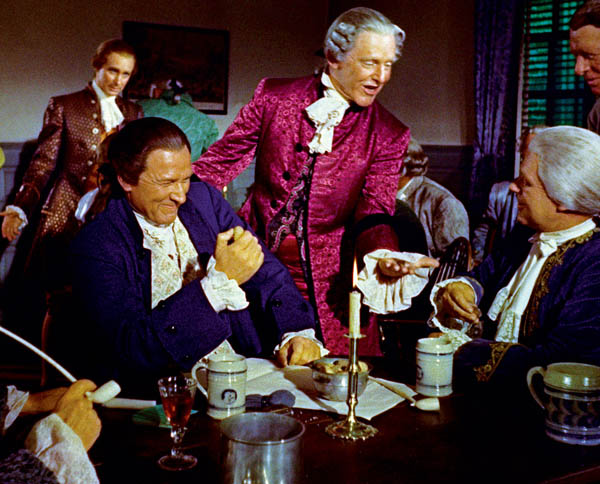
Finally, we’ll hear music from the longest continuously-shown film in cinematic history, “Williamsburg: The Story of a Patriot,” created exclusively for the tourist attraction of Colonial Williamsburg. The film features future “Hawaii Five-O” star Jack Lord, and the score is by none other than Bernard Herrmann. Peppered with recognizable patriotic tunes from the Revolutionary era, the charming suite includes quotations from “Yankee Doodle” and the William Billings hymn “Chester.”
Stick a feather in your hat and call it macaroni. Then join me for “Picture Perfect,” music for the movies, now in syndication on KWAX!
——-
Clip and save the start times for all three of my recorded shows:
PICTURE PERFECT, the movie music show – Friday at 8:00 PM EDT/5:00 PM PDT
SWEETNESS AND LIGHT, the light music program – Saturday at 11:00 AM EDT/8:00 AM PDT
THE LOST CHORD, unusual and neglected rep – Saturday at 7:00 PM EDT/4:00 PM PDT
Stream them, wherever you are, at the link!
https://kwax.uoregon.edu
——-
PHOTO: George Washington wagers he can crack a walnut with his bare hand in “Williamsburg: The Story of a Patriot”
Tag: John Corigliano
-
250 Years of Independence, and All I Got Was “Picture Perfect”
-

Music in Movies Fellini Corigliano Korngold
This week on “Picture Perfect,” get ready for an exercise in postmodern self-reflexivity, as we enjoy music from movies about music and musicians.
Federico Fellini’s “Orchestra Rehearsal” (1978) is a mock-documentary that presents the symphony orchestra as a metaphor for the human condition. Full of political overtones, the film explores the joys, sorrows, frustrations and triumphs of the musicians, who struggle with the concepts of individual liberty, tyranny and the collective good. The project would mark the final collaboration between Fellini and Nino Rota. The two artists first came together in 1952 on Fellini’s “The White Sheik.” They would go on to create such classics as “La Strada,” “Nights of Cabiria,” “La dolce vita” and “8 ½.”
We’ll also hear music from the Canadian art house hit “The Red Violin” (1998). The film traces the history of the fictional title instrument from its creation in 17th century Cremona to the present day. The violin passes through the hands of a child prodigy, into those of a romantic virtuoso in the Paganini mold; then to China during the Cultural Revolution; and finally to a Canadian auction house. John Corigliano wrote the Academy Award-winning music, which is performed on the soundtrack by violinist Joshua Bell.
Finally, we’ll turn to a classical music film noir from Hollywood’s Golden Age. “Deception” (1946) tells the tale of a dangerous love triangle between Bette Davis, Paul Henreid and Claude Rains. Much of the plot hinges on the premiere of a new cello concerto by a celebrated – though fictional – composer, played by Rains, who puts a fragile cellist, his rival in love, played by Henreid, through the psychological wringer. The music, which serves as both underscore and crux of the story, is by Erich Wolfgang Korngold. The composer subsequently published the on-screen concerto as his Op. 37.
All aboard the musical ouroboros! Join me for music from movies about music and musicians, on “Picture Perfect,” now in syndication on KWAX, the radio station of the University of Oregon!
Clip and save the start times for all three of my recorded shows:
PICTURE PERFECT, the movie music show – Friday at 8:00 PM EDT/5:00 PM PDT
SWEETNESS AND LIGHT, the light music program – ALL NEW! – Saturday at 11:00 AM EDT/8:00 AM PDT
THE LOST CHORD, unusual and neglected rep – Saturday at 7:00 PM EDT/4:00 PM PDT
Stream them, wherever you are, at the link!
The overheated trailer for “Deception”
PHOTO: Henreid wore a special jacket to accommodate the arms of two professional cellists who stood behind him as he emoted. On the film’s soundtrack the concerto was performed by Eleanor Aller Slatkin, mother of Leonard Slatkin.
-
Humbert Lucarelli Renowned Oboist Dies at 87
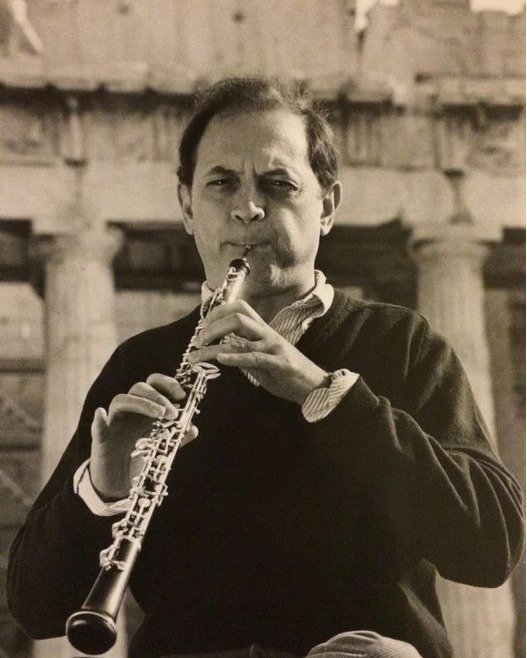
Described by the New Grove Dictionary of Music as “one of America’s most renowned oboists,” Humbert Lucarelli has died. In addition to his excellence as a performer, he was a noted teacher. In the latter regard, among other things, he was Professor of Oboe at the Hartt School of Music in West Hartford, Connecticut, a position he held since 1968.
Lucarelli performed and recorded widely throughout his distinguished career, working with musicians such as Leonard Bernstein, Arthur Fiedler, Kirill Kondrashin, Jean Martinon, George Pretre, Fritz Reiner, Robert Shaw, Sir Georg Solti, Leopold Stokowski, and Igor Stravinsky. He commissioned and gave first performances of many new works, including the Oboe Concerto of John Corigliano.
Those of you in the Lehigh Valley might be interested to know that in 1990 Lucarelli recorded a memorable album with the Lehigh Valley Chamber Orchestra for Koch International Classics. The program includes lovely renditions of Samuel Barber’s “Canzonetta,” Richard Strauss’ Oboe Concerto, Ermanno Wolf Ferrari’s “Idillio-Concertino,” and Ralph Vaughan Williams’ Oboe Concerto. I’ve included it in my on-air playlists often, especially the Barber and the Wolf-Ferrari works, which are still comparatively and puzzlingly “unknown.”
Lucarelli died on August 10 at the age of 87.
R.I.P.
Bach, Sinfonia from the “Easter Oratorio”
Barber, Canzonetta from his unfinished Oboe Concerto
Wayne Barlow, “The Winter’s Past”
-

Corigliano’s “Altered States” Dream
“Altered States,” you may recall, stars William Hurt as a psychopathologist whose experiments with sensory deprivation tanks and hallucinatory drugs result in strobe-lit episodes of biological devolution. Mr. Hyde has nothing on these regressions that have him turning into an ape man on the prowl for goat meat at the city zoo, or at their most extreme, transforming into a kind of whirlpooling proto-consciousness.
Nudity and religious symbolism? Well, it is a Ken Russell film, and one of his best, actually, because it’s actually rooted in character and plot. (The screenplay is by Paddy Chayefsky.)
Russell later recalled, “After a tiring day at the Burbank Studios working on ‘Altered States’ I was out for an evening of relaxation with a much loved and familiar masterpiece the memory of which was blown into oblivion by the music of a name totally unfamiliar to me – John Corigliano. Reading from my program that he was a contemporary composer I braced myself for thirty minutes of plinks and plunks that pass for music these days. I was in for a shock, a surprise, a revelation.
“Not since Bartok’s ‘Miraculous Mandarin’ have I been so excited in the concert hall. Here were sounds of magic and grandeur I had long since despaired of hearing from a modern musician. . . . if only he would compose the music for ‘Altered States’ instead of some commercial hack we directors are usually saddled with, I thought wistfully. But that’s just a dream.
“I should have known better – Hollywood is the place where dreams come true.”
The music he encountered on that Los Angeles Philharmonic concert? Corigliano’s Clarinet Concerto.
Corigliano composed his concerto for legendary New York Philharmonic principal clarinetist Stanley Drucker. The first movement, “Cadenzas,” is virtuosic right out of the box. When Drucker first looked at the score, he remarked, “How am I gonna play this?” The second movement, the soul of the piece, serves as an elegy to the memory of Corigliano’s father, longtime concertmaster of the Philharmonic, who died in 1975. The third movement evocates the antiphonal style of Renaissance composer Giovanni Gabrieli.
The work was given its first performance by Drucker and the New York Philharmonic, conducted by Leonard Bernstein, on December 6, 1977. It became the first concerto for the instrument by an American composer since Aaron Copland’s Clarinet Concerto to enter the repertoire.
Russell was so impressed with the piece when he heard it in Los Angeles that he offered Corigliano his first assignment scoring a feature film. (Earlier, he had written music for a documentary, “A Williamsburg Sampler.”) His music for “Altered States” would earn him an Academy Award nomination.
In the film, Corigliano’s score brilliantly complements Russell’s psychedelic flights of fancy. It’s not hard to understand why the composer caught the Academy’s attention. Ultimately, the Oscar that year went to “Fame,” of all things, but Corigliano revisited his score for a concert suite which he titled “Three Hallucinations.”
Later, he would win an Academy Award for his work on “The Red Violin.” He would also be honored with a Pulitzer Prize, for his Symphony No. 2, five Grammys, and a Grawemeyer Award for Contemporary Composition. His first opera, “The Ghosts of Versailles,” would be commissioned by the Metropolitan Opera for its 100th anniversary.
Even so, Hollywood can be a fickle town. He may have won an Oscar, but that didn’t shield him from the indignity of having his score for the Mel Gibson film “Edge of Darkness” chucked out. The studio decided it wanted to take a more bankable approach, and because of his obligations in the concert world, Corigliano was not available for rewrites. So the assignment was given to Howard Shore. Rejection stings, yet Corigliano has stated he remains open to the prospect of scoring another film, if the right project should present itself.
But the movies need John Corigliano more than he needs them.
The composer is 85 today. Happy birthday!
World premiere broadcast of the Clarinet Concerto
Selections from “Altered States”
“Three Hallucinations”
-
Bob Dylan at 80: Musical Influences
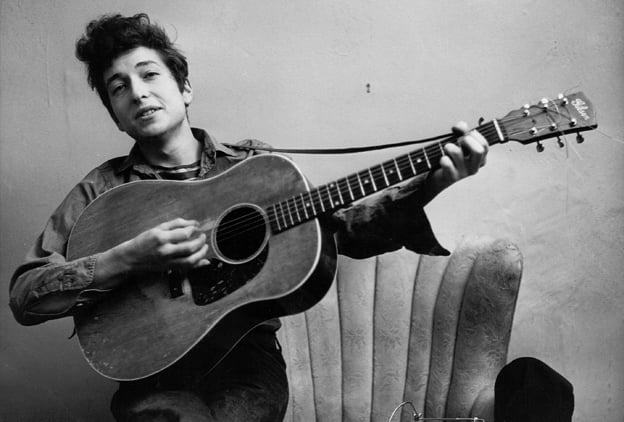
Happy birthday to Bob Dylan, 80 years-old today.
Dylan sings “Blowin’ in the Wind” (television, 1963):
George Crumb’s “Blowin’ in the Wind,” from his “American Songbook VI: Voices from the Morning of the Earth” (2008):
Dylan sings “Mr. Tambourine Man” (Newport Folk Festival, 1964):
John Corigliano’s “Mr. Tambourine Man: Seven Poems of Bob Dylan” (2000):
As the title indicates, there are seven songs in all, original settings of Dylan’s verse. If you let it run too long, it will go into Corigliano’s music for “Altered States.”
Both Crumb and Corigliano are Pulitzer Prize winners. Dylan said hold my beer – in 2016, he was awarded the Nobel Prize for Literature.
The times they are a-changin’.
Tag Cloud
Aaron Copland (94) Beethoven (95) Composer (114) Film Music (148) Film Score (143) Film Scores (255) Halloween (97) John Williams (196) KWAX (232) Leonard Bernstein (105) Marlboro Music Festival (125) Movie Music (163) Mozart (91) Opera (215) Philadelphia Orchestra (90) Picture Perfect (174) Princeton Symphony Orchestra (110) Radio (90) Ross Amico (244) Roy's Tie-Dye Sci-Fi Corner (290) The Classical Network (101) The Lost Chord (269) Vaughan Williams (107) WPRB (397) WWFM (881)