Tag: Judas Maccabaeus

  • Handel at 340: Still Fresh, Still Thrilling

    Handel at 340: Still Fresh, Still Thrilling

    George Frideric Handel was born 340 years ago, and he’s still as fresh as a rose. Fresher. Actually, come to think of it, there is a climbing rose named after him…

    For one thing, the standard of Handel performance has gotten so much better in recent decades. I guess you really don’t hit your stride as a composer until after the first 300 years.

    For as much as I hold a nostalgic affection for Hamilton Harty’s ponderous take on the “Water Music” – a concert staple for over half a century – a modern orchestra gives little indication of just how thrilling Handel can be. At its best, his vocal stuff, in particular, can be sublime.

    I didn’t always feel this way. When I attended a performance of “Ariodante” in Philadelphia, back in the 1989, even with the dream pairing of Benita Valente and Tatiana Troyanos, I was afraid I was going to give up the ghost. When it really doesn’t connect, three or four hours of Baroque opera can easily start to feel like too much of a good thing. My girlfriend at the time wanted to leave after the second act, but I insisted we stick it out. I was eager to witness the climactic swordfight, described in the synopsis – which, in the end, amounted to a single, slow-motion riposte. The weak pay-off earned me an evil glare.

    The experience had the effect of putting me off Handel opera in much the same way that downing a bottle of Inver House whiskey in my teens put me off Scotch. Just as I later discovered, to my surprise and delight, how much I truly appreciate a fine single malt, when I had occasion to reacquaint myself with “Ariodante” at the Princeton Festival in 2010, I was astonished to find that I actually liked Handel opera after all.

    A few years ago, when I wandered into a library book sale, I discovered that someone had dumped their entire collection of Handel operas and oratorios. I don’t know how many there were to begin with, but I walked out with everything that was left. Who knows if I’ll ever get through all of them before I die, but I am very happy to have them.

    That said, I do find Handel’s operas work best when encountered live, in performance – whether seen in person or on screen – which is the opposite of what I would say about most of the operas I prefer. The images that are formed in my mind by the music far surpass anything that can be realized on a stage. When attending opera, it is the experience of the orchestra, the voices, and the sense of “theater” I enjoy. But the visuals are too mundane for my grandiose vision.

    I also tend to get annoyed at modern stagings, with concepts that too often seem forced and undercut the vitality of the music. Again, Handel is different. David McVicar’s production of “Agrippina” must be one of the best things in the Met’s current repertoire.

    Of course, there is always the possibility that it is not so much Handel who has changed – despite a pronounced shift toward “authentic” performance practice over the past 40 years or so. It could be that even a paragon such as myself, sprung fully-formed from the head of Zeus, might have evolved. I’m reminded of the famous Twain observation that, when he was 14, his father was so ignorant he could hardly stand it; but when he was 21, he was astonished by how much the old man had learned.

    I’ve come a long way since my friends and I spent an ouzo-soaked 24 hours celebrating Handel’s tercentenary back in 1985. I recollect even now the six-mile round-trip I made with one of them, on foot, on a cold February evening, from Temple University campus to Center City Philadelphia and back, with a bottle nestled in his bag to keep us warm for an in-town performance of “Judas Maccabaeus.”

    Everything old is new again. Handel grows wiser with the years, but also more thrilling.

    Happy birthday, G.F.H.


    Amanda Forsythe and Apollo’s Fire, with an aria from “Giulio Cesare”

    Danielle de Niese with the same aria, staged:

    Of course, there’s always Thomas Beecham, bringing it old school, to prove me wrong:

  • Beethoven Handel & Hanukkah Music

    Beethoven Handel & Hanukkah Music

    Remember when 2020 was supposed to be the big Beethoven year? To mark the 250th anniversary of his birth, I mean? How did that work out?

    Small compensation, I know, but how about a week’s worth of posts about Beethoven, to mark his actual birthday, commonly observed on December 16?

    On the fourth evening of Hanukkah, the obvious choice is Beethoven’s “Variations on ‘See the conquering hero comes,’” from Handel’s “Judas Maccabaeus.” Here’s a performance I’ve got all cued up from a recording of the complete cello sonatas:

    Beethoven was a great admirer of Handel’s music. “Handel is the greatest composer who ever lived,” he said. “I would uncover my head and kneel down on his tomb.” On his deathbed, he indicated an edition of Handel’s works and said, “There is the truth.”

    Handel’s influence can also be heard in Beethoven’s “Consecration of the House Overture” (which has nothing at all to do with the Maccabees). Note the stately intro of the piece, the fanfares, and the magnificent fugal passages:

    If you’ve got a long evening ahead of you, why not give Handel’s “other” holiday oratorio a whirl?

    If you want to skip right to the big tune, here it is:

    Then I hope you’ll join me for an hour of Hanukkah music by Michael Isaacson, Leon Stein, and Ofer Ben-Amots, on “Pieces of Eight,” on “The Lost Chord,” this Sunday night at 10:00 EST, on WWFM – The Classical Network and wwfm.org.


    Judah Maccabee, 18th century style

  • Handel’s Judas Maccabaeus on WWFM

    Handel’s Judas Maccabaeus on WWFM

    During these shortest days of the year, we can use all the light we can get. With three candles in the menorah last night, we’ll celebrate the second day of Hanukkah with a complete recording of Handel’s other holiday oratorio, “Judas Maccabaeus.”

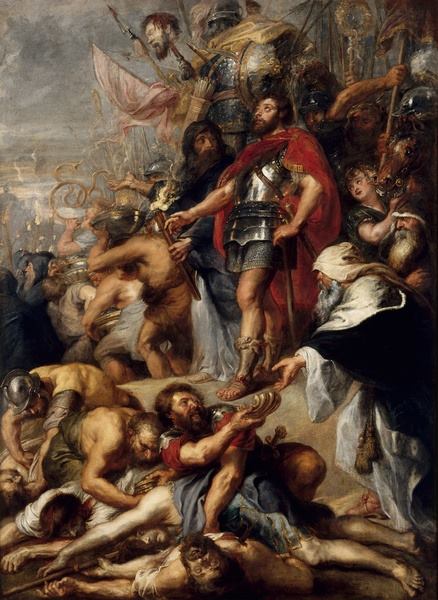
    Handel’s overshadowed masterpiece relates the successful victory of the Jewish people over the Seleucids, who would have had them worshiping Zeus! (In 170 BC, that was actually a thing.) Cannily, the premiere was scheduled to take place at Covent Garden in April 1746, to coincide with the return of William Augustus, Duke of Cumberland and youngest son of King George II, who had only just successfully routed the Jacobites at Culloden. Surfing the predicted wave of patriotic fervor, the 61 year-old Handel had engineered another smash.

    We’ll hear a complete performance of the work, following today’s Noontime Concert – another holiday treat centuries in the making – “Nowell Sing We: A Medieval Celebration,” presented by the Brooklyn-based ensemble Alkemie. The program is organized around the theme of Twelfth Night and/or Epiphany, celebrated at the far end of the Christmas season, and illustrated through musical selections from the 11th through 16th centuries.

    The performance took place on January 4, 2018, at St. Bartholomew’s Church, 50th Street and Park Avenue, in Midtown Manhattan, where free concerts are held every Thursday at 1:15 p.m.

    The broadcast is made possible in part by Gotham Early Music Scene, or GEMS. GEMS is a non-profit corporation that supports and promotes artists and organizations in New York City devoted to early music – music of the Middle Ages, Renaissance, Baroque, and early Classical periods. For more information and GEMS’ events calendar, look online at gemsny.org.

    Immediately following today’s concert broadcast, enjoy Norman Dello Joio’s “Variants on a Mediaeval Tune” – the tune being the familiar Christmas melody “In dulci jubilo.” Then at 1:00, arrange yourself a plate of rugelach and settle in for “Judas Maccabaeus.”

    What’s old is new, with the ensemble Alkemie; then get a Handel on the Maccabees, between 12 and 4 p.m. EST, on WWFM – The Classical Network and wwfm.org.

  • Hanukkah Handel and Modern Sounds on WWFM

    Hanukkah Handel and Modern Sounds on WWFM

    During these shortest days of the year, we can use all the light we can get. With four candles in the menorah last night, we’ll celebrate the third day of Hanukkah with a complete recording of Handel’s other holiday oratorio, “Judas Maccabaeus.” A complete performance of the piece will come your way this afternoon on WWFM, following today’s noontime concert.

    Today’s midday broadcast will highlight the Brooklyn-based concert venue, National Sawdust. Included will be performances by the Chiara String Quartet, which has been stunning audiences with its performances of all six string quartets by Béla Bartók from memory, and the violinist Francesca Anderegg, a new music champion, who will perform Clint Needham’s “On the Road” and selections from Reinaldo Moya’s “Imagined Archipelago.”

    After that, we’ll get a Handel on the Maccabees. What’s old is new, and what’s new is played as if it were standard repertoire, today between 12 and 4 p.m. EST, on WWFM – The Classical Network and at wwfm.org.

  • Hanukkah Beethoven Festival of Lights

    Hanukkah Beethoven Festival of Lights

    Hanukkah begins at sunset.

    The confluence of Beethoven’s birthday and the Festival of Lights: Twelve Variations for Cello & Piano on “See, the Conqu’ring Hero Comes,” from Handel’s oratorio “Judas Maccabaeus.”

    https://www.youtube.com/watch?v=R5s22uccgPk

Tag Cloud

Aaron Copland (92) Beethoven (94) Composer (114) Film Music (116) Film Score (143) Film Scores (255) Halloween (94) John Williams (185) KWAX (228) Leonard Bernstein (99) Marlboro Music Festival (125) Movie Music (131) Opera (197) Philadelphia Orchestra (86) Picture Perfect (174) Princeton Symphony Orchestra (106) Radio (86) Ralph Vaughan Williams (85) Ross Amico (244) Roy's Tie-Dye Sci-Fi Corner (290) The Classical Network (101) The Lost Chord (268) Vaughan Williams (99) WPRB (396) WWFM (881)

DON’T MISS A BEAT

Receive a weekly digest every Sunday at noon by signing up here


RECENT POSTS