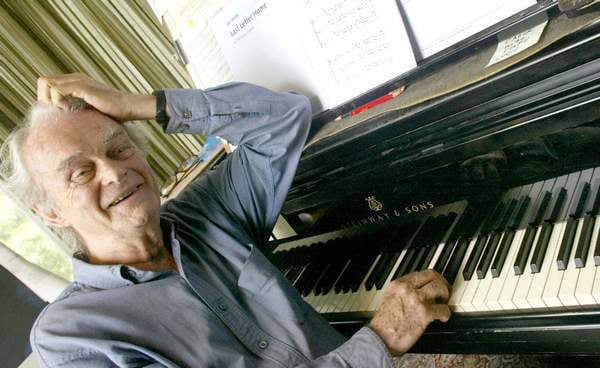
Today marks the 100th anniversary of the birth of American composer Lee Hoiby. Hoiby, a disciple of Gian Carlo Menotti, wrote a lot of vocal music and received particular acclaim for his operas. However, I first discovered him through an old recording of his Piano Concerto on the CRI label.
Hoiby, born in Madison in 1926, studied at the University of Wisconsin with Gunnar Johansen and Egon Petri. (His early ambition had been to become a concert pianist.) Then he struck out for California, where he studied at Mills College with Darius Milhaud. In San Francisco, he worked with a number of musicians whose thinking was decidedly outside-the-box, including Rudolf Kolisch, brother-in-law of Arnold Schoenberg, and Harry Partch.
It’s interesting, therefore, that his own music would wind up being so traditional. Chalk it up to further studies with Menotti at the Curtis Institute of Music in Philadelphia. It was Menotti who introduced Hoiby to opera, instilling in him a life-long love of the human voice. Hoiby was employed as an assistant on the Broadway debut productions of Menotti’s “The Consul” and “The Saint of Bleecker Street” (the latter of which earned his teacher a Pulitzer Prize). Menotti would produce Hoiby’s first opera, “The Scarf” (1958). Eight more would follow. The most highly-regarded of these is perhaps his Tennessee Williams adaptation, “Summer and Smoke” (1971).
Hoiby also had a powerful champion in Leontyne Price, who introduced many of his best-known arias and songs. He claimed Franz Schubert as an important influence. “What I learned from Schubert came from a long, deep and loving exposure to his songs. A lot happens on a subconscious level, so it’s hard to verbalize, but what I think his songs taught me have to do primarily with the line, the phrasing, the tessitura, the accentuations of speech, the careful consideration of vowels, the breathing required, and an extremely economical use of accompaniment material, often the same figure going through the whole song.”
I first encountered Hoiby’s opera – or perhaps monodrama – “Bon Appetit!” about five years ago, when it was streamed by Opera Philadelphia, with Jamie Barton as Julia Child. The work, Straussian (late Straussian) in its intimacy and word-painting, is through-sung, with a libretto essentially compiled from two transcripts of Child’s popular public television program, “The French Chef.” Most of it is lifted from an episode devoted to the creation of L’Éminence Brune, a classic French chocolate cake.
First performed at the Kennedy Center by Jean Stapleton with Hoiby at the keyboard in 1989, this is a work that seems to have really gained traction since the pandemic, since it requires a lone singer (no need for social distancing), often supported by a pianist (inexpensive). I was delighted to have been able to catch it live when it was performed at the Trenton State Museum in 2024, with mezzo-soprano Christine Meadows and the Philadelphia Virtuosi Chamber Orchestra, in a version for ten players, which I didn’t even know existed, enjoyment of the piece unquestionably enhanced by the additional musical colors.
Wholly by coincidence, not long after watching the Barton stream, I revisited a DVD I own of a production of “The Taming of the Shrew” that was staged by the American Conservatory Theater of San Francisco in 1976. Lo and behold, the incidental music is by Lee Hoiby!
The production is robust, Rabelaisian (influenced by commedia dell’arte, actually), and it moves like lightning. Come to think of it, it would be an appropriately festive viewing choice for Carnival. I guarantee it will charm your pantaloons off. And it is introduced by the late Hal Holbrook (with cigarette, no less).
Furthermore, it features Marc Singer as Petruchio, in a performance of astounding physicality. Indeed, it’s a wonder that any of the actors have enough breath to speak their lines. Singer went on to notoriety in the 1980s, when he seemingly singlehandedly sustained cable television through incessant repeats of his breakout feature, “The Beastmaster.”
Watch “The Taming of the Shrew” here, and see if you don’t owe me a debt of thanks. And note Hoiby’s contribution.
https://www.youtube.com/watch?v=ZMdXHoZD6Ag
Leontyne Price sings “Winter Song” (1950)
https://www.youtube.com/watch?v=McTpedYH15U
Schubert Variations (1981)
https://www.youtube.com/watch?v=X6K7IKG7oqs
Hoiby’s Piano Concerto (1957)
https://www.youtube.com/watch?v=jI_eCWlZ6_o&list=OLAK5uy_kddqucIKS2L3_HC4-JHoduWLauok6SEjM&index=5
Christine Meadows performs “Bon Appetit!”
https://www.youtube.com/watch?v=cTMg-mlzhRE
The primary episode of “The French Chef” adapted by Hoiby
https://www.facebook.com/watch/?v=1316700049262748
Audio of Jean Stapleton performance at the Kennedy Center
https://soundcloud.com/astrodreamer/bonappetit-jean-stapleton-composer-lee-hoiby
All roads lead to Lee Hoiby! Happy centenary!
Tag: Julia Child
-
100 Years of Lee Hoiby
-

Trenton Concert: Julia Child & Kitchen Capers
Last night’s concert at the Trenton State Museum with Daniel Spalding’s other group, the Philadelphia Virtuosi Chamber Orchestra, flowed naturally from his last as music director of the Capital Philharmonic of New Jersey. That program, which was presented at the historic Roebling Machine Shop in April, with George Antheil’s raucous “Ballet Mécanique” as its centerpiece, was a literal circus, employing acrobats and jugglers of Trenton Circus Squad to divert while the various configurations of percussion instruments were set. There were also musical interludes featuring the Plenty Pepper Steel Band and Gershwin’s “I Got Rhythm” played on the marimba by Greg Giannascoli.
Last night’s program similarly unfolded as a kind of vaudeville, with its disparate elements flowing one into another. The overarching theme was one of a gastronomical nature, with Lee Hoiby’s “comic culinary extravaganza” (really, a 20-minute chamber opera about Julia Child) “Bon Appétit!,” the main course. Composed in 1982, this is a work that seems to have really gained traction since the pandemic, since it requires only one singer (no need to social distance), often supported by a pianist (inexpensive).
Last night was the first time I heard it with a chamber orchestra of ten players, and unquestionably it enhanced the enjoyment to have the additional musical colors. Hoiby, who studied with Gian Carlo Menotti at the Curtis Institute of Music, has always been celebrated for his songs. I am unfamiliar with his other operas, but this one was Straussian (late Straussian) in its intimacy and word-painting. There are no arias. It is through-sung, with a libretto essentially compiled from two transcripts of Child’s popular public television program, “The French Chef,” most of it lifted from an episode devoted to the creation of L’Éminence Brune, a classic French chocolate cake.
Mezzo-soprano Christine Meadows, who’s performed the work quite a lot, was a convincing Child, convivial, high on life, and fast and loose in the kitchen. She pauses as she mixes chocolate icing to put the spatula in her mouth. She ignores a proffered clean replacement and keeps right on stirring. In the few moments when she actually gets to speak, Meadows has got the voice spot-on. Her singing is certainly much more ingratiating than that of Jean Stapleton, for whom the work was written (and no doubt compensated for by her stage presence). At the end, the cake completed, Meadows cuts a slice and hands it with a fork to a member of the audience. (A chocolate cake reception followed).
Gabriela Imreh, who is married to Spalding and last night served as creative director, had some amusing business (including having a bowl of flour dumped over her head) in a silent role as Child’s producer. (She’s the one who offers the clean spatula.)
If the chamber orchestra in “Bon Appétit!” was an unexpected luxury (I didn’t even know this version existed), things were stripped to the bone for the opening piece, Camille Saint-Saëns’ “The Wedding Cake,” a valse-caprice for piano and string orchestra. Strings were cut back to one per part – so essentially it was made into a piano quintet. Artem Tenkeli was the pianist, who played on a battered instrument that presumably belonged to the museum. I must say, I missed the full body of strings. This was followed by two solo piano works, an etude by Chopin nicknamed “The Honey Bee” and Scott Joplin’s “Pineapple Rag.” Curiously, although the pianist had “The Wedding Cake,” the most substantial and perhaps the rarest of the three pieces, committed to memory, he played the Joplin from sheet music.
More absorbing was Bohuslav Martinu’s “La revue de cuisine,” a 1920s ballet marked by dance rhythms and jazz inflections. The original scenario explored romantic entanglements among the kitchen utensils, but Spalding, in some spoken remarks, dismissed this as “dumb,” so he and Imreh concocted a new story that lacked anywhere near the kind of zany invention Martinu had in mind.
Dancers Ruth Hernandez and Anton Domansky enacted the early stages of a romantic dinner in an intimate restaurant, backlit, behind a screen. (Amusingly the musicians were all dressed in chef jackets and Spalding entered with a towel over his arm.) The pantomimed conversation turns contentious and devolves into a quarrel. The couple emerges from behind the screen for (presumably) two fantasy sequences, the first a sultry tango (Hernandez’s field of expertise) and the second a Charleston (complete with feathered headband and scarlet fringe dress). Parenthetically, the Charleston, which became the anthem of the 1920s, was composed by James P. Johnson, born about thirty minutes up Route 1, in New Brunswick, NJ.
In the end, the dancers are back behind the screen, the lovers’ quarrel is resolved, and they step out once more onto the stage for Domansky to take a knee in the time-honored position of proposal. Hernandez accepts.
Sure, the scenario was trite (lacking the surreal spectacle of amorous pots and pans) but the dancers were clearly expert. More importantly, from a performance standpoint, the musicians did full justice to Martinu’s music, which is both pleasingly witty and propulsively neoclassical.
In between the major numbers of this thoughtfully-constructed program, in which every component related in some way to food, were palate-cleansers, I suppose, in the form of totally unrelated Latin guitar music, performed by David Galvez. Galvez was the soloist when Spalding programmed Joaquin Rodrigo’s “Concierto de Aranjuez” with the Capital Philharmonic last season. He is a superb guitarist. It would be churlish of me to wonder what his presence had to do with food. Perhaps Saturday night is Spanish guitar night at the local romantic restaurant.
The concert was about 90 minutes in length, performed without intermission. The time passed agreeably. At no point did any of its disparate elements seem to outstay its welcome, with the Martinu, Hoiby, and guitar interludes highlights. Spalding pitched the idea of a regular series in Trenton. We’ll see if he continues with this kind of free-association-on-a-theme approach to concert programming.
Spalding’s tenure with the Capital Phil, an orchestra he founded, spanned ten seasons. He founded the Philadelphia Virtuosi Chamber Orchestra in 1991. The ensemble has recorded a number of CDs for the Naxos, New World, Arabesque, and Connoisseur Classics labels, including an acclaimed disc featuring Antheil’s “Ballet Mécanique” that was recorded at the Trenton War Memorial.
For more information about the group, visit http://www.pvco.org.
Bon appétit!
PHOTO: Christine Meadows as Julia Child from another production
-

Julia Child Opera & Chocolate Cake
“Bon Appétit!”
Composer Lee Hoiby took Julia Child’s iconic sign-off for her weekly PBS television program, “The French Chef,” as the title for his “comic culinary extravaganza.” The work, composed in 1982 (so Child would have still been alive) and based on transcripts from two of her actual shows, was originally written for Jean Stapleton, as a curtain-raiser for Hoiby’s “The Italian Lesson” (also performed by Stapleton).
This weekend, mezzo-soprano Christine Meadows will appear as Child, as she demonstrates for the audience the creation of L’Éminence Brune, a classic French chocolate cake, as part of a delectably-programmed concert to be presented by Daniel Spalding and the Philadelphia Virtuosi Chamber Orchestra at the Trenton State Museum on Saturday at 7:30 p.m.
Filling out the program will be music calculated to delight both palate and ear: Camille Saint-Saëns’ “The Wedding Cake,” Frédéric Chopin’s Etude Op. 25, No. 2 “The Honey Bees,” Scott Joplin’s “Pineapple Rag,” and a suite from Bohuslav Martinu’s ballet, “La revue de cuisine,” a witty examination of romantic entanglements among the kitchen utensils. Artem Tenkeli will be the pianist. The audience is invited to attend a post-concert chocolate cake reception. To learn more, visit https://www.pvco.org/event-list
The primary episode of “The French Chef” adapted by Hoiby
Audio of Jean Stapleton performance at the Kennedy Center in 1991
Stapleton is among the featured celebrities in this broadcast tribute to Child from 1993 that includes some unexpected musical interludes, including a percussion piece for pots and pans, played by members of the Boston Pops, and Garrick Ohlsson and musicians of the Boston Symphony Orchestra performing a movement from Dvořák’s Piano Quintet. Apparently, Julia herself played the bugle, the accordion, and the piano. At 58 minutes in, Diana Rigg shows up to read an erotic panegyric from Child’s husband!
PHOTOS (top to bottom): Stapleton and Hoiby; Child at work on L’Éminence Brune; and mezzo-soprano Christine Meadows
Tag Cloud
Aaron Copland (94) Beethoven (95) Composer (114) Film Music (150) Film Score (143) Film Scores (255) Halloween (102) John Williams (198) KWAX (233) Leonard Bernstein (105) Marlboro Music Festival (125) Movie Music (165) Mozart (91) Opera (215) Philadelphia Orchestra (90) Picture Perfect (174) Princeton Symphony Orchestra (110) Radio (90) Ross Amico (244) Roy's Tie-Dye Sci-Fi Corner (290) The Classical Network (101) The Lost Chord (269) Vaughan Williams (107) WPRB (397) WWFM (881)