Is it really “emigration” when you don’t go anywhere?
This week on “The Lost Chord,” we’ll have music by flagrantly anti-fascist composers who remained in Germany during the Nazi regime. This type of opposition was described by Thomas Mann as “inner emigration.”
There were plenty of opportunists who joined the Nazi Party as a means to curry favor, in the hopes of securing prominent posts. Then there were those who, while critical of the Nazis, nevertheless joined the Party to protect their families and to continue working.
A group which seems to have faded from memory is that made up of composers who remained, opposed the regime, and yet somehow survived. These artists were condemned by the Nazis, their music labeled degenerate and banned from performance. They were either prevented from escape or remained of their own accord. Some justified the decision to stay as an act of social consciousness. Some were active in resistance circles. Others simply withdrew into ostentatious silence.
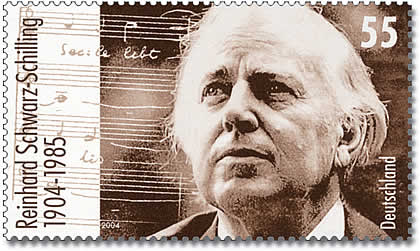
Reinhard Schwarz-Schilling is not a terribly well-known composer, largely for the reasons I just mentioned. Schwarz-Schilling had been a professor of music at the Berlin Academy of Music. During Hitler’s reign, his family was subjected to frequent interrogations by the Gestapo. Luckily, it was never found out that Schwarz-Schilling’s wife, the concert pianist Dusza von Hakrid, was of Jewish descent. It was only through the beneficence and courage of a sympathetic official who falsified documents that the Schwarz-Schillings escaped arrest.
Schwarz-Schilling may have survived the Nazis, but following the war, he had to deal with the musical establishment, which had grown hostile to such flagrantly tonal music. Something like his Violin Concerto of 1953 couldn’t be taken seriously. It starts out sounding a bit like Hindemith, but embraces Korngoldian sentiment at its candy core. If you can’t stick around for the whole show, I hope at least you’ll stay tuned for the gorgeous slow movement of this concerto.
We’ll also hear music by Karl Amadeus Hartmann, regarded in some circles as the most important German symphonist of the mid-20th century, yet is now largely overlooked. In his 30s, Hartmann was viewed as politically undesirable in his homeland. He completely withdrew from musical life during the Nazi era. On the rare occasion any of his works would have been permitted performance, Hartmann would not allow it. Alas, most of his greatest champions were also his contemporaries. Therefore, performances of his music nearly died with them.
After the war, Hartmann was one of the few prominent surviving anti-fascists in Bavaria whom the Allied Forces could promote to a position of responsibility. Hartmann used that trust to reintroduce the world to music which had been banned since 1933 under National Socialist aesthetic policy. He remained in Munich for the rest of his life, where his administrative duties cut heavily into what would have been his compositional time and energy. He died in 1963. We’ll hear Hartmann’s Symphony No. 6, composed between 1951 and 1953.
I hope you’ll join me for “Staying Power” – music by anti-fascist composers who remained in Nazi Germany – on “The Lost Chord,” now in syndication on KWAX Classical Oregon!
——–
Clip and save the start times for all three of my recorded shows:
PICTURE PERFECT, the movie music show – Friday at 8:00 PM EDT/5:00 PM PDT
SWEETNESS AND LIGHT, the light music program – Saturday at 11:00 AM EDT/8:00 AM PDT
THE LOST CHORD, unusual and neglected rep – Saturday at 7:00 PM EDT/4:00 PM PDT
Stream them, wherever you are, at the link!
https://kwax.uoregon.edu
Tag: Karl Amadeus Hartmann
-

Inner Emigration Composers Under the Nazis
Is it really “emigration” when you don’t go anywhere?
This Sunday night on “The Lost Chord,” we’ll have music by flagrantly anti-fascist composers who remained in Germany during the Nazi regime. This type of opposition was described by Thomas Mann as “inner emigration.”
There were plenty of opportunists who joined the Nazi Party as a means to curry favor, in the hopes of securing prominent posts. Then there were those who, while critical of the Nazis, nevertheless joined the Party to protect their families and to continue working.
A group which seems to have faded from memory is that made up of composers who remained, opposed the regime, and yet somehow survived. These artists were condemned by the Nazis, their music labeled degenerate and banned from performance. They were either prevented from escape or remained of their own accord. Some justified the decision to stay as an act of social consciousness. Some were active in resistance circles. Others simply withdrew into ostentatious silence.
Reinhard Schwarz-Schilling is not a terribly well-known composer, largely for the reasons I just mentioned. Schwarz-Schilling had been a professor of music at the Berlin Academy of Music. During Hitler’s reign, his family was subjected to frequent interrogations by the Gestapo. Luckily, it was never found out that Schwarz-Schilling’s wife, the concert pianist Dusza von Hakrid, was of Jewish descent. It was only through the beneficence and courage of a sympathetic official who falsified documents that the Schwarz-Schillings escaped arrest.
Schwarz-Schilling may have survived the Nazis, but following the war, he had to deal with the musical establishment, which had grown hostile to such flagrantly tonal music. Something like his Violin Concerto of 1953 couldn’t be taken seriously. It starts out sounding a bit like Hindemith, but embraces Korngoldian sentiment at its candy core. If you can’t stick around for the whole show, I hope at least you’ll stay tuned for the gorgeous slow movement of this concerto.
We’ll also hear music by Karl Amadeus Hartmann, regarded in some circles as the most important German symphonist of the mid-20th century, yet is now largely overlooked. In his 30s, Hartmann was viewed as politically undesirable in his homeland. He completely withdrew from musical life during the Nazi era. On the rare occasion any of his works would have been permitted performance, Hartmann would not allow it. Alas, most of his greatest champions were also his contemporaries. Therefore, performances of his music nearly died with them.
After the war, Hartmann was one of the few prominent surviving anti-fascists in Bavaria whom the Allied Forces could promote to a position of responsibility. Hartmann used that trust to reintroduce the world to music which had been banned since 1933 under National Socialist aesthetic policy. He remained in Munich for the rest of his life, where his administrative duties cut heavily into what would have been his compositional time and energy. He died in 1963. We’ll hear Hartmann’s Symphony No. 6, composed between 1951 and 1953.
I hope you’ll join me for “Staying Power” – music by anti-fascist composers who remained in Nazi Germany – this Sunday night at 10:00 EDT, on WWFM – The Classical Network and wwfm.org.
-

Whitman’s Lilacs: Hartmann & Higdon’s Musical Echoes
“When Lilacs Last in the Dooryard Bloom’d,” Walt Whitman’s pastoral elegy, written in the wake of the assassination of Abraham Lincoln, drew its most famous musical response from Paul Hindemith. Hindemith dedicated his requiem to the memory of Franklin Delano Roosevelt. This Sunday night on “The Lost Chord,” we continue our celebration of the bicentennial of the birth of America’s national poet (on May 31, 1816) with two lesser-known works inspired by the same source.
Karl Amadeus Hartmann died within weeks of Hindemith (who fled Germany in 1938), in December of 1963. An anti-fascist composer who made the decision to remain at home during Hitler’s reign of terror, Hartmann’s music was condemned as degenerate and banned from public performance. Holding fast was a dangerous game for an artist at odds with the regime. This type of opposition was described by writer Thomas Mann as “inner immigration.”
Following the war, Hartmann was one of the few surviving anti-fascists in Bavaria whom the Allied Forces could promote to a position of responsibility. He used that trust to reintroduce the world to music which had been prohibited since 1933 under National Socialist aesthetic policy.
Hartmann remained in Munich for the rest of his life, where his administrative duties cut heavily into what would have been his own compositional time and energy. His own greatest champions were his contemporaries, and performances of his music nearly died out with them. However, in recent years, his works have received more exposure thanks to recordings.
Hartmann wrote Symphony No. 1 in 1935 as an act of political dissidence. Naturally, at the time, no one in Germany would touch it, and Hartmann cemented his “undesirable” status. It would be over a decade before the piece would receive its first performance, in 1948. Following revisions, the work reached its final form in 1955.
Subtitled “Versuch eines Requiems” (or “Attempt at a Requiem”), the symphony employs texts selected from Whitman’s poetry. Unusually, it falls into five movements, as opposed to four. Four of them employ a contralto, but the third is purely instrumental, a set of variations on a theme from Hartmann’s anti-war opera, “Simplicius Simplicissimus.”
Closer to home, Philadelphia-based composer Jennifer Higdon scored her setting, “Dooryard Bloom,” for baritone and orchestra. The work was written on a commission from the Brooklyn Philharmonic in 2004.
Higdon, born in Brooklyn in 1962, but raised in Atlanta and Seymour, TN, took up composition while studying as a flutist at Bowling Green State University. She went on to earn an Artist’s Diploma from the Curtis Institute of Music, and a Master’s Degree from the University of Pennsylvania. She is now on the faculty of Curtis, and her works are frequently programmed by the Philadelphia Orchestra. She was the recipient of the Pulitzer Prize for Music in 2010 for her Violin Concerto.
I hope you’ll join me for the third of four weeks devoted to music inspired by the verse of Walt Whitman. Whitman chants his song of “sane and sacred death,” on “Lilacs Last,” this Sunday night at 10:00 EDT, on WWFM – The Classical Network and wwfm.org.
Clockwise from left: Lilacs, Whitman, Hartmann, and Higdon (with helper)
-
“Inner Emigration” Composers Under the Nazis
Is it really “emigration” when you don’t go anywhere?
This Sunday night on “The Lost Chord,” we’ll have music by flagrantly anti-fascist composers who remained in Germany during the Nazi regime. This type of opposition was described by Thomas Mann as “inner emigration.”
There were plenty of opportunists who joined the Nazi Party as a means to curry favor, in the hopes of securing prominent posts. Then there were those who, while critical of the Nazis, nevertheless joined the Party to protect their families and to continue working.
A group which seems to have faded from memory is that made up of composers who remained, opposed the regime, and yet somehow survived. These artists were condemned by the Nazis, their music labeled degenerate and banned from performance. They were either prevented from escape or remained of their own accord. Some justified the decision to stay as an act of social consciousness. Some were active in resistance circles. Others simply withdrew into ostentatious silence.
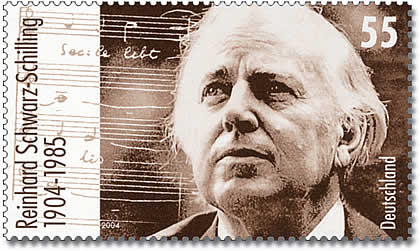
Reinhard Schwarz-Schilling is not a terribly well-known composer, largely for the reasons I just mentioned. Schwarz-Schilling had been a professor of music at the Berlin Academy of Music. During Hitler’s reign, his family was subjected to frequent interrogations by the Gestapo. Luckily, it was never found out that Schwarz-Schilling’s wife, the concert pianist Dusza von Hakrid, was of Jewish descent. It was only through the beneficence and courage of a sympathetic official who falsified documents that the Schwarz-Schillings escaped arrest.
Schwarz-Schilling may have survived the Nazis, but following the war, he had to deal with the musical establishment, which had grown hostile to such flagrantly tonal music. Something like his Violin Concerto of 1953 couldn’t be taken seriously. It starts out sounding a bit like Hindemith, but embraces Korngoldian sentiment at its candy core. If you can’t stick around for the whole show, I hope at least you’ll stay tuned for the gorgeous slow movement of this concerto.
We’ll also hear music by Karl Amadeus Hartmann, regarded in some circles as the most important German symphonist of the mid-20th century, yet is now largely overlooked. In his 30s, Hartmann was viewed as politically undesirable in his homeland. He completely withdrew from musical life during the Nazi era. On the rare occasion any of his works would have been permitted performance, Hartmann would not allow it. Alas, most of his greatest champions were also his contemporaries. Therefore, performances of his music nearly died with them.
After the war, Hartmann was one of the few prominent surviving anti-fascists in Bavaria whom the Allied Forces could promote to a position of responsibility. Hartmann used that trust to reintroduce the world to music which had been banned since 1933 under National Socialist aesthetic policy. He remained in Munich for the rest of his life, where his administrative duties cut heavily into what would have been his compositional time and energy. He died in 1963. We’ll hear Hartmann’s Symphony No. 6, composed between 1951 and 1953.
I hope you’ll join me for “Staying Power” – music by anti-fascist composers who remained in Nazi Germany – this Sunday night at 10:00 EST, on WWFM – The Classical Network and wwfm.org.
-
Elgar’s Symphony No 3 Celebrated Today
No Payne, no gain!
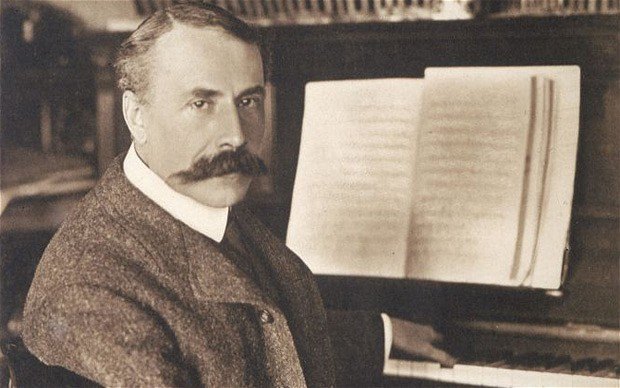
I hope you’ll join me this afternoon, as we celebrate the 80th birthday of composer and musicologist Anthony Payne. Payne did an uncanny job channeling the spirit of one of England’s most celebrated composers in bringing about the completion of sketches for Sir Edward Elgar’s Symphony No. 3. The resultant work, judiciously titled “Edward Elgar: Sketches for the Symphony No. 3 elaborated by Anthony Payne,” will be heard in the 1:00 hour.
We’ll also honor a former Master of the Queen’s Music, Sir Arthur Bliss, on his birthday, and I wouldn’t be the least bit surprised if music by Karl Amadeus Hartmann will turn up at some point, as well.
Hartmann was an anti-fascist German composer who played the dangerous game of remaining in Nazi Germany during World War II. He withdrew completely from musical life there and refused to allow his works to be performed. However, his symphonies continued to be championed abroad. Though still very much underrated, Hartmann was one of the great composers of the 20th century. We’ll be listening to his Symphony No. 6.
Experience these and more today, when you tune in from noon to 4 p.m. EDT, on WWFM – The Classical Network and at wwfm.org.
PHOTOS: Elgar (top) and Payne
Tag Cloud
Aaron Copland (92) Beethoven (94) Composer (114) Film Music (116) Film Score (143) Film Scores (255) Halloween (94) John Williams (185) KWAX (228) Leonard Bernstein (99) Marlboro Music Festival (125) Movie Music (131) Opera (197) Philadelphia Orchestra (86) Picture Perfect (174) Princeton Symphony Orchestra (106) Radio (86) Ralph Vaughan Williams (85) Ross Amico (244) Roy's Tie-Dye Sci-Fi Corner (290) The Classical Network (101) The Lost Chord (268) Vaughan Williams (99) WPRB (396) WWFM (881)