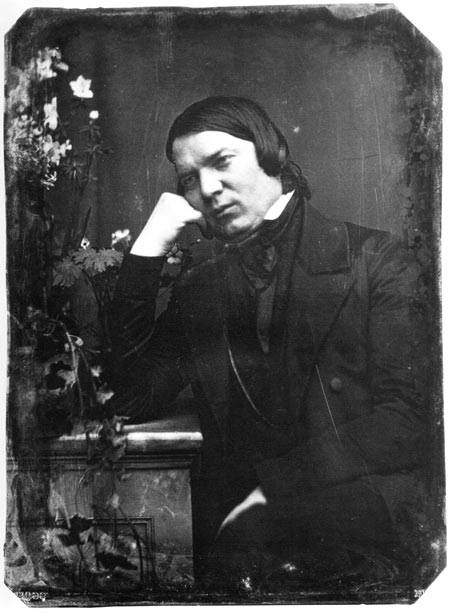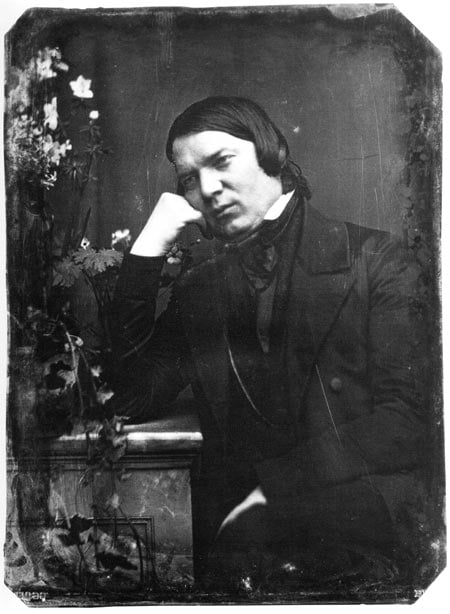
A would-be concert pianist, he’s said to have destroyed his hand through the use of a finger-strengthening device of his own design.
He took his underage sweetheart’s father – who also happened to be his teacher – to court, to sue for the right to marry, ultimately winning that right the day before she came of age.
He went mad from syphilis, hurled himself into the Rhine, and spent his final months in an asylum.
His name was Robert Schumann, and he was one of the most romantic of Romantic composers.
It’s hardly surprising that such an overheated personality would write such emotionally turbulent music. Whether tender (as per “Kinderszenen,” his reminiscences of childhood) or troubled (the “Nachtstücke,” a premonition of his brother’s death), Schumann was the ne plus ultra of tormented genius.
Happy birthday, Florestan! Or should that be Eusebius?
“Kinderszenen” (“Scenes from Childhood”), performed by Clara Haskil
“Nachtstücke” (“Night Pieces”), performed by Emil Gilels
“Fantasie in C major,” performed by Valdimir Horowitz
The “Fantasie” was completed in 1839, during Schumann’s enforced separation from Clara Wieck, his future wife. He wrote to her: “The first movement is the most passionate I have ever composed; it is a profound lament on your account.”
In the end, he dedicated the work to Franz Liszt. Liszt returned the favor by dedicating his Piano Sonata in B minor to Schumann in 1854. By that time, Liszt had long been persona non grata to the Schumanns. Clara, in particular, loathed him and his music.
She confided in her diary: “Liszt sent Robert today a sonata dedicated to him and several other things with a friendly letter to me. But the things are dreadful! [Johannes] Brahms played them for me, but they made me utterly wretched … This is nothing but sheer racket – not a single healthy idea, everything confused, no longer a clear harmonic sequence to be detected there! And now I still have to thank him – it’s really awful.”
In any case, Robert, at 44, was already in the asylum.