Tag: Kol Nidre

  • Yom Kippur Music Reflection on “Lost Chord”

    Yom Kippur Music Reflection on “Lost Chord”

    The Jewish High Holy Days are a period of reflection, ten days of awe and repentance. This Sunday night on “The Lost Chord,” the mood is largely meditative for Yom Kippur.

    In 1950, Jacob Weinberg composed a string quartet, published as his Opus 55. The work falls into three movements, bearing the respective subtitles “Rosh Hashanah” (the Jewish New Year), “Yom Kippur” (the Day of Atonement) and “Sukkot” (the harvest festival).

    Weinberg’s “Yom Kippur” is based on the famous sung prayer “Kol Nidre” that opens the Yom Kippur Eve service, best known to gentiles, probably, through a setting for cello by Max Bruch. Bruch, though not Jewish, always had a good ear for characteristic melodies of different cultures (further exemplified by his “Scottish Fantasy,” “Swedish Dances,” “Suite on Russian Themes,” etc.).

    Likewise, Emil Nikolaus von Reznicek – he of “Donna Diana Overture” fame – was moved by the Yom Kippur melody, on which he wrote a large-scale set of orchestral variations. In contrast to the reverential setting by Bruch, Reznicek puts the theme through a befuddling array of permutations, pivoting back and forth from light to serious. It’s not synagogue music, but it is fascinating.

    The hour will conclude with a reverential setting by Patrick Sinozich of ”Avinu Malkeynu” (“Our Father, Our King”) by Max Janowski, performed by Chicago a cappella.

    Make room for rumination. I hope you’ll join me for “Tones of Atonement,” this Sunday night at 10:00 EDT, on WWFM – The Classical Network and wwfm.org.
  • Ferdinand Hiller

    Ferdinand Hiller

    Who was Ferdinand Hiller, and what does he have to do with the most famous setting of “Kol Nidre” in all of classical music?

    Hiller, born to Jewish parents in 1811 (his father changed his name from Hildesheim), was a child prodigy. By 10, he was playing Mozart piano concertos in public, and by 12, he completed his first original composition. As a child, he met Felix Mendelssohn, who was two years his senior. Their friendship deepened in their teens and endured for over 20 years. Eventually, Hiller succeeded Mendelssohn as director of the Leipzig Gewandhaus Orchestra, which likely precipitated a rapid cooling between them. Within four years, Mendelssohn was dead at the age of 38.

    Hiller, who nearly doubled his friend’s lifespan (he died in 1885), composed in all forms – opera, symphony, concerto, chamber and instrumental works, and choral music, including an oratorio, “The Destruction of Jerusalem.” An outstanding pianist, he became the dedicatee of Robert Schumann’s Piano Concerto. Chopin also dedicated his three Nocturnes, Op. 15, to him.

    Hiller was a forceful writer on music and an influential teacher. His star pupil was Max Bruch, who was not Jewish. Bruch became acquainted with the cantorial chant “Kol Nidre” after being introduced by Hiller to the Berlin hazzan, Abraham Lichtenstein. In 1880, the same year that Bruch composed his “Scottish Fantasy” for the violinist Pablo de Sarasate, he embarked on his famous cello elegy.

    “Even though I am a Protestant, as an artist I deeply felt the outstanding beauty of these melodies,” Bruch wrote in 1889. He uses the plural because the second section of the work is a treatment of a setting by Isaac Nathan of Lord Byron’s “Oh! Weep for those that wept by Babel’s stream.”

    “Kol Nidre” – the traditional prayer, not the cello work – opens the evening service on Yom Kippur. The Day of Atonement, the holiest day on the Jewish calendar, begins tonight at sunset.


    Bruch, “Kol Nidrei”

    Nathan’s setting of Byron, which supplies the work’s B-section.

    Selections from Hiller’s neglected oratorio, “The Destruction of Jerusalem”

    His once popular Piano Concerto No. 2

    An absorbing article on the power, influence, and universality of “Kol Nidre”

    https://www.timesofisrael.com/how-the-haunting-kol-nidre-melody-harnessed-the-power-to-convert/


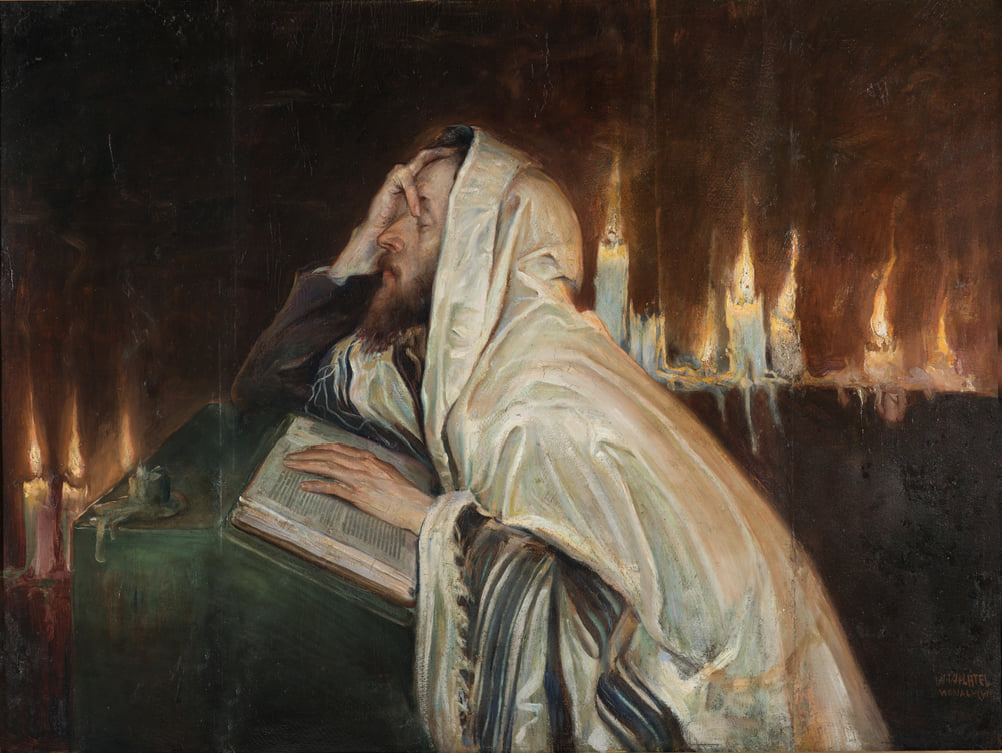
    IMAGES (counterclockwise from top): “Kol Nidre” by Wilhelm Wachtel; Ferdinand Hiller; Janos Starker’s classic recording of “Kol Nidrei;” and its composer, Max Bruch

  • Beethoven’s Yom Kippur Connection?

    Beethoven’s Yom Kippur Connection?

    Beethoven for Yom Kippur?

    Somehow, in my 40-plus-year passion for classical music, I have never before stumbled across this theory. But now that I know, it’s definitely out there. A Google search turns up plenty.

    There are those who speculate that Beethoven’s String Quartet No. 14 in C-sharp Minor, Op. 131, contains a quotation from the Yom Kippur melody “Kol Nidre.” It’s certainly possible.

    When the first Reform synagogue opened in Vienna in 1825, the theory posits, Beethoven was approached to supply a cantata. He never committed, though it appears he did devote some time to the study of Jewish music. However, by 1825, he was already stone deaf.

    It’s also been speculated that, as a younger man, in Bonn, he happened to be sweet on Rachel Levin, the daughter of a wealthy jeweler, who traveled in artistic circles. The two met in Teplitz at a gathering of poets, musicians, and intellectuals. Levin’s parents were opposed to Beethoven pursuing a relationship. Levin would distinguish herself as a radical thinker, gaining notoriety for her rejection of bourgeois values. Ironically, she later converted to Christianity to marry the biographer Karl August Varnhagen von Ense. Was Beethoven looking back, perhaps still carrying the torch?

    The melody of “Kol Nidre” was first written down in Berlin in the 18th century, but its origins reach back deep into the Middle Ages, perhaps earlier. Legend has it that the tune has remained unchanged since Moses climbed down from Sinai.

    The alleged quotation appears in the sixth movement of Beethoven’s quartet. I’m not sure I’m entirely convinced. If it is indeed true, which would be very cool, I wish that the composer would have gone for broke, à la Max Bruch, rather than simply feinting at the melody.

    Yom Kippur begins at sundown. The Day of Atonement marks the culmination of the Jewish High Holy Days, ten days of awe and repentance. Observed with fasting and prayer, it is the holiest day on the Jewish calendar.


    Beethoven, String Quartet No. 14, Movt. VI: Adagio quasi un poco andante (1826)

    Max Bruch, “Kol Nidrei” (1880)

    Jacob Weinberg, String Quartet No. 2, Movt. II: “Yom Kippur” (1950)

    Emil Nikolaus von Reznicek, “Symphonic Variations on Kol Nidre” (1929)

    Part I https://www.youtube.com/watch?v=jKA30FrX4jU
    Part II https://www.youtube.com/watch?v=bF_B66dAS04

    Arnold Schoenberg, “Kol Nidre” (1938)

  • Yom Kippur Music on WPRB

    Yom Kippur Music on WPRB

    Yom Kippur begins on Friday evening. The holiest day of the Jewish calendar caps ten Days of Awe and Repentance, which began with the Jewish New Year on Rosh Hashanah. This Thursday morning on WPRB, we’ll mark the Jewish High Holy Days with a full playlist of music on Jewish themes.

    We’ll begin with some evocations of the shofar, in Aaron Minsky’s “Judaic Concert Suite” and David Stock’s “Tekiah,” then progress through several arrangements of the Yom Kippur prayer Kol Nidre — by Jacob Weinberg, Arnold Schoenberg, Emil Nikolaus von Reznicek (of “Donna Diana Overture” fame), and of course Max Bruch — and arrive finally at Thomas Beveridge’s “Yizkor Requiem,” which beautifully consolidates the Jewish and Catholic liturgies for the dead. Along the way, there will be a symphony, some dances, and even a collection of tone portraits of the stained glass windows of Abell Syagogue at Hadassah University Medical Center in Jerusalem, which depict the Twelve Tribes of Israel.

    If you’re looking for music for the High Holidays, I’m your goy, this Thursday morning from 6 to 11 EDT, on WPRB 103.3 FM and wprb.com. Wishing you a sweet and happy 5778, on Classic Ross Amico.

  • Yom Kippur Music This Week on WPRB

    Yom Kippur Music This Week on WPRB

    Yom Kippur, the holiest day on the Jewish calendar, will commence this Friday at sundown. We anticipate the Day of Atonement and mark the ten Days of Awe and Repentance that began on Rosh Hashanah, the Jewish New Year, with our annual show devoted to the Jewish High Holidays.

    This Thursday morning on WPRB, we’ll hear plentiful music on Jewish themes, a piece or two evocative of the shofar, and of course multiple renderings of the prayer “Kol Nidre,” which is recited in the synagogue before the Yom Kippur evening service.

    A highlight of the morning will be the “Yizkor Requiem” by Thomas Beveridge, who attempts to bridge Jewish and Christian traditions by paying tribute to the Hebraic roots of the Roman Catholic liturgy.

    That’s music for the Days of Awe, this Thursday morning from 6 to 11 EDT, on WPRB 103.3 FM and wprb.com. The results will be predictably awesome, on Classic Ross Amico.

Tag Cloud

Aaron Copland (92) Beethoven (94) Composer (114) Film Music (117) Film Score (143) Film Scores (255) Halloween (94) John Williams (185) KWAX (228) Leonard Bernstein (99) Marlboro Music Festival (125) Movie Music (132) Opera (197) Philadelphia Orchestra (86) Picture Perfect (174) Princeton Symphony Orchestra (106) Radio (86) Ralph Vaughan Williams (85) Ross Amico (244) Roy's Tie-Dye Sci-Fi Corner (290) The Classical Network (101) The Lost Chord (268) Vaughan Williams (101) WPRB (396) WWFM (881)

DON’T MISS A BEAT

Receive a weekly digest every Sunday at noon by signing up here


RECENT POSTS