Tag: La Bohème

  • Puccini’s Christmas La Bohème Origins

    Puccini’s Christmas La Bohème Origins

    Puccini?! What you doing, being born so close to Christmas?

    No matter, here’s a student work, his “Capriccio sinfonico.” Puccini wrote the piece in 1883, while still at the Milan Conservatory. You may recognize some of the music since he later recycled it in his most frequently performed opera, “La bohème.” You’ll detect the bohemians at around the 4-minute mark.

    Now that you’re in the mood for hopeless Christmas romance, here’s Luciano Pavarotti and company in Acts I & II of “La bohème,” set on Christmas Eve. Interestingly, the production is directed by Gian Carlo Menotti (he of “Amahl and the Night Visitors” fame). Mimi is sung by Fiamma Izzo d’Amico – no relation, surely?

  • Puccini’s Birthday: La Bohème & Bohemian Life

    Puccini’s Birthday: La Bohème & Bohemian Life

    Happy birthday, Giacomo Puccini!

    The first two acts of “La bohème,” of course, are set on Christmas Eve – Act I in a chilly but cheery artists’ garret, and Act II on the festive streets of Paris’ Latin Quarter.

    The world premiere of Puccini’s opera took place at the Teatro Regio in Turin on February 1, 1896. On the podium was a 28-year-old Arturo Toscanini.

    Allegedly, the opening night reaction was a subdued one, and critics were divided. But it wasn’t long before Rodolfo’s kindling gave rise to a flame that would engulf all of Europe and the New World.

    Though audiences quickly grew to love it, “Bohème” and its composer have always been regarded with a degree of suspicion – condescension even – by critics and Puccini’s envious colleagues. The music lacks sophistication, we are told, and the opera’s lyricism and pathos are calculating – emotional pandering. Whether or not that’s the case, music lovers can’t get enough of it and Puccini cried all the way to the bank.

    Prior to his years of success, Puccini and his friends, mostly writers and artists, would gather at a roadside shed in Torre del Lago to drink and play cards. They referred to the structure as “Capanna di Giovanni delle Bande Nere” (“Cabin of Giovanni of the Black Stripes”), after its owner, a local cobbler. When the cobbler struck out to seek his fortune in America, the artists bought the shack and continued to meet under the banner “La Bohème Club” (as stated on a sign they painted on the roof).

    Further signs were posted on the walls inside, in faulty Latin and ungrammatical Italian. Its members pledged themselves under oath to be well and eat butter.

    The following were the club’s by-laws:

    1. Poker faces, pedants, weak stomachs, blockheads, puritans and other wretches of the species are not admitted and will be chased away.

    2. The President acts as conciliator but undertakes to hinder the Treasurer in the collection of the subscription money.

    3. The Treasurer is empowered to abscond with the money.

    4. The lighting of the locale is provided by a petrol lamp. Failing the fuel, the “moccoli” of the members are to be used [a pun on “moccolo,” meaning either “candle stump” or “blockhead”].

    5. All games permitted by law are forbidden.

    6. Silence is prohibited.

    7. Wisdom is not permitted, except in special cases.

    One can imagine the carefree bohemians, Rodolfo’s companions, rollicking in their garret. After the triumph of “Bohème,” the opera, no one was having to burn their plays for fuel, or hock their coats for medicine.

    There’s nothing like a little success to take the worry out of “bohemian life.”


    André Kostelanetz (also born on this date) conducting a purely orchestral suite of highlights from “La bohème”

    The bohemians in their garret

    Mimi’s hands are cold, so Rodolfo goes to work (the old smoothie)


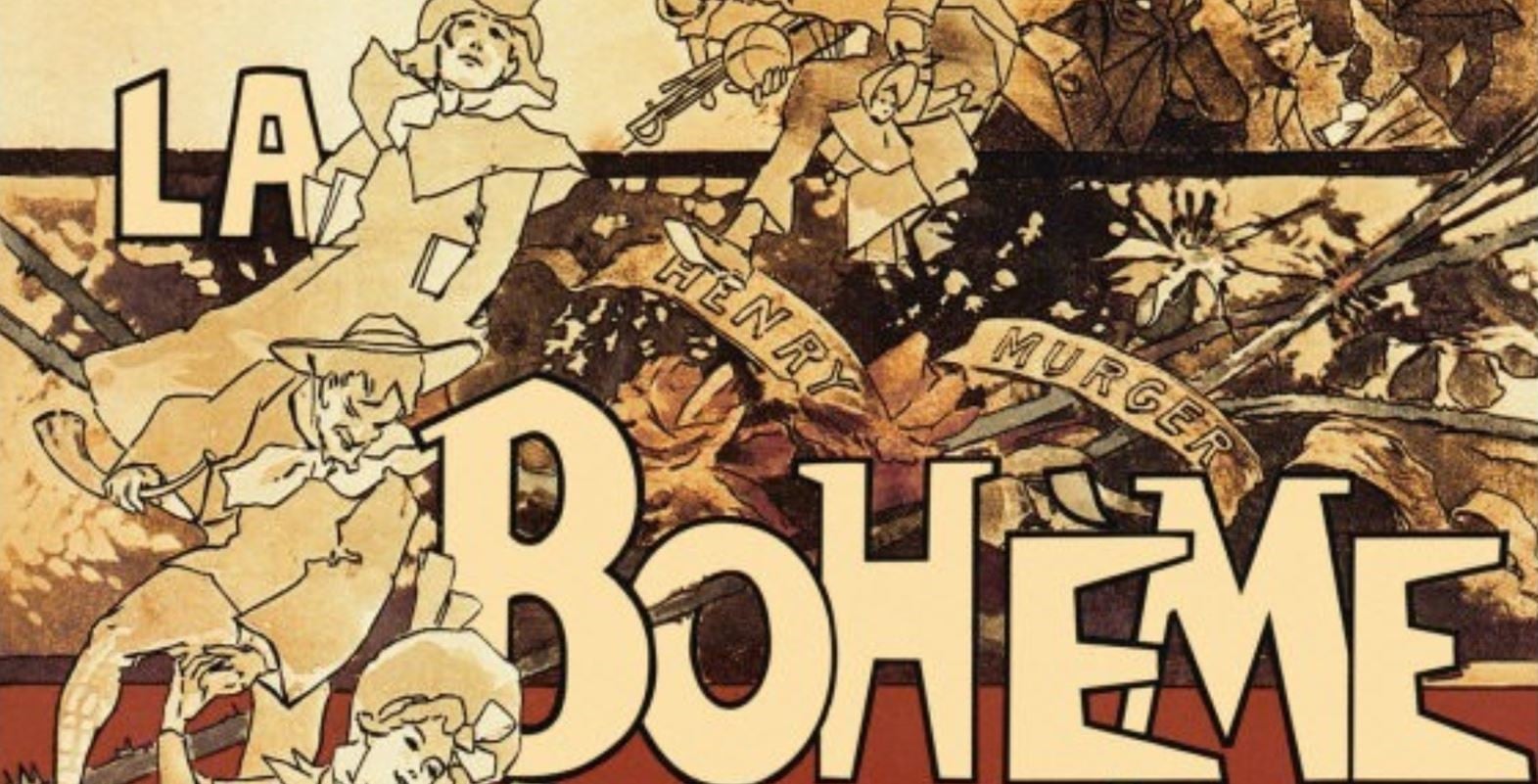
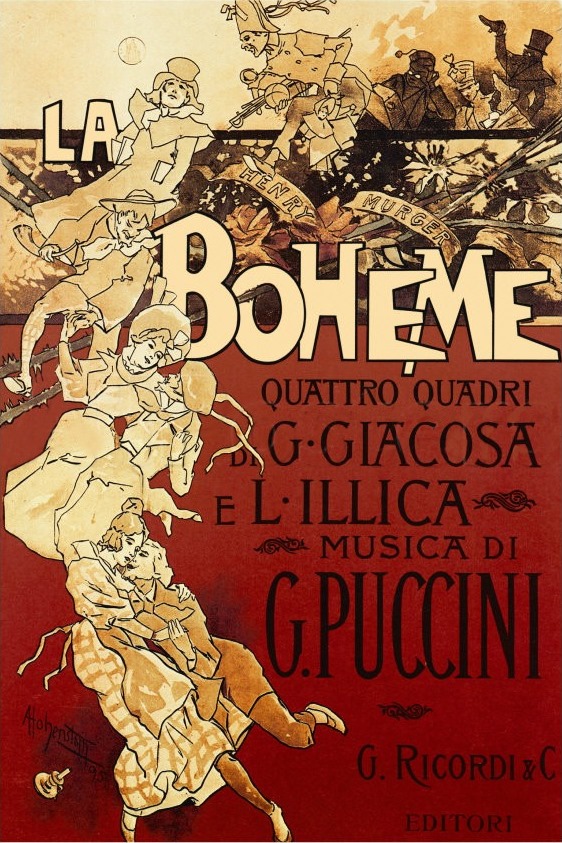
    IMAGES: From an 1896 poster of the opera, and an 1897 photo of the club

  • La Bohème A Christmas Eve Tragedy

    La Bohème A Christmas Eve Tragedy

    Giacomo Puccini’s opera “La bohème” opens in an artist’s garret on Christmas Eve. After Mimi and Rodolfo meet cute (she knocks on his door looking for a match for her candle), they join their friends on the boisterous streets of Paris for a good old-fashioned Latin Quarter Christmas. This effectively knocks out the first two acts.

    By Act III, their love is on the rocks. On a snowy night, Rodolfo confides to the painter Marcello that Mimi is slowly dying of consumption (tuberculosis). He loves her still, but he doesn’t have the money to take care of her, so he is feigning jealousy in an attempt to drive her into the arms of another. Mimi overhears, and apparently agrees to the split, but then the lovers decide it’s too horrible to part in winter. We know it’s just an excuse, though, so that they can stay together until spring.

    In Act IV, we have no idea what month it is, but it’s sometime later. Mimi shows up at the garret, and she is not well. The circle of bohemians offer comfort, each in their own way. Earrings are sold for a muff, and an overcoat is hocked for medicine. Left to themselves, Mimi and Rodolfo relive their past happiness, but the reunion is agonizingly brief. Their friends return, only just in time for everyone to dissolve into tears.

    Merry Christmas.


    On Puccini’s birthday, here’s a recording of André Kostelanetz (also born on this date) conducting a purely orchestral suite of highlights from “La bohème”:

    Mimi’s hands are cold, so Rodolfo goes to work. The old smoothie.

  • Met Opera Streams This Week Free!

    Met Opera Streams This Week Free!

    Thanks a lot, Met, for last night’s subversion of “Prince Igor.” Pee-yew.

    However, it would be churlish of me to suggest that the overall quality of the Met streams – and the hours of pleasure they have afforded – have been anything less than appreciated, as the superlative gifts that they are.

    This week’s opera offerings are especially appealing, beginning with “The Marriage of Figaro,” performed by an all-star cast (tonight); followed by “Hamlet” by Ambroise Thomas (tomorrow); “Capriccio,” Richard Strauss’ final opera, with Renée Fleming (Thursday); a classic performance of “La bohème,” with Renata Scotto and Luciano Pavarotti (Friday), and a double-bill of “Cav” & “Pag” (Sunday).

    On Saturday, a change of pace, as the stream will be devoted to the 2017 feature-length documentary “The Opera House,” about the creation and 1966 opening of the new Met at its current home in Lincoln Center.

    Surely the pick of the week, however, is Wednesday’s opera: Kaija Saariaho’s “L’Amour de Loin,” the first opera by a woman to be performed at the Met in over 100 years! (The last was Ethel Smyth’s “Der Wald,” back in 1903.) Way to go, Met.

    All operas stream free, for 23 hours, beginning each day at 7:30 p.m. (“Prince Igor” is available until 6:30 this evening.) You’ll find teasers and bonus materials when following the link.

    https://www.metopera.org/user-information/nightly-met-opera-streams/week-8/

    Monday, May 4
    Mozart’s Le Nozze di Figaro
    Starring Renée Fleming, Cecilia Bartoli, Susanne Mentzer, Dwayne Croft, and Sir Bryn Terfel, conducted by James Levine. From November 11, 1998.

    Tuesday, May 5
    Thomas’s Hamlet
    Starring Marlis Petersen, Jennifer Larmore, Simon Keenlyside, and James Morris, conducted by Louis Langrée. From March 27, 2010.

    Wednesday, May 6
    Saariaho’s L’Amour de Loin
    Starring Susanna Phillips, Tamara Mumford, and Eric Owens, conducted by Susanna Mälkki. From December 10, 2016.

    Thursday, May 7
    Strauss’s Capriccio
    Starring Renée Fleming, Sarah Connolly, Joseph Kaiser, Russell Braun, Morten Frank Larsen, and Peter Rose, conducted by Sir Andrew Davis. From April 23, 2011.

    Friday, May 8
    Viewers’ Choice: Puccini’s La Bohème
    Starring Renata Scotto and Luciano Pavarotti, conducted by James Levine. From March 15, 1977.

    Saturday, May 9
    The Opera House
    A 2017 feature-length documentary by Susan Froemke about the creation and 1966 opening of the new Met at Lincoln Center

    Sunday, May 10
    Mascagni’s Cavalleria Rusticana and Leoncavallo’s Pagliacci
    Cavalleria Rusticana: Starring Eva-Maria Westbroek, Marcelo Álvarez, and George Gagnidze.
    Pagliacci: Starring Patricia Racette, Marcelo Álvarez, and George Gagnidze.
    Conducted by Fabio Luisi. From April 25, 2015.
Tag Cloud

Aaron Copland (92) Beethoven (94) Composer (114) Film Music (117) Film Score (143) Film Scores (255) Halloween (94) John Williams (185) KWAX (228) Leonard Bernstein (99) Marlboro Music Festival (125) Movie Music (132) Opera (197) Philadelphia Orchestra (86) Picture Perfect (174) Princeton Symphony Orchestra (106) Radio (86) Ralph Vaughan Williams (85) Ross Amico (244) Roy's Tie-Dye Sci-Fi Corner (290) The Classical Network (101) The Lost Chord (268) Vaughan Williams (101) WPRB (396) WWFM (881)

DON’T MISS A BEAT

Receive a weekly digest every Sunday at noon by signing up here


RECENT POSTS