Tag: Léonide Massine

  • Manuel de Falla’s Bewitched Love a Powell Masterpiece

    Manuel de Falla’s Bewitched Love a Powell Masterpiece

    I have always been a great admirer of the team of Michael Powell and Emeric Pressburger, who made such strange, astonishing films as “The Red Shoes” (1948) and “The Tales of Hoffmann” (1951). Yet somehow I never encountered this one until a couple of years ago. It was made by Powell alone, after the two had amicably split to pursue their own projects.

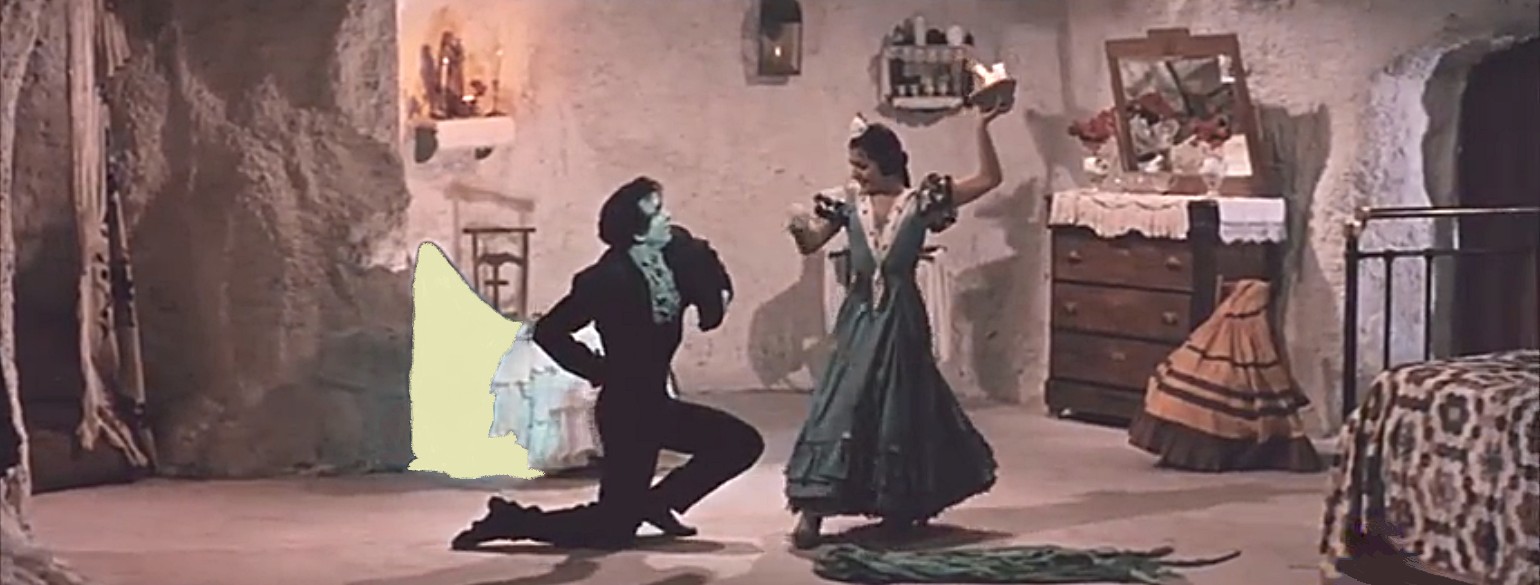
    “Honeymoon” (1959) reunited Powell with legendary Ballets Russes principal dancer and choreographer Léonide Massine, for a film based in part on Manuel de Falla’s ballet “El Amor Brujo” (here translated as “Bewitched Love”). Massine created the role of the Miller in Falla’s “The Three-Cornered Hat” with the Ballets Russes and a specially-assembled all-Spanish company, back in 1919. Naturally, after his turn as the sinister shoemaker in “The Red Shoes,” Massine assumes the role of the creepy Ghost. Sir Thomas Beecham conducts.

    If you can’t be bothered to watch the whole thing – and you should – check out the freaky graveyard scene at 6:49 (linked below). It leads directly into the ballet’s most famous music, the “Ritual Fire Dance.” Like a Goya painting brought to life.

    Alicia de Larrocha gives “Ritual Fire Dance” a whirl at the piano.

    Manuel de Falla plays his Harpsichord Concerto, a very different piece.

    Documentary, “When the Fire Burns: The Life and Music of Manuel de Falla” (1991)

    ¡Feliz cumpleaños, Manuel de Falla!
  • Powell’s Lost Falla Ballet Film Honeymoon

    Powell’s Lost Falla Ballet Film Honeymoon

    Wow! How did I never hear of this before?

    On Manuel de Falla’s birthday, I’ve been bouncing around YouTube, looking for exceptional or unusual material, and as always, the effort – if anything so enjoyable could be described as such – has paid off.

    I have always been a great admirer of the filmmaking team of Michael Powell and Emeric Pressburger, who made such strange, astonishing films as “The Red Shoes” (1948) and “The Tales of Hoffmann” (1951), and yet somehow I have never encountered this one, apparently made by Powell alone, after the team had amicably split.

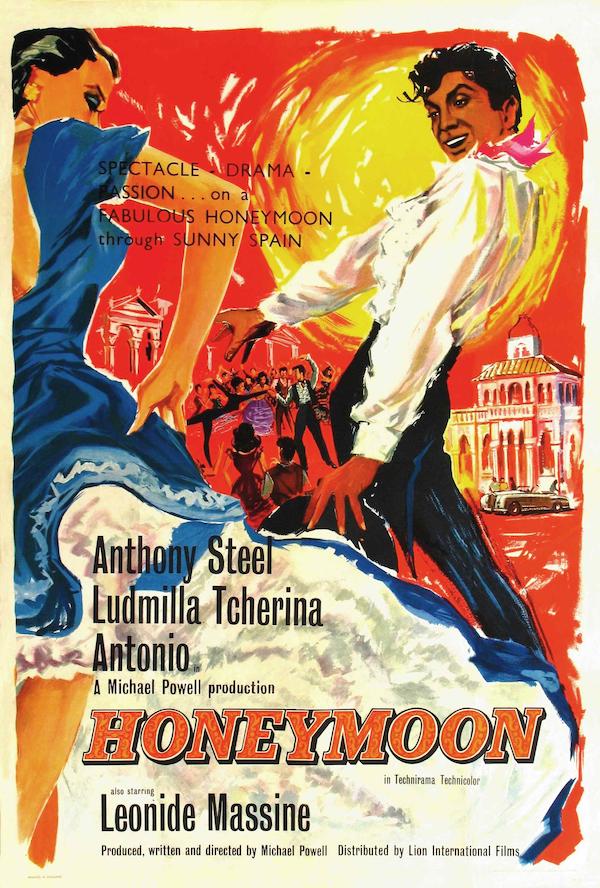
    “Honeymoon” (1959) reunited Powell with legendary Ballets Russes principal dancer and choreographer Léonide Massine, for a film based in part on Falla’s ballet “El Amor Brujo” (here translated as “Bewitched Love”). Massine created the role of the Miller in Falla’s “The Three-Cornered Hat” with the Ballets Russes and a specially-assembled all-Spanish company, back in 1919. Naturally, after his turn as the sinister shoemaker in “The Red Shoes,” Massine here assumes the role of the creepy Ghost.

    Supposedly the film is something of a Spanish travelogue with musical interludes. Mikis Theodorakis, of “Zorba the Greek” fame, wrote the aptly named “The Honeymoon Song.” It was later covered by The Beatles.

    For the leads, Powell was hoping to reunite with his “Red Shoes” star Moira Shearer and Paul Scofield, of all people. Instead, he got Ludmilla Tchérina, once the youngest prima ballerina in history when she danced “Romeo and Juliet” in Paris in 1942, while still in her teens, for the Ballets Russes de Monte Carlo. Tchérina had worked with Powell in both of his previous dance films. For the male lead, the director was less fortunate, stuck with Anthony Steel, whom Powell despised. (He described him as “the archetypal British s**t.”)

    Allegedly, “Honeymoon” is regarded as one of Powell’s least-impressive achievements. Unquestionably it is at least as much “Red Shoes” as it is authentic Falla. Still, I am grateful to have discovered it.

    The “El Amor Brujo” sequence is posted here in two parts.

    Happy birthday, Manuel de Falla!


    Check out the freaky graveyard scene at 6:49 (here linked directly), which leads into the ballet’s most famous music, “The Ritual Fire Dance.” Like a Goya painting brought to life!

  • Charles Lecocq Birthday & “Mam’zelle Angot”

    Charles Lecocq Birthday & “Mam’zelle Angot”

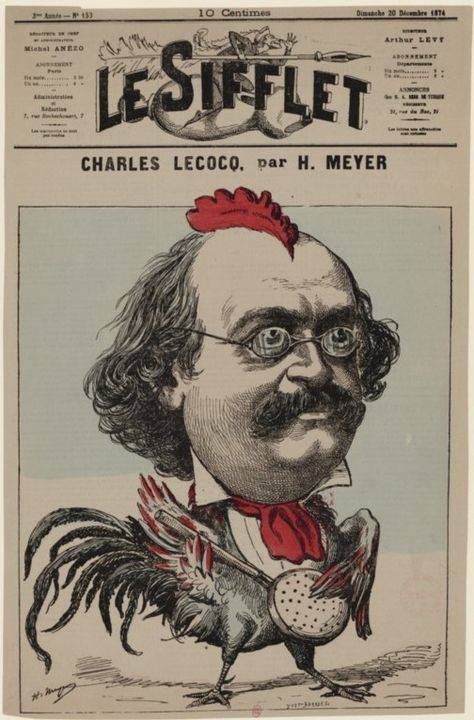
    Today is the birthday of Charles Lecocq (1832-1918). Lecocq’s affinity for light opera made him a natural successor of sorts to Jacques Offenbach. “La fille de Madame Angot” was a triumph when it opened in Brussels in 1872. Soon, it was wowing them not only in Paris, but also London and New York, and indeed all across Europe. In fact, it was the most successful French-language musical theater piece up through the turn of the century. In terms of box office, it managed even to outpace “H.M.S. Pinafore” and “Die Fledermaus.” Its momentum was such that it is now the only work of Lecocq that is ever performed.

    The opera was given a superfluous boost in the 1940s, when choreographer Léonide Massine created a new version that found its definitive form in a production by the Sadler’s Wells Ballet. Margot Fonteyn and Moira Shearer were among the principals. The adaptation, “Mam’zelle Angot,” employs arrangements by Gordon Jacob and broadly follows the opera’s original plot. Let’s just say that it is a flighty and frothy divertissement, set in a politically charged climate following the Reign of Terror. Despite the threat of looming peril, all ends happily, with mismatched lovers paired off to everyone’s general delight.

    Get an idea of what the fuss was about. It will be a boost from the roost – music from Lecocq and beyond – between 4 and 7 p.m. EDT, on WWFM – The Classical Network and wwfm.org.

Tag Cloud

Aaron Copland (92) Beethoven (94) Composer (114) Film Music (116) Film Score (143) Film Scores (255) Halloween (94) John Williams (185) KWAX (228) Leonard Bernstein (99) Marlboro Music Festival (125) Movie Music (131) Opera (197) Philadelphia Orchestra (86) Picture Perfect (174) Princeton Symphony Orchestra (106) Radio (86) Ralph Vaughan Williams (85) Ross Amico (244) Roy's Tie-Dye Sci-Fi Corner (290) The Classical Network (101) The Lost Chord (268) Vaughan Williams (99) WPRB (396) WWFM (881)

DON’T MISS A BEAT

Receive a weekly digest every Sunday at noon by signing up here


RECENT POSTS