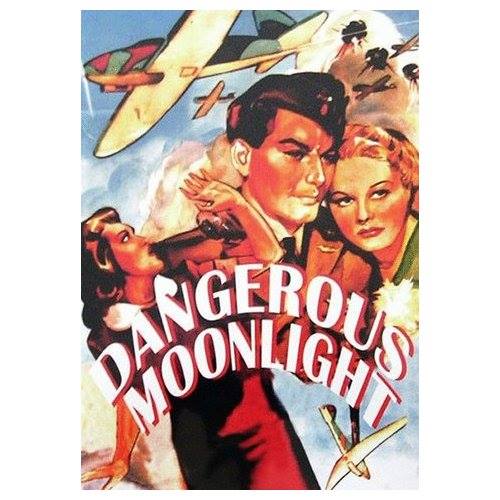
When he was hired to play the piano in a World War II potboiler, he asked that he not receive credit, for fear that it would damage his integrity as a concert artist. But when the spin-off record sold millions, he wisely changed his tune.
Today is the birthday of Louis Kentner (1905-1987). The pianist went by several names. He was born Lajos Kentner to Hungarian parents in the present-day Czech Republic (then Austrian Silesia). Among his teachers at the Royal Academy of Music in Budapest were Arnold Székely (piano), Leó Weiner (chamber music) and Zoltán Kodály (composition). He began performing in public at the age of 15. Until 1931, he was known professionally as Ludwig Kentner. He settled in England in 1935 and became a naturalized citizen in 1946.
Kentner excelled in the works of Franz Liszt. He founded the British Liszt Society. The sprawling “Years of Pilgrimage” was among the works he tackled complete. He also gave radio broadcasts of the complete sonatas of Beethoven and Schubert, and Bach’s “The Well-Tempered Clavier.” He was the pianist of choice for Béla Bartók, who requested him as soloist for the Hungarian premiere of his Piano Concerto No. 2 and the first European performance of the Concerto No. 3. Later, Kentner gave the British premiere of Bartók’s Scherzo for Piano and Orchestra.
Also in England, he gave first performances of works by Sir Arthur Bliss, Sir Michael Tippett, and Sir William Walton (Walton’s Violin Sonata, played with his brother-in-law, the violinist Yehudi Menuhin).
Nothing he played, however, touched so many as Richard Addinsell’s “Warsaw Concerto,” which became world-famous following its use in the 1941 film “Dangerous Moonlight” (known in the U.S. by the more lurid title, “Suicide Squadron”). The piece, never heard complete in the film, took on a life of its own when arranged as a mini Rachmaninoff-style concerto by Addinsell’s frequent collaborator, Roy Douglas. The eight-minute playing time ensured that it would fit perfectly on two sides of a 78 rpm disc. Its sheet music sales went through the roof, and the “Warsaw Concerto” was a smash. It was not the first spin-off concerto from the movies, but it did spark an unlikely rage for concertos at the movies.
Kentner’s legacy has been tied very closely to my own radio work, since it is he who performs the theme to my weekly show, “The Lost Chord” (which is, for the record, the “Berceuse” from Kentner’s 1972 recording of the “Transcendental Etudes” of Sergei Lyapunov).
So it is with gratitude, as well as with admiration, that I offer this remembrance of Louis Kentner on his birthday!
Kentner’s recording of the “Warsaw Concerto”
“Berceuse” from Lyapunov’s “Transcendental Etudes” (theme music for “The Lost Chord”)
Bartók’s Piano Concerto No. 3
Video of Kentner performing Liszt’s “Years of Pilgrimage (Second Year: Italy)” complete