Tag: Lulu

  • Alban Berg’s Lulu of an Opera

    Alban Berg’s Lulu of an Opera

    If one were to bake a birthday cake for Alban Berg, one would be forgiven for rendering a handgun in icing and hollowing out the layers to make room for prostitutes and madmen.

    When Berg came to write his sordid, darkly humorous, ultimately bloodcurdling masterpiece “Lulu,” he based it on the plays of Frank Wedekind. However, significantly, the influence of film also permeates the work.

    I don’t know that it’s ever been proved, but the composer had to have seen Louise Brooks’ sensational performance in G.W. Pabst’s “Pandora’s Box” (1929). The scandalous silent film classic, based on the same material, was an international triumph, and to this day, stage Lulus frequently emulate Brooks’ iconic style.

    Also, at the very center of the opera is a filmed interlude. The composer was obsessed with symmetry and palindromes. They pervade the opera, so much so that in the cinematic centerpiece, a silent film that dramatizes the events surrounding Lulu’s incarceration and escape, the music reads the same backwards and forwards.

    In a piece that’s so aggressively contemporary in its decadence and cynicism, it’s unsurprising that Berg would embrace modern technology. One wonders what he would have made of the digital age.

    Love, eroticism, and death were nothing new to opera, but there is something about “Lulu” that’s especially disturbing and transgressive. It’s subversive, sleazy, squalid, and calculated to shock. It’s not for nothing that Lulu, the protagonist, is introduced by a lion tamer!

    But Lulu is just being Lulu. The title of the first of Wedekind’s plays is “Erdgeist” – “Earth Spirit.” Lulu is plucked from the streets, and her raw sexuality has devastating effects on both the men and women in her life. Moral confusion abounds. Sure, she makes some monstrous choices. But we’re left to wonder, as with Jessica Rabbit, is she bad, or did society just draw her that way?

    Lulu in her amorality is the product of in an inauthentic world. After three acts of unfettered destruction, she dies at the hands of Jack the Ripper. Serialism’s greatest heroine falls prey to history’s most notorious serial killer.

    Berg composed his opera between 1929 and 1935. The ‘30s were a fraught time in Europe. It goes without saying, the Nazis did not like “Lulu.” Berg himself may not have been Jewish, but his teacher, Arnold Schoenberg, high priest of dodecaphony, was. Berg’s twelve-tone idiom alone would have been enough to get his opera banned. And his reputation had already been made with the equally disturbing “Wozzeck,” given its first performance in Berlin in 1925. He was added to the Nazi catalogue of “entartete” composers in 1933.

    The composer did not live to see the Führer’s furor over “Lulu.” He died of blood poisoning, the result of an insect sting, on Christmas Eve 1935. He was 50 years-old.

    At the time of his death, the opera was not yet quite complete. He was well along on the piece when two things occurred:

    First, he learned from Wilhelm Furtwängler that the climate in Berlin was unfavorable to a performance there. So he broke off on orchestrating the opera to develop some of the music into a “Lulu Suite,” which he hoped to have played in concert. Erich Kleiber, who had introduced “Wozzeck” in 1925, programmed the suite at the Berlin State Opera. After the performance, he was forced to resign and basically run out of the country.

    Berg paused a second time to compose his Violin Concerto for Louis Krasner. This he dedicated to the memory of 18 year-old Manon Gropius, one of Berg’s muses, whom he and his wife had come to view as their own daughter. Manon’s birth parents were Alma Mahler, Gustav’s widow, and Walter Gropius. The concerto would go on to become Berg’s best-loved work.

    At some point, the composer wrote to Anton Webern to let him know that “Lulu” was essentially complete. He anticipated he would need only two or three weeks to overhaul it before he started in on its orchestration.

    After his death, it was found he had managed to complete most of it. The parts he did not were left in short score, with detailed indications as to his plans for filling out the orchestration. Nevertheless, Schoenberg, Webern, and Zemlinsky, all friends of Berg, declined to take up its completion. Berg’s widow was left with the impression that the task must have been impractical, if not impossible. It was only after her own death in 1976 that Friedrich Cerha moved ahead with plans to finish it.

    “Lulu” received its premiere, incomplete, in Switzerland, in 1937. Cerha’s edition was first staged soon after its publication in 1979. This was rapturously received, and it is now the preferred version.

    Berg was always considered the Romantic among serialists. One critic dubbed him “the Puccini of twelve-tone music.” “Lulu” is freely-composed, but makes use of the twelve-tone technique promulgated by Schoenberg. Fascinatingly, each character in the opera gets his or her own tone row, so that each of the rows serves the purpose of a leitmotif – a fragmentary slip of music, bearing extramusical associations – as in the works of Richard Wagner. But if there is an opera further from Wagner’s Valhalla than “Lulu,” I don’t know it!

    Interestingly, there was nothing at all sordid about Berg the man. There was no violence or scandal in his life. He was intellectual and well-spoken, and he didn’t consort with criminals and prostitutes. He just knew a good succès de scandale when he saw one.

    “Lulu” has long since taken its place in the standard repertoire, alongside Berg’s “Wozzeck.” I can’t say it’s the most pleasant night at the theater, but it is an absorbing one, and it still retains its modern edge.

    Happy birthday, Alban Berg!

    ———

    Berg’s “Lulu Suite”


    The Violin Concerto


    Louise Brooks as Lulu


    “Lulu”… by Lou Reed and Metallica?

  • Cerha’s “Lulu” & Legacy

    Cerha’s “Lulu” & Legacy

    The composer Friedrich Cerha has died at the age of 96. But what he left us is a complete “Lulu.”

    When Alban Berg died unexpectedly – of blood poisoning from an insect bite on Christmas Eve, 1935 – his second opera remained incomplete. His work on “Lulu,” begun in 1929, was interrupted so that he could develop some of the music into a “Lulu Suite,” an attempt to subvert the Nazis, which had already added Berg to their catalogue of “entartete” – or degenerate – composers in 1933. When Erich Kleiber, who had introduced Berg’s first opera, “Wozzeck,” at the Berlin State Opera in 1925, performed the suite there in 1934, he was forced to resign and basically run out of the country.

    Berg broke off work on the opera a second time to compose his Violin Concerto for Louis Krasner. This he dedicated to the memory of 18-year-old Manon Gropius, one of Berg’s muses, whom he and his wife had come to view as their own daughter. Manon’s birth parents were Alma Mahler, Gustav’s widow, and Walter Gropius. The concerto would go on to become Berg’s most beloved work.

    At some point, the composer wrote to Anton Webern to let him know that “Lulu” was essentially complete. He anticipated he would need only two or three weeks to overhaul it before he started in on its orchestration.

    After his death, it was found he had managed to complete most of it. The parts he did not were left in short score, with detailed indications as to his plans for filling out the orchestration.

    Schoenberg, Webern, and Zemlinsky, all friends of Berg, declined to take up its completion. Berg’s widow was left with the impression that the task must have been impractical, if not impossible. It was only after her own death in 1976 that Friedrich Cerha moved ahead with plans to finish it.

    “Lulu” received its premiere, incomplete, in Switzerland, in 1937. Cerha’s edition was first staged soon after its publication in 1979. This was rapturously received, and it is now the preferred version.

    Lulu” has long since taken its place in the standard repertoire, alongside Berg’s “Wozzeck.”

    Cerha himself produced orchestral music and five original operas. He was a teacher at Vienna’s University of Music and Performing Arts (formerly the Viennese Music Academy, where he studied). He received a doctorate in philosophy from the University of Vienna.

    A noted interpreter of the music of the Second Viennese School (Schoenberg, Berg, and Webern), he was invited to conduct at orchestra halls, opera houses, and festivals around the world. He cofounded with his wife Gertraud and composer Kurt Schwertsik the contemporary music ensemble die reihe (“the row” or “the series”).

    Interestingly, he and Gertraud were also founding members of the Joseph Marx Society. Though Marx is credited with having coined the term atonality, one would be hard-pressed to think of a 20th century composer more Romantic in outlook. The pianist Jorge Bolet described Marx’s “Romantic Piano Concerto” (1919-20) as his favorite among the great virtuoso works.

    Of his own music, Cerha’s publisher singles out “Spiegel I-VII” as occupying a special place. His first opera, “Baal,” appeared in 1981.

    Percussion Concerto (2007-08)

    “Nachtstücke” (“Night Piece”) for piano trio (1992)

    Spiegel II for 55 Strings (1964)

    Act III of “Lulu”

    Cerha talks about his music

    Jorge Bolet performs Joseph Marx’s “Romantic Piano Concerto”

  • Alban Berg’s Romantic Revolution

    Alban Berg’s Romantic Revolution

    Had your fill of snow? Make an appointment today to sweat it out in the fin de siècle hothouse of Alban Berg.

    Berg has always been regarded as the Romantic among serialists – one critic described him as “the Puccini of twelve-tone music” – so it’s hardly surprising to find a shimmering, unresolved longing in much of his music, linking him to the more traditional-minded among his Viennese contemporaries.

    Berg’s operas, “Wozzeck” and “Lulu,” are in the standard repertoire. His “Lyric Suite” and Chamber Concerto are played with frequency. But it is his Violin Concerto of 1935 that has really entered people’s hearts.

    In this work – a response to the death of Manon Gropius, the 18-year-old daughter of Alma Mahler and Walter Gropius – Berg processes loss and grief with the kind of humanity that seems have eluded Arnold Schoenberg, his teacher, in his own dogmatic dodecaphony. Furthermore, Berg’s masterpiece offers identifiable signposts for the uninitiated, with allusions to a chorale melody employed by Johann Sebastian Bach and a Carinthian folk song.

    The concerto is a fine example of a talented artist bending the rules of a particular system to achieve his own expressive ends. Berg dedicated the piece “To the memory of an angel.” Work on the concerto proved to be a cathartic experience for the composer. He confessed in a letter to violinist Louis Krasner, who commissioned the piece, that it had actually brought him joy.

    Berg himself died of a blood poisoning, the result of an insect sting, later that year. He was 50 years-old. His output may be comparatively small, but he continues to stand tall as one of the most important musical voices of the early 20th century. He is certainly the most readily approachable of composers of the Second Viennese School.

    Happy birthday, Alban Berg.


    Lulu Suite

    Violin Concerto

    Seven Early Songs


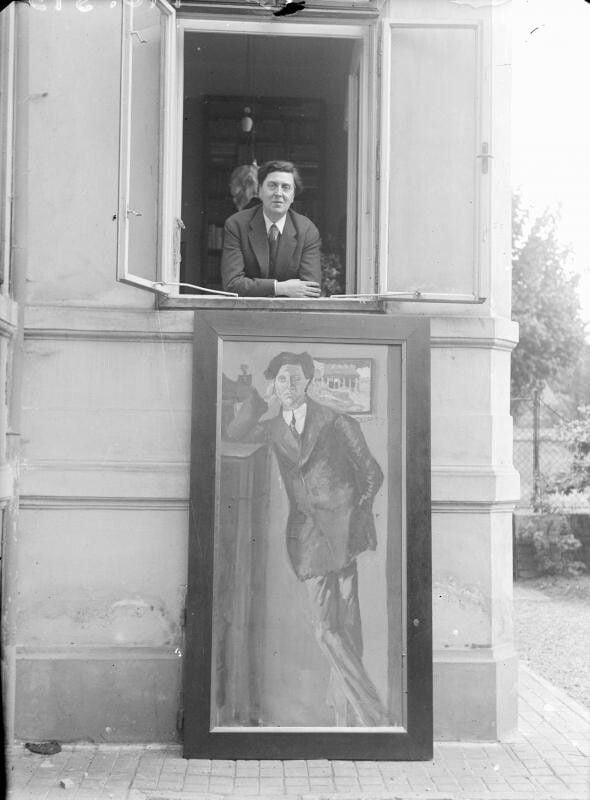
    PHOTO: Alban Berg, captured on canvas, if not in spirit, by Arnold Schoenberg

  • Lulu Act I Interrupted Building Crash

    Lulu Act I Interrupted Building Crash

    I got through Act I of Alban Berg’s “Lulu”…

    And then a tree fell on my building!

  • Met Opera Free Streams This Week

    Met Opera Free Streams This Week

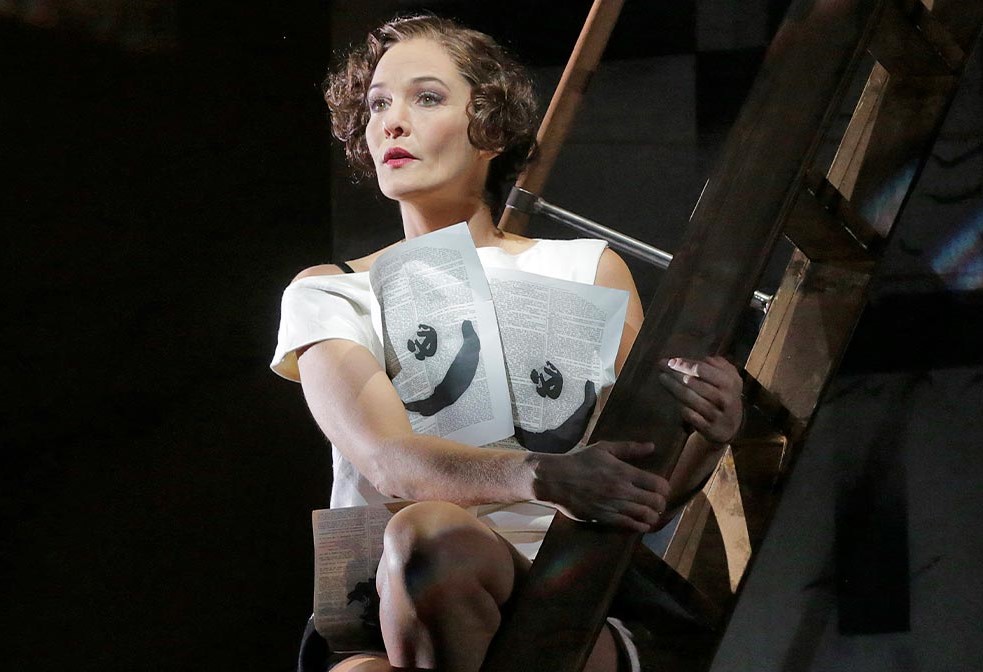
    Among this week’s Metropolitan Opera “Live in HD” encores is a real Lulu. No, I mean it. Alban Berg’s “Lulu” will be available, starting on Tuesday night.

    The Met continues to make good on its pledge to stream free opera for the duration of the shutdown. Each opera is accessible for approximately 23 hours, starting every day around 7:30 p.m. EDT. Stream now at metopera.org.

    Here’s a complete schedule of this week’s offerings. You’ll find teasers and bonus materials when following the link:

    https://www.metopera.org/user-information/nightly-met-opera-streams/week-12/

    Monday, June 1
    Bellini’s I Puritani
    Starring Anna Netrebko, Eric Cutler, Franco Vassallo, and John Relyea, conducted by Patrick Summers. From January 6, 2007.

    Tuesday, June 2
    Berg’s Lulu
    Starring Marlis Petersen, Susan Graham, Daniel Brenna, Paul Groves, Johan Reuter, and Franz Grundheber, conducted by Lothar Koenigs. From November 21, 2015.

    Wednesday, June 3
    Gluck’s Orfeo ed Euridice
    Starring Danielle de Niese, Heidi Grant Murphy, and Stephanie Blythe, conducted by James Levine. From January 24, 2009.

    Thursday, June 4
    Puccini’s Tosca
    Starring Shirley Verrett, Luciano Pavarotti, and Cornell MacNeil, conducted by James Conlon. From December 19, 1978.

    Friday, June 5
    Thomas Adès’s The Exterminating Angel
    Starring Audrey Luna, Amanda Echalaz, Sally Matthews, Sophie Bevan, Alice Coote, Christine Rice, Iestyn Davies, Joseph Kaiser, Frédéric Antoun, David Portillo, David Adam Moore, Rod Gilfry, Kevin Burdette, Christian Van Horn, and John Tomlinson, conducted by Thomas Adès. From November 18, 2017.

    Saturday, June 6
    Verdi’s Otello
    Starring Sonya Yoncheva, Aleksandrs Antonenko, and Željko Lučić, conducted by Yannick Nézet-Séguin. From October 17, 2015.

    Sunday, June 7
    Massenet’s Thaïs
    Starring Renée Fleming, Michael Schade, and Thomas Hampson, conducted by Jesús López-Cobos. From December 20, 2008.

Tag Cloud

Aaron Copland (92) Beethoven (94) Composer (114) Film Music (117) Film Score (143) Film Scores (255) Halloween (94) John Williams (185) KWAX (228) Leonard Bernstein (99) Marlboro Music Festival (125) Movie Music (132) Opera (197) Philadelphia Orchestra (86) Picture Perfect (174) Princeton Symphony Orchestra (106) Radio (86) Ralph Vaughan Williams (85) Ross Amico (244) Roy's Tie-Dye Sci-Fi Corner (290) The Classical Network (101) The Lost Chord (268) Vaughan Williams (101) WPRB (396) WWFM (881)

DON’T MISS A BEAT

Receive a weekly digest every Sunday at noon by signing up here


RECENT POSTS