
Going through Marlboro withdrawal? “Music from Marlboro” may be on hiatus at WWFM – The Classical Network, but while we wait out the Coronavirus, there’s plenty in the larder to indulge your appetite for great chamber music performances at the website of the Marlboro Music School and Festival.
Tag: Marlboro Music School and Festival
-
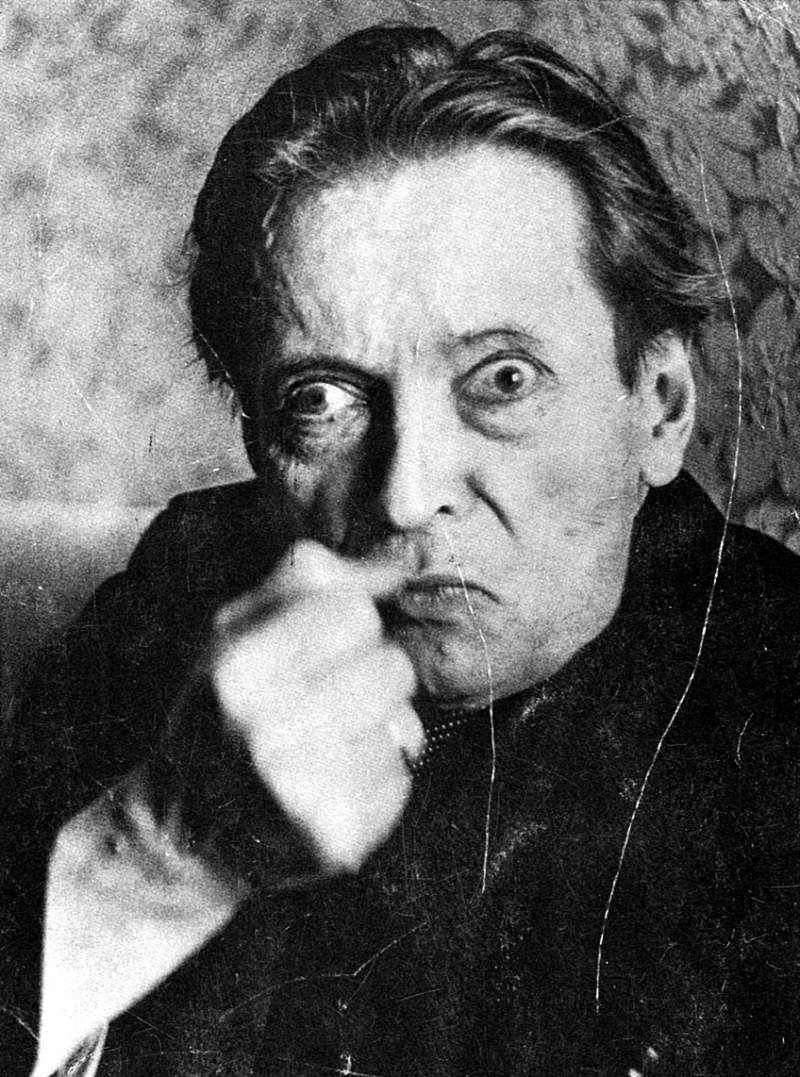
Enescu’s Delightful “Dixtuor” at Marlboro
George… GEORGE! Do you want your face to stay that way?
If George Enescu is itching for a fight, it’s nowhere in evidence in his delightful “Dixtuor.” The work – scored for ten wind instruments, as its title suggests – can be heard on this evening’s “Music from Marlboro” broadcast.
We’ll enjoy a 1978 performance by a “who’s who” of fabulous Marlboro wind players, including flutists Carol Wincenc and Julia Bogorad, oboist Rudolph Vrbsky, English hornist Gerard Reuter, clarinetists David Krakauer and Yehuda Hanani, bassoonists Kim Walker and Alexander Heller, and French hornists David Jolley and Meir Rimon, all under the direction of Marlboro co-founder Marcel Moyse.
Perhaps Enescu is miffed that Marlboro musicians have elected to play Béla Bartók’s String Quartet No. 4 as the centerpiece of their upcoming tour. The first of this year’s Marlboro tours will take place from November 11 to November 18, with stops within our listening area – in New York City, at Weill Recital Hall in Carnegie Hall, on November 12, and in Philadelphia, at the American Philosophical Society, on November 14, presented by the Philadelphia Chamber Music Society. The tour will also feature two works by Antonín Dvořák: his Piano Trio in F minor, Op. 65, and the Miniatures, Op. 75a. Learn more and find a complete schedule at marlboromusic.org.
Tonight’s broadcast will open with a 2016 performance of Bartók’s quartet, played by violinists Robyn Bollinger and Soovin Kim, violist Hwayoon Lee, and cellist Tony Rymer.
It’s understandable that Enescu might be a little jealous. The quartet, composed in Budapest in 1928, when Bartók was in his mid-40s and at the height of his mastery, displays a striking, five movement, “arched” structure, and is full of unusual sonorities – rhythmic sforzandi (notes played with strong, sudden emphasis), passages performed on muted strings, passages performed without vibrato (the rapid oscillation on a sustained tone used for added warmth and expressivity), glissandi (sliding from note to note), and snap pizzicati (plucked strings slapping back against the instruments’ fingerboards).
By contrast, Enescu’s “Dixtuor,” written in 1906, when the composer was in his mid-20s, is a much more relaxed-sounding work. However, its seemingly laid-back, almost rhapsodic disposition and seductive veneer disguise a carefully thought-out classical structure that makes it a kind of spiritual descendant of the 18th century divertimento. I think you’ll find it the perfect balm for the end of a long work day.
Who needs anger management, when you’ve got access to great music-making from the legendary Marlboro Music School and Festival? Music hath charms to soothe the savage breast, this Wednesday evening at 6:00 EST, on WWFM – The Classical Network and wwfm.org.
Marlboro School of Music and Festival: Official Page
-

Jonathan Biss to Lead Marlboro Music
In foreign lands, cries of “Bis!” at the end of a concert signify an audience’s desire to hear more. It is a happy coincidence, then, that at the Marlboro Music School and Festival, Biss happens to be the surname of its incoming co-artistic director.
Earlier this week, it was announced that the pianist Jonathan Biss will join Mitsuko Uchida as co-director of the celebrated chamber music retreat, which is situated in Vermont’s Green Mountains. Uchida has served in a leadership capacity at Marlboro for over 20 years. For the past five of these, she has been the festival’s sole artistic director. Prior to that, she was assisted in the festival’s direction by Richard Goode (1994-2013) and Andras Schiff (1994-1999).
Biss first attended the Marlboro Music Festival in 1997. He was invited to return as a senior artist in 2006 – in classic Marlboro fashion, giving back to new generations of young musicians the kind of mentorship and comradery he himself experienced there.
Biss, who is on the faculty of the Curtis Institute of Music in Philadelphia, is acclaimed not only as a performer and recording artist, but also as a teacher and a writer, wholly comfortable exploring unique opportunities of the digital age, offering online lectures and publishing a bestselling eBook, “Beethoven’s Shadow.”
We’ll celebrate Biss’ appointment on this week’s “Music from Marlboro,” with a performance of Franz Schubert’s Piano Trio No. 1 in B-flat major, D. 898. Biss will be joined by violinist David Bowlin and cellist Marcy Rosen, from the 2008 Marlboro Music Festival.
Then we’ll hear Marlboro legends, soprano Benita Valente, clarinetist Harold Wright, and pianist Rudolf Serkin, in Schubert’s “The Shepherd on the Rock.” The three set down a classic recording of the work in 1960; we’ll hear a live performance, captured at Marlboro nine years later.
The Marlboro Music School and Festival was co-founded in 1951 by Serkin, Adolf Busch, and Marcel Moyse. Serkin served as Marlboro’s first artistic director until his death in 1991.
Today happens to be the anniversary of Busch’s birth. Tune in this afternoon, between 4 and 6 p.m., prior to today’s “Music from Marlboro” broadcast, for a little bonus, in the form of one of Busch’s own compositions.
“Music from Marlboro” begins at 6:00 EDT, on WWFM – The Classical Network and wwfm.org.
Marlboro School of Music and Festival: Official Page
PHOTO: Uchida (left), with Marlboro’s incoming co-artistic director
-
Vera’s Story Holocaust Remembrance on WWFM
Have you heard Vera’s story?
Vera Herman Goodkin was just shy of her 9th birthday when her hometown of Uzhorod, Czechoslovakia, was occupied by the Nazis. She spent the next four years in hiding, until she was finally rescued and taken to freedom under the protection of Swedish diplomat Raoul Wallenberg. “Vera’s Story: A Holocaust Remembrance” will be rebroadcast on WWFM The Classical Network today at 11 a.m. This riveting and award-winning program also includes music by composers who fled Europe or perished during the War, as well as works written in memory of the millions of victims of the Holocaust.
Later, between 4 and 6 p.m., we’ll hear music by Gideon Klein and Pavel Haas, who lost their lives at Fürstengrube and Auschwitz, respectively, alongside performances by Holocaust survivors, including cellist Janos Starker, conductor Karel Ančerl, pianist Edith Kraus, harpsichordist Zuzana Růžičková, and violinist Henry Meyer, a founding member of the LaSalle Quartet. Růžičková died in September at the age of 90, and Kraus lived to be 100. Also featured will be Eric Zeisl’s uplifting “Requiem Ebraico,” written in memory of his father, and some of John Williams’ music for “Schindler’s List.”
Then, at 6 p.m., it’s another “Music from Marlboro.” The hour will begin with a Divertissement for Oboe, Clarinet and Bassoon, by Erwin Schulhoff, a composer who was intercepted by the Nazis while in the process of fleeing Czechoslovakia for the Soviet Union. He died of tuberculosis in a concentration camp in Bavaria.
The program will conclude on a happier note, with Rudolf Serkin and friends performing Antonin Dvořák’s Piano Quartet No. 1 in D major. Serkin had lived with violinist Adolf Busch and his family in Berlin in the 1920s, as he established himself as one of Europe’s outstanding young pianists. The musicians remained in Germany until 1933. Busch, who was not Jewish, vehemently opposed the National Socialists. With the rise of Adolf Hitler, Serkin and the Busches relocated to Switzerland. They arrived in the United States with the outbreak of war in 1938, and settled in Vermont in the 1940s. There, alongside flutist Marcel Moyse, they founded the Marlboro Music School and Festival in 1951, having successfully eluded the horrors that had claimed so many others to create something of lasting beauty – a chamber music retreat in what must have seemed like a bucolic paradise.
The music continues to enrich. Tune in for “Vera’s Story,” on this Yom HaShoah eve – Holocaust Memorial Day begins at sunset – at 11 a.m. EDT, and then listen for more music of remembrance, from 4 to 7 p.m., on WWFM – The Classical Network and wwfm.org.
Marlboro School of Music and Festival: Official Page
-
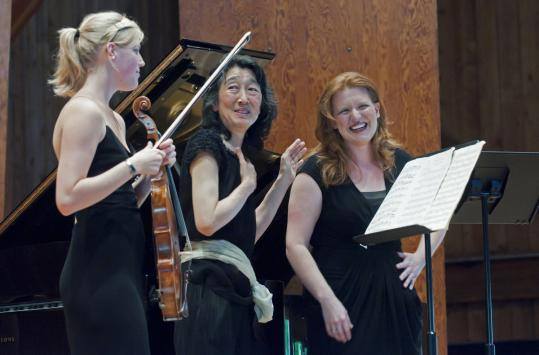
Mitsuko Uchida Birthday Broadcast
Happy birthday, Mitsuko Uchida!
In addition to being one the world’s most celebrated pianists, Uchida has served as artistic director of the Marlboro Music School and Festival since 2013. We’ll honor her on this week’s broadcast of “Music from Marlboro” with two of her performances, documented in live recordings from the festival she manages.
The highlight of the hour will be Beethoven’s Piano Trio in B-flat, Op. 97, popularly known as the “Archduke.” Nicknamed for Beethoven’s patron and pupil, Archduke Rudolph of Austria, the trio is one of fourteen works Beethoven dedicated to Rudolph, who was the youngest child of Emperor Leopold II of Austria. We’ll hear a 2006 performance. Uchida will be joined by Soovin Kim, violin, and the venerable David Soyer, cello.
The hour will begin with music by Johannes Brahms. We’ll hear his “Zwei Gesänge” (Two Songs) for voice, viola and piano, Op. 91. The text of the first, “Gestillte Sehnsucht” (Longing at Rest), composed in 1884, is by Friedrich Rückert. That of the second, “Geistliches Wiegenlied” (Sacred Lullaby), composed in 1863, is by Emanuel Geibel, who in turn was inspired by Lope de Vega. The songs were published as a set in 1884.
The first, touched by nature and yearning, begins “Immersed in golden evening glow, how solemnly the woods stand!” Imagery of wind and birds whispering the world to slumber gradually metamorphose into a desire for wishes and longing to be hushed to slumber, as well. The song ends there, though in the original Rückert continues his poem for another stanza, acknowledging that these desires will only be silenced by death. So German…
The second song (written first) was composed for Brahms’ friend, the violinist Joseph Joachim, and Joachim’s wife, Amalie. It was intended as a wedding present, but resubmitted a year later on the baptism of the couple’s son (named after Johannes). Joseph also played the viola, and Amalie was a contralto. The work is a cradle song sung by Mary, mother of Jesus, who addresses the holy angels, requesting that they silence the rustling palms because her Child is sleeping. The viola quotes the Christmas melody “Joseph, lieber Joseph mein,” a sly reference on the part of Brahms, who incorporates the carol’s text, in order to include Joachim’s given name.
The performance, from 2011, again features Mitsuko Uchida at the keyboard, with mezzo-soprano Jennifer Johnson Cano and violist Hélène Clément.
That’s a cradle song for Baby Jesus by Johannes Brahms and music composed for Rudolph by Beethoven, on this week’s “Music from Marlboro,” this Wednesday evening at 6:00 EST, on WWFM – The Classical Network and wwfm.org.
Marlboro School of Music and Festival: Official Page
PHOTO: Hélène Clément, Mitsuko Uchida, and Jennifer Johnson Cano
Tag Cloud
Aaron Copland (92) Beethoven (94) Composer (114) Film Music (117) Film Score (143) Film Scores (255) Halloween (94) John Williams (185) KWAX (228) Leonard Bernstein (99) Marlboro Music Festival (125) Movie Music (132) Opera (197) Philadelphia Orchestra (86) Picture Perfect (174) Princeton Symphony Orchestra (106) Radio (86) Ralph Vaughan Williams (85) Ross Amico (244) Roy's Tie-Dye Sci-Fi Corner (290) The Classical Network (101) The Lost Chord (268) Vaughan Williams (101) WPRB (396) WWFM (881)