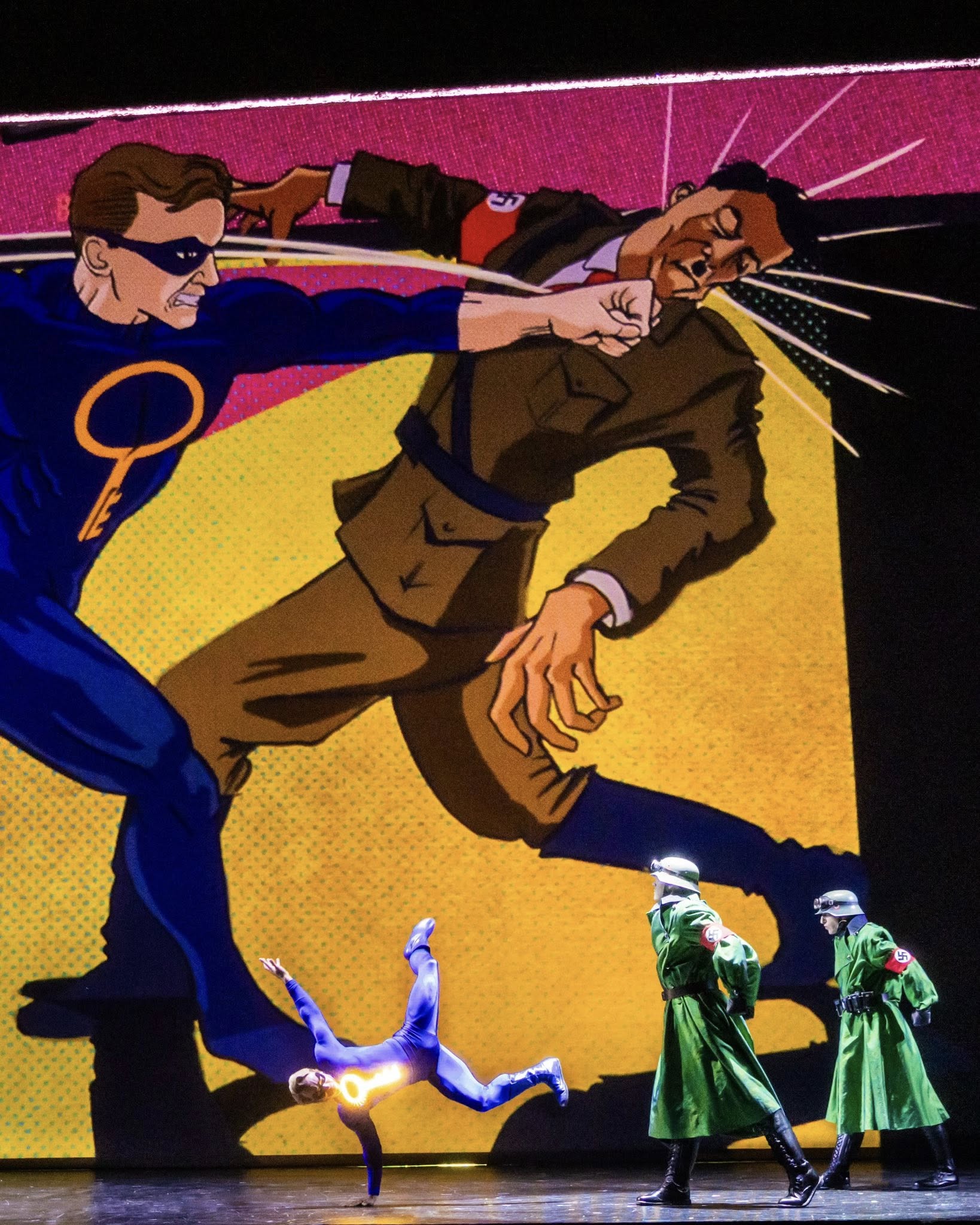
“The Amazing Adventures of Kavalier & Clay” is the first opera I’ve seen that plays more like a movie. A triumph of production design, in some respects it realizes the Wagnerian ideal of Gesamkuntswerk, the synthesis of disparate elements into a “total work of art,” here employing technology of a sort Wagner couldn’t possibly have imagined. That’s not to say Mason Bates’ music is anywhere near the same exalted level, which probably, in this case, is not such a bad thing. As a piece of pop art, “Kavalier & Clay” works. Mostly.
The inspiring story of two Jewish cousins – one a Brooklyn native, the other a refugee from Nazi-occupied Czechoslovakia – who channel their hopes, heartbreaks, and thirst for justice into the creation one of the comic’s bestselling superheroes – is back at New York’s Metropolitan Opera with all its whiz-bang dazzle. I caught it earlier in the season, in the fall, but The Met had a special on tickets around the holidays, so I’m going to see it again with a friend next month. The production will run through February 21.
Can’t make it to New York? You’ll have a chance to experience it at select movie theaters this Saturday, January 24, and next Wednesday, January 28, as part of “The Met: Live in HD” series, presented through Fathom Entertainment. (Look for the link below.)
As a fan of Michael Chabon’s Pulitzer Prize winning novel, I knew going in that concessions would have to be made. Even at its most surfacy, Chabon’s book (which I read for a second time to prep for the opera) is simply too grand – even with the Met’s stagecraft being as wondrously vertiginous as it is – and too epic to be conveyed even on the boards of the world’s largest opera palace. It also happens to be beautifully and characterfully written. There is only so much of that (the story is told from a third person omniscient perspective) that is going to survive translation to the theater.
In the end, this panegyric to the power of comic books and the role of popular culture in the American Dream at an especially dynamic time in this nation’s history – while simultaneously exploring comics as an outlet through which the artists grapple with their personal demons and grasp for redemption – can never hope to serve as more than “Classics Illustrated.” So definitely read the book.
But the opera recreates a great escape from the bottom of the Moldau, a superhero, called The Escapist, punching out Nazis in the best Jack Kirby tradition, Salvador Dali in a diving suit, a thunderstorm over the observation deck of the Empire State Building, and a final act, with the stage in its full, mechanized glory, that departs significantly from the action of the book, but contains a touch of poetry and grace courtesy of another one of the cousin’s heroic creations. I do miss the business with the Golem, the World’s Fair, the entire Antarctica segment, the cameo by Orson Welles, and the recurring allusions to Polish composer Karol Szymanowski. Only Chabon could have written it. (Gene Scheer is the opera’s librettist.)
Opera as a genre rises and falls on its writing for voice, at its most powerful, arousing overwhelming emotions. At its most magnificent, there really is nothing else like it. From a purely musical standpoint, “Kavalier & Clay” never achieves that level of irrational grandeur, but as I indicated at the start, this may be the rare instance in which that’s okay. It would have been nice had it cracked the extraordinary, but the music does actually serve as but one component, and an equal one, in the three-hour entertainment. It’s almost like underscore, breezy in the New York street scenes and rhythmically driving in flights from the Nazis. There’s a spiritual kinship to film music. The emotional moments are lower-voltage than I would have liked – pretty, but hardly indelible – and the hard-driving action scenes and scenery changes sound like John Williams with a bit of a John Adams gloss.
Manhattan street and office scenes sport “jazz” inflections of a Gershwinesque variety, there’s a bawdy dance party that bristles with Bernstein, and at times in the European scenes, you could make out the inclusion of a mandolin – not necessarily the first instrument I associate with either Czechoslovakia or Jewry, but it is an instrument with a long folk tradition that reaches across the continent. I concede, this particular observation could simply reveal a blind spot in my own education.
Bates’ much-vaunted electronic additions (he experiments with electronica and even DJs on the side) really don’t add up to very much. That element of the score barely registers in the opera’s first act. In the second, it could just as easily not have been there. It’s just another element of seasoning.
The work’s real energy comes in its frequent, dizzying set changes and eyepopping set pieces, propelled by technical/technological wizardry. A great escape at the opera’s start prepares the audience for the synthesis of opera, movie, and even comic book, to come. There are entire montages that conjure the layout and dynamism of a comic’s page.
It’s insane to even consider that “The Amazing Adventures of Kavalier & Clay” could be made into an opera, and I’m not sure that it actually succeeds as one. But I am unshakeable in my conviction that it is a hell of a good show.
See it at the Met, February 17-21
https://www.metopera.org/season/2025-26-season/the-amazing-adventures-of-kavalier–clay/
Or at the movies, January 24 & 28
https://www.fathomentertainment.com/releases/the-metropolitan-opera-the-amazing-adventures-of-kavalier-clay/
