With Ridley Scott’s “Napoleon” in theaters – and tanking with the critics – it might be a good time to revisit Hector Berlioz’s “Te Deum.” The “Te Deum,” literally “To God,” was originally conceived as the climax of a grand symphony in celebration of Napoleon Bonaparte. The first performance took place on April 30, 1855, at the Church of Saint-Eustache in Paris, with the composer conducting, in true Berlioz fashion, an ensemble of 900-950 performers.
As the real-life Napoleon had also tanked with critics, Berlioz dedicated his “Te Deum” to Prince Albert, husband of Queen Victoria. What an ambitious concert it would make if revived on the same program with Beethoven’s “Eroica” Symphony, undertaken in a wave of euphoria at a time when Bonaparte was perceived as a democratic reformer. In Beethoven’s case, his disillusionment is reflected in the violence with which he scratched out the original dedication on his score, offering it instead “to celebrate the memory of a great man.”
Some of the material employed in the creation of Berlioz’s “Te Deum” was originally conceived for his “Messe solennelle” of 1824. The Mass was commissioned by Paris’ Church of Saint-Roch to mark the Feast of the Slaughter of the Holy Innocents by King Herod in his attempt to the snare the baby Jesus.
Berlioz was only 22 years-old at the time, but already driven by his creative demons. If you are a fan of the composer, you must hear this piece, which teems with presentiments of many of his major works, including the “Symphonie fantastique,” “The Damnation of Faust,” “Benvenuto Cellini” (with its “Roman Carnival Overture”), and of course the Requiem.
Berlioz himself played the tam-tam at the Mass’ premiere, and in his excitement gave it such a blow that it blew everyone back in their pews. The “Messe” was favorably received (unusual for this composer), but Berlioz decided he hated the piece and wound up burning the score.
The work was believed lost for nearly 170 years, until it was rediscovered by a Belgian schoolteacher in an organ gallery in Antwerp in 1991. Sir John Eliot Gardiner conducted the first modern performance two years later.
Gardiner is on self-imposed sabbatical after punching a bass (singer) after a performance of Berlioz’s “The Trojans” in August. He’s expected to return to the podium next year.
Berlioz too was recognized for his unbridled passion. At one time, he planned to murder his inconstant fiancée, her mother, and the fiancée’s new beau (in drag, no less), then take his own life. Thankfully, he cooled his jets when he realized he forgot his disguise. At any rate, Berlioz and Gardiner seem to be made for each other.
Berlioz’s oratorio “L’enfance du Christ,” mostly composed in 1853-54, returns to the topic of the Slaughter of the Innocents. The work is much better known, as it is frequently encountered during the Christmas season.
Berlioz knew a thing or two about tanking with the critics. But unlike Ridley Scott, most of his works get better with age.
Happy birthday, Hector Berlioz!
“Te Deum”
Gardiner conducts the “Messe solennelle”
“L’enfance du Christ”
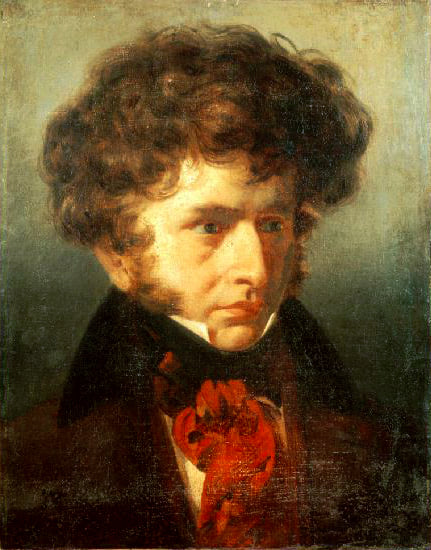
Berlioz in 1832. Believe or not, I once had hair like that.