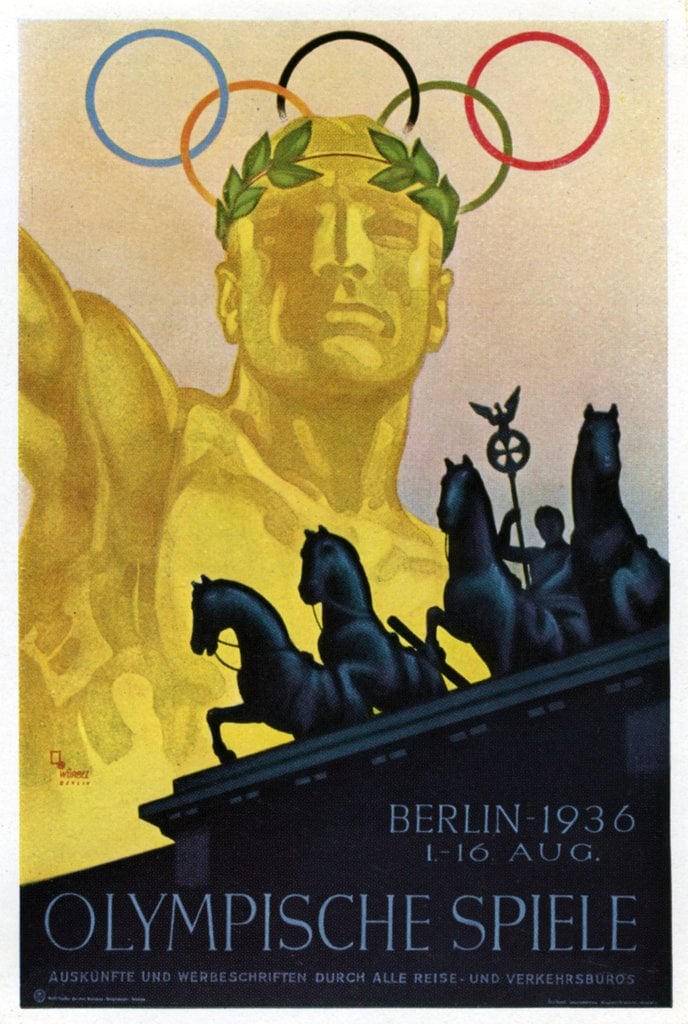
When Richard Strauss wrote and conducted his “Olympic Hymn” for the 1936 Berlin Games, his seeming willingness to act as a puppet for the Third Reich earned him international criticism. But Strauss was no Nazi.
In 1933, Strauss was named president of the newly instituted Reichsmusikkammer. He was not consulted on the appointment and accepted it as what he saw as a preventative measure, hoping to head-off reorganization of German musical life by “amateurs and ignorant place-seekers.”
Professionally, he did what he could to preserve musical culture, extending copyrights, conducting works by banned composers (like Mendelssohn and Mahler), and continuing to collaborate with Jewish artists (like Stefan Zweig). In fact, he became such a thorn in the side to the Nazi regime that Goebbels wrote in his diary, “Unfortunately we still need him, but one day we shall have our own music and then we shall have no further need of this decadent neurotic.” For his part, Strauss referred to Goebbels as a “pipsqueak.”
Unfortunately, the composer’s subversive correspondence was intercepted by the Gestapo and forwarded to Hitler himself. Strauss was quietly demoted (on the grounds of “ill health”), dismissed from his position in the Reichsmusikkammer, and trotted out thereafter only for propaganda purposes, most notably at the 1936 Games. His music was appropriated by filmmaker Leni Reifenstahl for her paean to German athletic prowess, “Olympia.”
Part of Strauss’ motivation in playing along was to protect those closest to him, including his daughter-in-law, Alice Grab Strauss (née von Hermannswörth), and his grandchildren, all Jewish. Late in the war, Alice was arrested, and Strauss was barely able to secure her release. Thereafter, everyone was kept under house arrest. Strauss could do nothing to save to her relations. 32 members of Alice’s family died in concentration camps.
Strauss never joined the Nazi Party and refused to give the Nazi salute. He may have been naïve to think he could do anything to stem the regime’s calamitous torrent, but he wasn’t stupid. With the rise of Hitler, he believed, or rather hoped, that he could keep his head down and quietly accomplish what good he was able until the storm had passed.
In 1948, at the age of 84, he was cleared of any wrongdoing by a denazification tribunal. Still, for many, a pall hung over his reputation. The demonstratively anti-fascist Toscanini, who resigned his position as director of the Bayreuth Festival in 1933 (to be replaced by Strauss), is said to have told Strauss to his face, “For Strauss the composer, I take my hat off. For the Strauss the man, I put it on again.”
It was in the final months of World War II that Strauss composed his “Metamorphosen,” a lament for strings spanning nearly half an hour. In the work, he ruminates on the funeral march from Beethoven’s “Eroica” Symphony. At the bottom of the score is inscribed “In Memoriam.”
Though Strauss never commented on the inspiration for the piece, it’s generally been interpreted as an elegy for German civilization, as symbolized by the opera house in Munich, city of his birth, laid waste by bombs. Strauss had a deep personal connection to the theater. He had attended performances there since boyhood and enjoyed many successful productions of his own works. His father played first horn in the orchestra for 39 years. Further, the destruction of the Vienna State Opera took place on the very eve of Strauss putting pen to paper.
It may have been Allied bombs that brought physical devastation to the structures of Munich and Vienna, but Strauss harbored no illusions as to what was truly responsible for the ruination of all he loved.
The composer confided in his diary, “The most terrible period in human history is at an end, the twelve year reign of bestiality, ignorance and anti-culture under the greatest criminals, during which Germany’s 2,000 years of cultural evolution met its doom.”
Strauss’ “Olympic Hymn”
“Metamorphosen”