Tag: Michael Chabon

  • The Return of “Kavalier & Clay” – to the Met and at the Movies

    The Return of “Kavalier & Clay” – to the Met and at the Movies

    “The Amazing Adventures of Kavalier & Clay” is the first opera I’ve seen that plays more like a movie. A triumph of production design, in some respects it realizes the Wagnerian ideal of Gesamkuntswerk, the synthesis of disparate elements into a “total work of art,” here employing technology of a sort Wagner couldn’t possibly have imagined. That’s not to say Mason Bates’ music is anywhere near the same exalted level, which probably, in this case, is not such a bad thing. As a piece of pop art, “Kavalier & Clay” works. Mostly.

    The inspiring story of two Jewish cousins – one a Brooklyn native, the other a refugee from Nazi-occupied Czechoslovakia – who channel their hopes, heartbreaks, and thirst for justice into the creation one of the comic’s bestselling superheroes – is back at New York’s Metropolitan Opera with all its whiz-bang dazzle. I caught it earlier in the season, in the fall, but The Met had a special on tickets around the holidays, so I’m going to see it again with a friend next month. The production will run through February 21.

    Can’t make it to New York? You’ll have a chance to experience it at select movie theaters this Saturday, January 24, and next Wednesday, January 28, as part of “The Met: Live in HD” series, presented through Fathom Entertainment. (Look for the link below.)

    As a fan of Michael Chabon’s Pulitzer Prize winning novel, I knew going in that concessions would have to be made. Even at its most surfacy, Chabon’s book (which I read for a second time to prep for the opera) is simply too grand – even with the Met’s stagecraft being as wondrously vertiginous as it is – and too epic to be conveyed even on the boards of the world’s largest opera palace. It also happens to be beautifully and characterfully written. There is only so much of that (the story is told from a third person omniscient perspective) that is going to survive translation to the theater.

    In the end, this panegyric to the power of comic books and the role of popular culture in the American Dream at an especially dynamic time in this nation’s history – while simultaneously exploring comics as an outlet through which the artists grapple with their personal demons and grasp for redemption – can never hope to serve as more than “Classics Illustrated.” So definitely read the book.

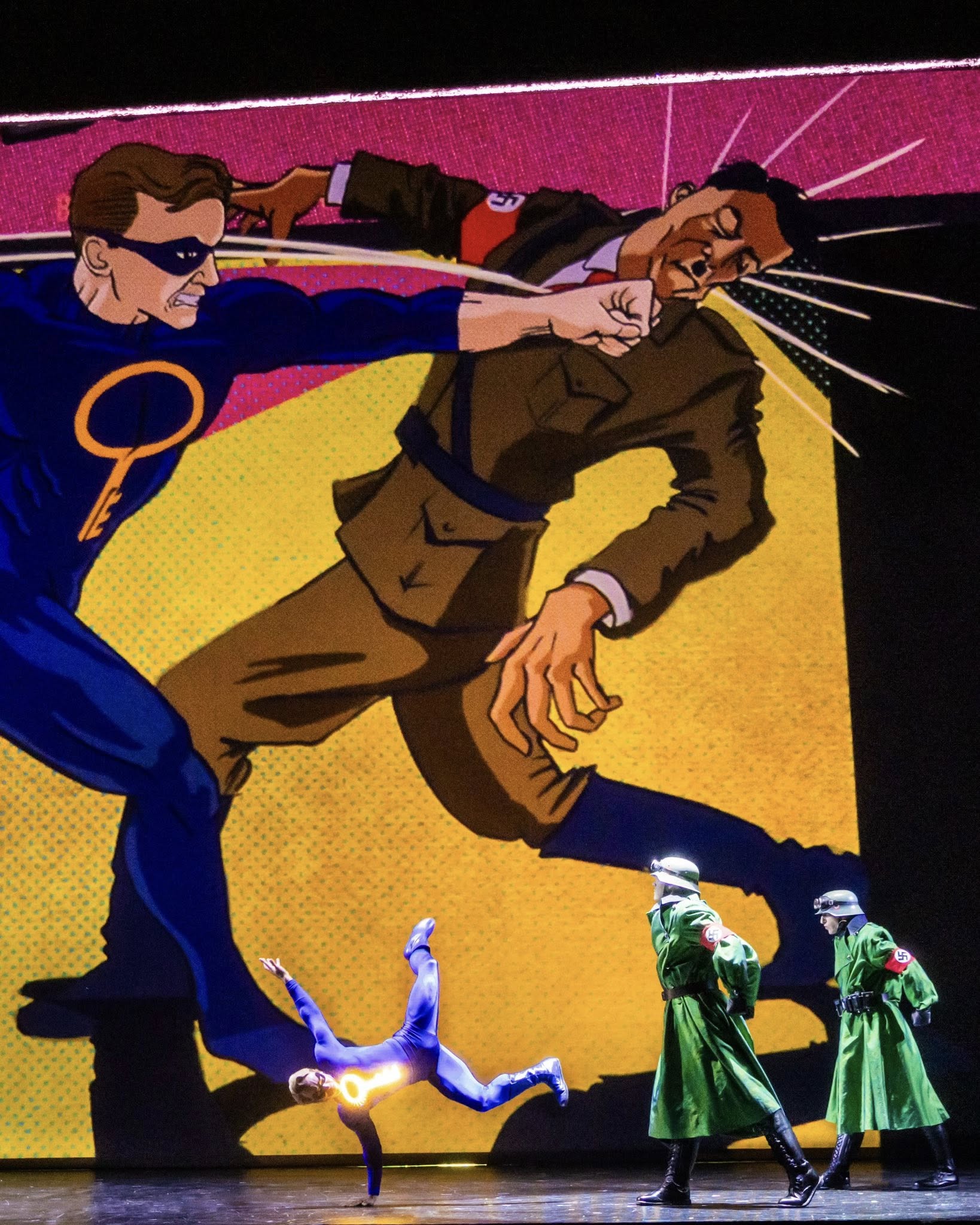
    But the opera recreates a great escape from the bottom of the Moldau, a superhero, called The Escapist, punching out Nazis in the best Jack Kirby tradition, Salvador Dali in a diving suit, a thunderstorm over the observation deck of the Empire State Building, and a final act, with the stage in its full, mechanized glory, that departs significantly from the action of the book, but contains a touch of poetry and grace courtesy of another one of the cousin’s heroic creations. I do miss the business with the Golem, the World’s Fair, the entire Antarctica segment, the cameo by Orson Welles, and the recurring allusions to Polish composer Karol Szymanowski. Only Chabon could have written it. (Gene Scheer is the opera’s librettist.)

    Opera as a genre rises and falls on its writing for voice, at its most powerful, arousing overwhelming emotions. At its most magnificent, there really is nothing else like it. From a purely musical standpoint, “Kavalier & Clay” never achieves that level of irrational grandeur, but as I indicated at the start, this may be the rare instance in which that’s okay. It would have been nice had it cracked the extraordinary, but the music does actually serve as but one component, and an equal one, in the three-hour entertainment. It’s almost like underscore, breezy in the New York street scenes and rhythmically driving in flights from the Nazis. There’s a spiritual kinship to film music. The emotional moments are lower-voltage than I would have liked – pretty, but hardly indelible – and the hard-driving action scenes and scenery changes sound like John Williams with a bit of a John Adams gloss.

    Manhattan street and office scenes sport “jazz” inflections of a Gershwinesque variety, there’s a bawdy dance party that bristles with Bernstein, and at times in the European scenes, you could make out the inclusion of a mandolin – not necessarily the first instrument I associate with either Czechoslovakia or Jewry, but it is an instrument with a long folk tradition that reaches across the continent. I concede, this particular observation could simply reveal a blind spot in my own education.

    Bates’ much-vaunted electronic additions (he experiments with electronica and even DJs on the side) really don’t add up to very much. That element of the score barely registers in the opera’s first act. In the second, it could just as easily not have been there. It’s just another element of seasoning.

    The work’s real energy comes in its frequent, dizzying set changes and eyepopping set pieces, propelled by technical/technological wizardry. A great escape at the opera’s start prepares the audience for the synthesis of opera, movie, and even comic book, to come. There are entire montages that conjure the layout and dynamism of a comic’s page.

    It’s insane to even consider that “The Amazing Adventures of Kavalier & Clay” could be made into an opera, and I’m not sure that it actually succeeds as one. But I am unshakeable in my conviction that it is a hell of a good show.

    See it at the Met, February 17-21

    https://www.metopera.org/season/2025-26-season/the-amazing-adventures-of-kavalier–clay/

    Or at the movies, January 24 & 28

    https://www.fathomentertainment.com/releases/the-metropolitan-opera-the-amazing-adventures-of-kavalier-clay/
  • Kavalier & Clay Opera: Chabon’s Szymanowski Secret

    Kavalier & Clay Opera: Chabon’s Szymanowski Secret

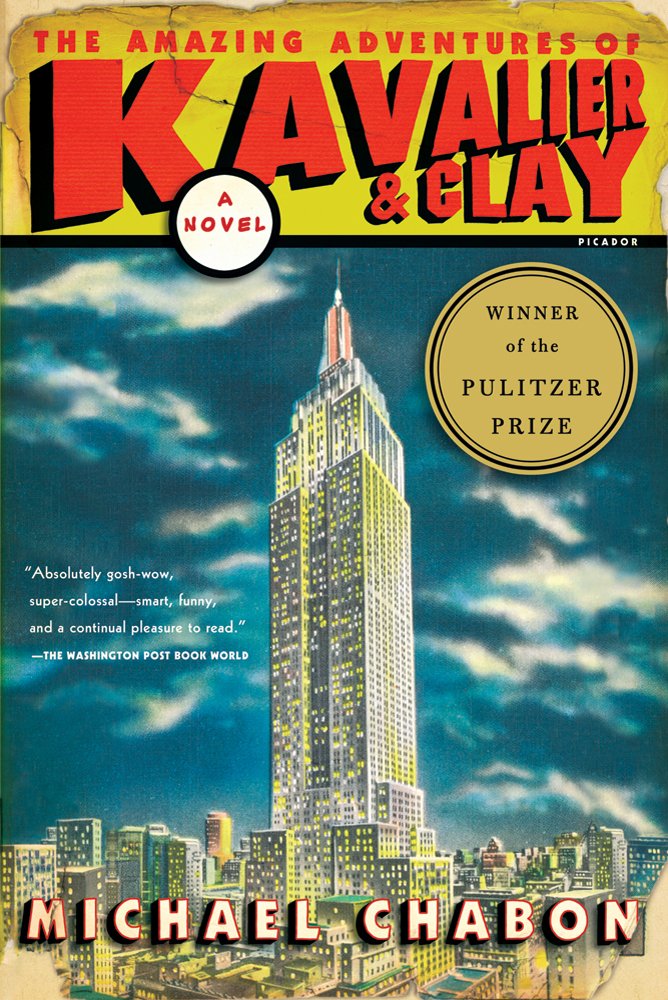
    I’ve been rereading “The Amazing Adventures of Kavalier & Klay” to refresh my memory, in advance of checking out Mason Bates’ new opera at the Met this week. A little while ago, I watched an unrelated interview with the book’s author, Pulitzer Prize winner Michael Chabon, who straddles the worlds of “serious” and pop cultural fiction (i.e. comic books, the pulps, genre pastiche) with the authority of a literary colossus. The interview was geared toward young readers, and one of the things he recommended was making an effort to read outside one’s comfort zone. By that, he means not only reading about subjects to which one wouldn’t ordinarily gravitate, but also getting to know different characters by writers who come from diverse backgrounds, as it can really expand one’s understanding and empathy for other perspectives. It’s clear that Chabon practices what he preaches, as it’s the only explanation for the richness of the world he creates and recalls in “Kavalier & Clay” (much of the book is set during the Great Depression and World War II) and the realistic characters who occupy it.

    For instance, I don’t know what kind of music Chabon enjoys, but clearly he’s an intellectual omnivore. His curiosity about the classics may not extend very deeply into opera (the premiere of “Kavalier & Klay” was the first time he ever set foot in the Met), but it drove him far enough beyond Bach and Beethoven to turn up no less than Karol Szymanowski. Szymanowski, one of Poland’s foremost composers, was born on this date (according to some sources) in 1882. Szymanowski is referenced multiple times throughout “Kavalier & Clay,” and I’m not entirely sure why. It could just be that the author enjoys his music, or perhaps he simply likes the sound of his name (Shim-an-OFF-ski). Or it could be that he is trying to demonstrate, as he lets drop several times throughout the narrative, that many of these characters who are caught up in the pulp, comic, and novelty business are actually very talented people, immigrants who perhaps abandoned their higher aspirations when they settled in the United States and determined to improve their lot. Which would explain why long-suffering publisher Sheldon Anapol is a member of the Szymanowski Society.

    Later in the book, Szymanowski is not mentioned by name when we are told that a portrait of the composer of “Songs of an Infatuated Muezzin” hangs on the wall behind his desk. Holy moly, Chabon! “Songs of an Infatuated Muezzin” isn’t even one of Szymanowski’s better-known works! I wonder if, thematically, the author might also have found the subject matter – a Muslim holy man who, in the execution of his sacred duty to call the faithful to prayer five times a day, finds himself increasingly distracted by erotic thoughts of his beloved – apposite to the situation of one of Chabon’s protagonists, Joe Kavalier, who succumbs to his guilt over the distraction from his primary mission, to get his family out of Nazi-occupied Czechoslovakia. In the meantime, he’s been engaged in a serious affair. Two affairs, actually – one with a free-spirited Greenwich Village bohemian and another, his artistic devotion to comic books – and the reader wonders which passion outstrips the other. In his way, he too is distracted from his sacred duty by a beguiling mistress.

    I don’t know that Chabon had this in mind, but the parallel is there. Or, as I say, it could be that he just likes the music.

    Looking forward to “Kavalier & Clay.” Also, happy birthday, Karol Szymanowski!


    “Songs of an Infatuated Muezzin”

    “The Amazing Adventures of Kavalier & Clay” at the Met

    https://www.metopera.org/season/2025-26-season/the-amazing-adventures-of-kavalier–clay/

    Szymanowski’s Violin Concerto No. 2, recorded by Henryk Szeryng

    Michael Chabon interview geared to young readers


    CLOCKWISE FROM LEFT: The novel, a still from the opera, and Karol Szymanowski

  • Kavalier & Clay Opera A Comic Book Masterpiece Revisited

    Kavalier & Clay Opera A Comic Book Masterpiece Revisited

    I’ve been revisiting Michael Chabon’s “The Amazing Adventures of Kavalier and Clay,” which I finally got around to reading for the first time only within the past decade. (The book won the Pulitzer Prize for Fiction in 2001.) I wanted it to be fresh in my mind when I see Mason Bates’ new opera at the Met next week. I’m a little over halfway through (I was hoping to knock it out before the first of October so that I can get on with my Halloween reading), and I’m loving it all over again.

    First of all, I sense in the author a kindred spirit, as he obviously adores all the pop cultural detritus that I myself have been lapping up since childhood. He also has an enviable grasp of the history and the social history of New York, a mindboggling eye for detail, and a real flair for crafting playful similes that makes Ray Bradbury seem positively drab by comparison.

    Of course, there’s a lot of comic book lore, both real and fabricated, as the dynamic duo of Joe Kavalier and Sammy Clayman, cousins, one European and one native, are brought together in a Brooklyn tenement to pool their talents in the creation of an unapologetically antifascist superhero, The Escapist. (Recall when Jack Kirby had the temerity to draw Captain America punching out Hitler a year before Pearl Harbor.) The team is also, I assume, inspired in part by Siegel and Shuster of “Superman” fame, both in terms of a crafting one of the first comic book superheroes and also getting screwed by their publishers.

    But the story is lent a whole other, higher-stakes dimension through Joe’s plight, his separation from his family in his own escape from Nazi-occupied Prague, and later his efforts to have his younger brother to join him in safety in the United States. Joe’s passage is lent a touch of magical realism in the inclusion of a genuine Golem (folkloric protector of the Jews). Quite the ponderous symbol! Golems and escapists and explorations of the true nature of heroism pervade the narrative. The backdrop of the war, the Holocaust, and the tragedy that propelled so many immigrants to the United States haunts the American dream at a time when the U.S. is about to emerge – thanks in no small part to the ingenuity and hard work of European refugees – as the mightiest and most vibrant force in the history of the world.

    Chabon shuffles a magic card deck, interleaving characteristics of the American Jewish experience and those of their displaced brethren with the worlds of classic comics, escape artists, magicians, strong men, surrealists, pulp writers, radio actors, Greenwich Village bohemians, the Empire State Building, the 1939 World’s Fair, “Citizen Kane,” and too many other subjects to catalogue. There’s even mention of a Karol Szymanowski Society (and Szymanowski’s “Songs of the Infatuated Muezzin”)!

    It’s the rare modern novel that I wish I had written. We’ll see what Mason Bates does with it. I’m happy to see that some of The Escapist’s exploits will be brought to life through choreography and projections. If nothing else, it will be a spectacle. But it will be the music, especially idiomatic, ingratiating writing for voice, that will determine whether or not the opera will have legs. I can’t for the life of me imagine how one can cram so much incident into an opera. I assume librettist Gene Scheer worked with the composer to pare down the novel to what they believe is its essence. I am amused to find Salvador Dali, at least, made the final cut.

    “The Amazing Adventures of Kavalier and Klay” runs at the Metropolitan Opera through October 11.

    https://www.metopera.org/season/2025-26-season/the-amazing-adventures-of-kavalier–clay/


    Photos taken during my recent trip to Lincoln Center to see Gustavo Dudamel conduct the New York Philharmonic, with the exception of the one of The Escapist cleaning Hitler’s clock, borrowed from the Met’s Facebook page

  • The Long Ships: A Sly and Wry, Rip-Roaring Viking Adventure

    The Long Ships: A Sly and Wry, Rip-Roaring Viking Adventure

    Since we don’t really seem to be having winter this year – a dusting of snow this morning aside – I thought I would generate some cold comfort of my own by reading Frans G. Bengtsson’s “The Long Ships.” And let me tell you, the book is the most fun I’ve read in a long while.

    If you’ve seen the 1964 movie, with Richard Widmark, Sidney Poitier, and Russ Tamblyn, I assure you it has very little to do with Bengtsson’s book. Almost nothing, in fact, beyond bringing Vikings into contact with Moorish culture, which happens fairly early in Bengtsson’s narrative. Orm’s adventures take him all over Spain, England, Ireland, Scandinavia, and Kievian Rus. Along the way, he and his men give thanks for their ship-luck, woman-luck, money-luck, fighting-luck, etc. Orm must be the luckiest hypochondriac in the Viking world. But he’s also one of the most rational and fair-minded.

    During the course of his adventures, he encounters temperamental chieftains, kings of all dispositions, spirited princesses, intriguing courtiers, Irish acrobats, a Friar Tuck-like priest and another whose irresistibility to women proves to be his undoing. There are oaths, outrages, abductions, bold heists, blood feuds, bawdiness, and much high-spirited derring-do. I imagine Orm’s rambunctious best friend, Toke, as looking and behaving much like Ernest Borgnine in the 1958 film “The Vikings.”

    But the tale is in the telling. It would take a lot of skill to capture the flavor of the book in a movie. Though certainly crammed with incident, it is Bengtsson’s sly and wry tone that really makes it, especially as the Vikings begin to assimilate Christianity. Much of the humor derives from the characters’ pragmatic, if at times morally-problematic view of the world. To Bengtsson’s credit, the characters behave like real people, as opposed to the stereotypes often put through the motions in this kind of action-packed narrative – even more impressive as the overall tone tends to echo the laconic spirit of the sagas.

    Treachery is to be expected in Orm’s world; what’s remarkable is how much goodness he encounters. His own evolution in outlook seems to mirror larger themes in the novel, as civilization begins to take its first tentative steps from a more impulsive era, marked by greed, lust, and revenge, to glimmers of a wiser, more ethical, humanist age.

    In some respects, Bengtsson’s Vikings behave in a more enlightened manner than some of the author’s own neighbors at the time of the novel’s writing, as we see in their dealings with the Sephardic Jew Solomon, who plays an important role in the Spanish segment of the book. There’s no mistaking the Vikings for feminists, though they do respect some of the female characters for their strength, resilience, and wisdom. Others, they fear for their wrath. There aren’t a lot of women among the main characters, but Orm’s love interest, Ylma, is well-realized. Also, after a warrior, the Vikings respect no one more than a poet. Who knew?

    The foreword to the paperback edition issued by New York Review Books is by Michael Chabon, who holds the distinction of not only being a Pulitzer Prize winner, for his outstanding novel “The Amazing Adventures of Kavalier and Klay,” but also a lifelong champion of pulps and comics. I do not pretend to be fluent in Swedish, but the translation by Michael Meyer is flavorful and flows wonderfully.

    Bengtsson lived from 1894 to 1954. He himself did quite a bit of translating, producing Swedish-language editions of “Paradise Lost,” “The Song of Roland,” and “Walden.” He was also a poet, an admirer of Chaucer, with a marked fondness for antiquated forms. In addition, he wrote a two-volume biography of Charles XII of Sweden. “The Long Ships,” published in Sweden in two parts (as “Red Orm at Home and on the Western Way,” in 1941, and “Red Orm at Home and on the Eastern Way, in 1945), is his only novel.

    Scrolling through the reader reviews I found online, on sites such as Amazon and Goodreads, I find that some did not find it as gripping or peculiarly charming as I did, though the vast majority of reviewers seem to love it. So the book is not for everyone, perhaps. There’s probably a better chance you’ll enjoy it if you’re not the kind of person who reads historical fiction expecting it to reflect 21st century values.

    The reviews I really don’t understand are from readers who describe it as “boring.” This is one rip-roaring yarn. Like Alexandre Dumas, only without the courtliness, and with lots and lots of Vikings.

    “The Long Ships” receives my enthusiastic endorsement. For 500 pages of picaresque Viking adventure, amusingly rendered, it’s a tough one to beat.

Tag Cloud

Aaron Copland (92) Beethoven (94) Composer (114) Film Music (116) Film Score (143) Film Scores (255) Halloween (94) John Williams (185) KWAX (228) Leonard Bernstein (99) Marlboro Music Festival (125) Movie Music (131) Opera (197) Philadelphia Orchestra (86) Picture Perfect (174) Princeton Symphony Orchestra (106) Radio (86) Ralph Vaughan Williams (85) Ross Amico (244) Roy's Tie-Dye Sci-Fi Corner (290) The Classical Network (101) The Lost Chord (268) Vaughan Williams (99) WPRB (396) WWFM (881)

DON’T MISS A BEAT

Receive a weekly digest every Sunday at noon by signing up here


RECENT POSTS