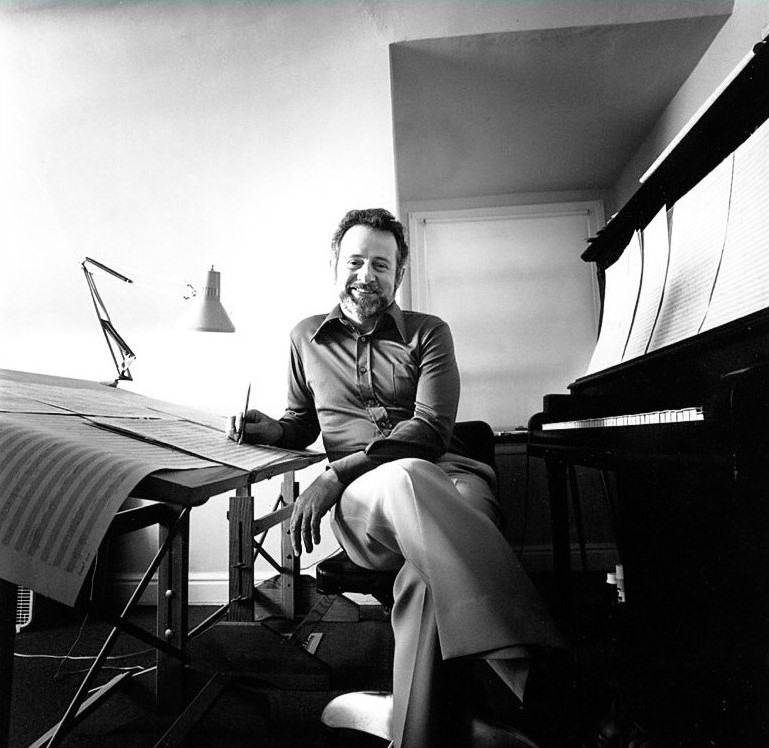
Trenton’s Bad Boy has a birthday!
Join me this afternoon on The Classical Network as we pile gifts at the feet of original Trenton cracker George Antheil (1900-1959), self-proclaimed “Bad Boy of Music.” Antheil’s “Ballet Mécanique,” scored for player pianos, airplane propellers, siren and electric bells, inspired one of classical music’s great riots at its Paris premiere in 1926.
Antheil would practice the piano with such ferocity that he would have to pause periodically to thrust his hands into two fish bowls filled with ice water. Before commencing a recital, he would ostentatiously remove a pistol from a silk holster in his jacket and place it atop the piano to send a message that he would brook no nonsense.
Later, he became a Hollywood film composer, a war correspondent, the author of a column of advice to the lovelorn, an expert in endocrinology, and co-inventor, with actress Hedy Lamarr, of a frequency-hopping system for the guidance of Allied torpedoes that would become the basis for modern spread-spectrum communications technology.
Wouldn’t you know it, it’s also the birthday today of another of music’s great eccentrics, Percy Aldridge Grainger (1882-1961).
Grainger, born outside Melbourne, Australia, was an outstanding pianist and an innovative composer. He also happened to be obsessed with physical fitness. Rather than drive or take the train between towns and engagements, he preferred to jog. He was also known to throw a ball over one side of a house, and then race around the other side to catch it.
Enamored of Nordic culture, he went out of his way to use only Anglo-Saxon words, avoiding in his letters anything of Norman or Latin origin. However, the dominance of German music rankled him, and he loved Duke Ellington.
He was unusually close to his mother and developed sadomasochistic tendencies. He donated whips and blood-stained clothes to the Grainger Museum, which he founded in 1932. (His request to have his skeleton displayed – posthumously, of course – was denied.)
Later, while living in White Plains, NY, he experimented with electronics and “machine music,” in a sense paralleling an obsession of Antheil, who besides “Ballet Mécanique,” wrote such works as “Airplane Sonata” and “Death of Machines.”
Sadly, only the smallest portion of Grainger’s output is known by the general public, and he is celebrated as the composer of such trifles as “Country Gardens,” “Molly on the Shore,” and “Shepherd’s Hey.” But Grainger’s treatment of harmony and rhythm could be highly original. He was a brilliant musician, and wholly unconventional in more ways than one.
Join me this afternoon for music by Antheil and Grainger. We’ll also remember Pulitzer Prize winner Michael Colgrass, who died on July 2 at the age of 87, with a selection from Boston Modern Orchestra Project (BMOP)’s new release “Michael Colgrass: Side by Side.” In addition, we’ll sample from the album “Gentle Winds” (issued on PARMA Recordings’ classical music imprint Navona Records), featuring music by Hopewell composer Samuel A. Livingston.
Livingston is a clarinetist in The Blawenburg Band. The rain is expected to move out of the Princeton area by this afternoon, which means the first of the band’s summer lawn chair concerts should take place as scheduled at Hopewell Train Station tonight at 7:30 p.m. Tomorrow, Livingston will perform with the Blawenburg Dixieland Band at Mary Jacobs Memorial Library in Rocky Hill, from 6:30 to 8:15 p.m.
I’ll be spinning the discs, rain or shine, today from 4 to 7 p.m. EDT, on WWFM – The Classical Network and wwfm.org.
Two peas in a pod: George Antheil, smoking, and Percy Grainger, smoking hot, in self-designed “toweling clothes”