At first, I was waiting for a slow news day – and one without a lot of major musical anniversaries – to share my elation, but then I kept finding myself cowed by the enormity of the undertaking. But if I’m going to do it, and it’s going to be relevant, I had better get on with it already. As the proverb says, a journey of a thousand miles begins with but a single step. So here goes!
sharp intake of breath
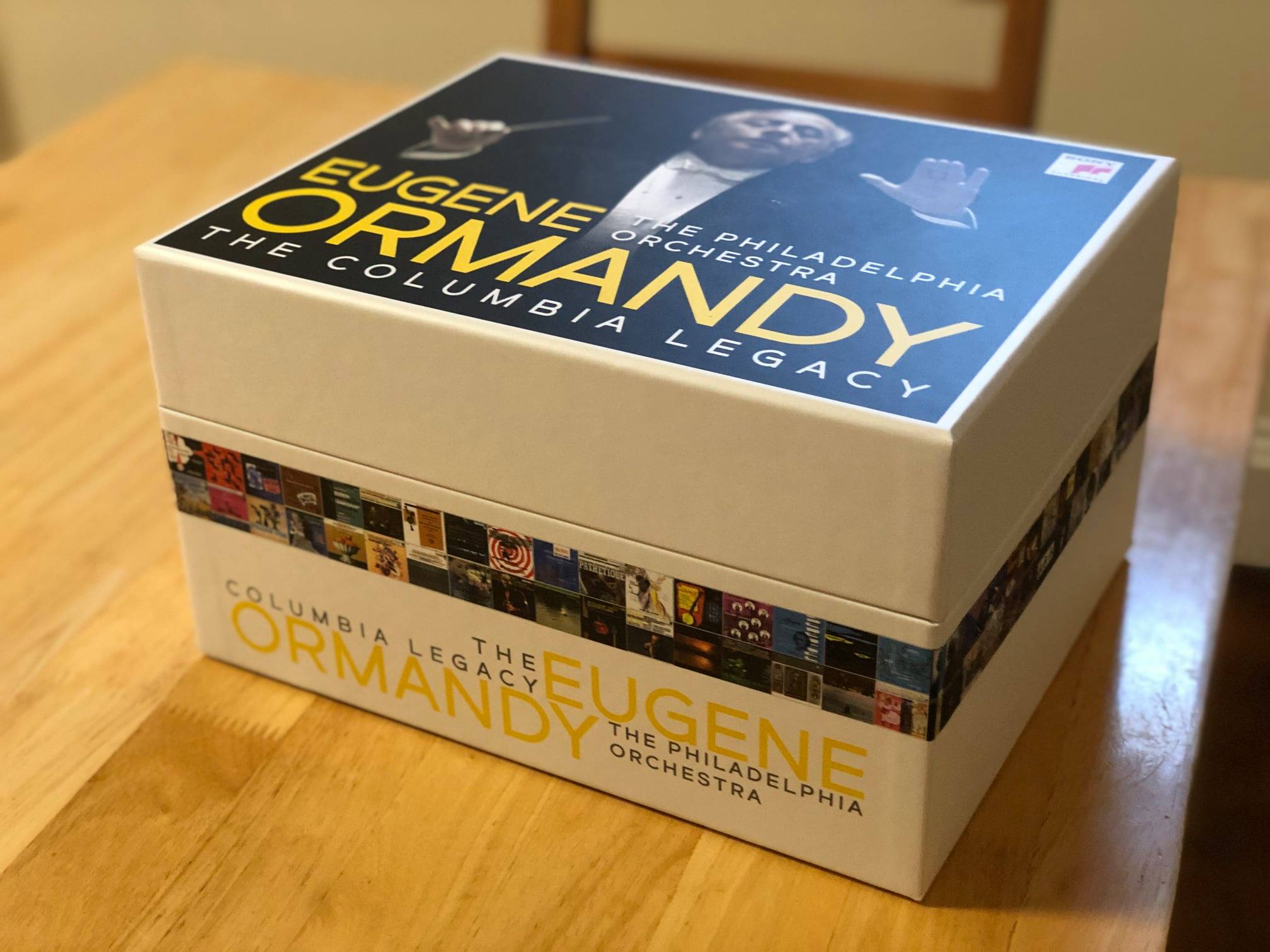
My “Eugene Ormandy: The Columbia Legacy” set has arrived!
Actually, it was delivered to my doorstep, finally, about two weeks ago.
Perversely, so intensely have I been looking forward to it, I couldn’t even bring myself to remove the shrink wrap for three or four days, lest I lose my grip on reality, forgoing the needs of daily existence to assimilate its contents and drift, with pinwheeling eyes, into fatal obsession. Last week, I finally broke the Seventh Seal.
An early birthday present to myself – months early – this set includes 120 compact discs, newly remastered from original analogue sources, discs and tapes recorded between 1944 and 1958. I want to stress that THESE ARE MONO RECORDINGS, not the frequently reissued stereo performances that have formed the core of Ormandy and the orchestra’s enduring reputation on record.
The CDs are filed in miniature facsimiles of the original album covers. These include the original cover designs and miniscule font for the liner notes. I can still read them, but if your eyes aren’t what they used to be, you may have to get yourself a magnifying glass.
A full 152 of these recordings are making their first-ever appearance on CD. 139 are receiving their first authorized releases. The list of world-class soloists is too long to catalogue here, but I will address them, along the way, as I offer future observations on the set.
This is, quite simply, a paragon of how this type of thing should be done. The box itself is so sturdy, it could serve as an elephant’s stool, if such a thing were still fashionable – a neck-and-shoulder interior, with a snow-white ribbon to lift a 208-page hardbound book from where it rests, atop a double row of enticing compact discs. The book contains an introductory essay in three languages (English, German, and French), reproductions of cover art, detailed recording information, an index of Ormandy’s Columbia mono recordings, facsimiles of session sheets, and some very nice photos.
The design is of a sort that is so rarely encountered these days, when it’s commonplace for record companies simply to toss everything into paper sleeves, put them in a utilitarian box with no notes, and just drop them on the market, as quickly and cheaply as possible. The Ormandy box is an object of beauty – which is a good thing, because it won’t fit on a standard CD shelf. The dimensions are 11 x 8 ½ x 6 ½”, so start thinking of a table on which you’d like to construct your shrine! The set itself weighs nearly 13 pounds.
Tantalizingly, the decision was made to retain the original couplings on some of the original records, which include performances by other conductors and orchestras (Szell, Walter, Mitropoulos, Beecham, Kostelanetz, etc.) This is one seriously impressive set! Only four volumes into it, and already I’ve been delighted again and again, with ample surprises from this “safe,” avuncular, underrated conductor. It turns out the young Ormandy knew a thing or two about turning on the juice and kicking up some genuine thrills.
The musicianship, too, is first-rate. This is not the luxuriantly upholstered Philadelphia Orchestra of legend. Don’t get me wrong, it still sounds great. Just different than you might expect, at least at the start. The sound is at least as good as other recordings from the period and often a good deal better. The Philadelphia Orchestra had a reputation for being at the cutting edge of developing technology. Just don’t go into it expecting crystalline digital. Make no mistake: these are vintage recordings.
Also, be forewarned, the set is not cheap (around 300 bucks U.S., give or take), but taken on a per-disc basis, it is an absolute steal. At any rate, you can’t really put a monetary value on the contents – the music, the performers, and the promise of years of enjoyment are all priceless.
If you are interested in the box, I would move on it sooner than later. These kinds of sets tend to have fairly brief distribution, and this one is the best I’ve ever seen. Grab it soon, before it winds up on the collectibles market, with dealers charging double or even triple the price.
I anticipated that one of the great joys of the set would be the excuse it presents to get reacquainted with a lot of the standard repertoire in, at the very least, extraordinarily well-played performances. As someone who gravitates toward unusual and neglected music, almost the only time I listen to top-40 classical is if I’m in the car and it happens to come on the radio, or if I’m attending a live concert. This, despite the fact that I can’t even tell you at this point how many performances I have of all of these pieces in a record collection that encompasses perhaps 10,000 CDs.
Since I’ve been out of the studio for over a year, and not attending concerts, thanks to COVID – and since the broadcast of complete performances of major works seems to be becoming more and more a thing of the past – finding an excuse to revisit the oldies again is actually a big treat.
(Please note: this set also contains many surprises! Almost right from the start, Disc 2 is an all-American program, and none of the composers are the usual suspects.)
No doubt the box will keep me busy for a long time. Here’s hoping one day, in the not-too-distant future, that a “Eugene Ormandy: The Columbia Stereo Legacy” set will also appear, consisting of the 200+ albums that comprise the balance of Sony’s archive of Ormandy’s work in Philadelphia.
For now, I’ve been easing my way, slowly, very slowly, through each of the CDs in sequence, savoring each one, so I am still not very far along. I deliberately avoided the set entirely during my illness last week, not wanting to associate any aspect of it with fever or nausea.
Who should acquire this box?
- Philadelphia Orchestra maniacs
- Eugene Ormandy advocates
- Collectors with shelves full of dusty old records from the 1940s that will never sound as clean as this
-
Anyone interested in totally reassessing a conductor, often damned with faint praise, at a time when he really sounds as if he has something to prove
Who should pass?
- The casual listener seeking performances in wide-dynamic, digital clarity
-
Those who can’t lift 13 pounds
-
I don’t know who else
So as to keep this post manageable, I’ll offer further observations, and more hard information, as I wade deeper into Elysium and find I can no longer keep its delights to myself.
The first disc, after all, does contain Alexander Borodin’s “Polovtsian Dances” – which, as we all know, from the ubiquitous 1970s television commercial, was the basis for “Stranger in Paradise.”
THANK YOU, Sony Classical!
Take a closer look, with members of the orchestra here: