Tag: Monster Movies

  • American Werewolf in London & Monster Memories

    American Werewolf in London & Monster Memories

    From the time I was a little kid, I was fascinated by monsters. I used to sit on the couch next to my mother, transfixed by the old Universal horror classics on Chiller Theatre on WPIX out of New York. Saturday afternoons were spent at my grandparents’ house with Dr. Shock on Channel 17 out of Philadelphia. I remember the smell of the print and pulp of Forrest Ackerman’s “Famous Monsters of Filmland,” of the stale chewing gum in Topp’s Creature Feature trading cards, and of Testors Glue, with its warning of harmful vapors on the tube, as I assembled with sticky fingers Aurora monster models acquired from Hobby Hang-Out.

    Monsters were my first passion. Then came comic books. Then came “Star Wars.” Then came classical music. Parallel to these ran a lifelong love of the movies, and movie monsters were my favorites.

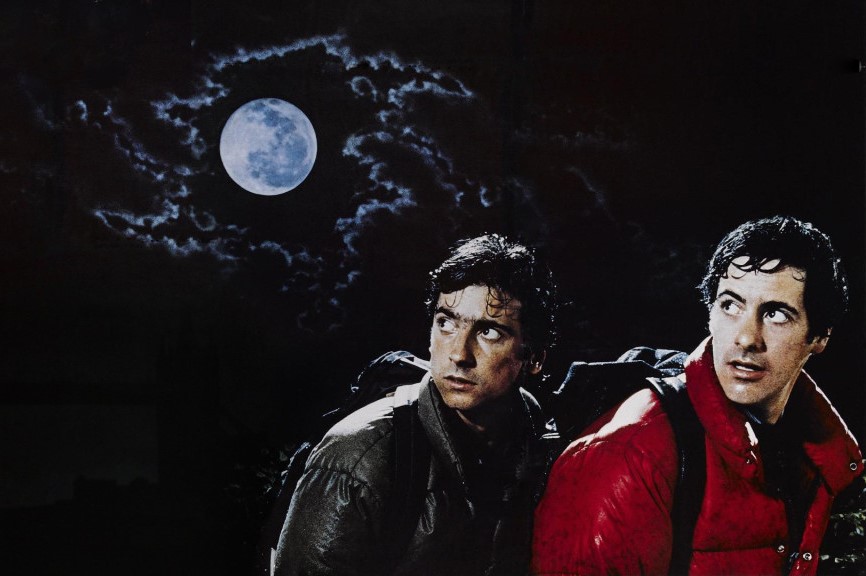
    I offer all this as preamble to the fact that Roy and I will be discussing “An American Werewolf in London” tomorrow night, as we continue our month-long celebration of Halloween, on Roy’s Tie-Dye Sci-Fi Corner.

    Ironically, I was a rather squeamish kid. I may have been drawn to monsters, but I always had complex feelings about the anguish and tragedy that were part and parcel of their existence, and certainly I didn’t want to see any blood. So into my teens I had mixed feelings about the Hammer films of the 1950s and ‘60s, with their buckets of Technicolor gore. And I was definitely very wary of anything more modern that ran the risk of splatter or viscera. I remember, I had a lot of apprehension when my mother took me to see “Day of the Dolphin” in the theater – not a monster movie, but rated PG!

    My favorite monster was always the werewolf. I still have Nancy Garden’s book on the history of the werewolf (“Werewolves,” from Lippincott’s “The Weird and Horrible Library”) that my parents bought me at F.A.O. Schwarz on one of our trips in to New York City. Later, I acquired Sabine Baring-Gould’s 1865 study “The Book of Were-Wolves.” On one memorable occasion, when I was about 10 years old, my parents allowed me to stay up and watch “The Werewolf of London” with Henry Hull and Warner Oland.

    The thing is, there weren’t very many good werewolf movies. I assume it’s because, of all the movie monsters, the werewolf was the hardest to pull off. Put a guy in a cape and give him fangs and you’ve got a vampire. But it took some real skill to engineer a palatable werewolf, especially in the old days. Even among all the monster cereals spawned by Count Chocula, including Franken Berry, Boo Berry, and the only vaguely recollected Yummy Mummy, Frute Brute was always the weakest.

    Since I was weaned on the Universal films, I was all about atmosphere, broodingly-lit Gothic landscapes full of shadows and mists. Of course, these were necessary in order to effectively sustain believability, when nobody back in the day vaguely resembled a wolf. In the classic 1941 version of “The Wolfman,” always the best of the vintage werewolf movies, Bela Lugosi’s supporting character was represented, in monster form, by a genuine canine; but when it came to Lon Chaney, they gave him a toupée, teeth, and whiskers. Not that I loved him any the less for them. I hasten to add, the transformations, for the time, and certainly Jack Peirce’s makeup, were brilliant.

    But by the 1980s, effects had come a long way, and now we could witness the genuine process of shapeshifting. What was sacrificed in terms of the power of suggestion was superseded by eyepopping elongation of limbs and growing fur. 1981 brought a werewolf bumper crop, between Joe Dante’s “The Howling,” with Rob Bottin’s never-look-away transformations, and John Landis’ “An American Werewolf in London,” with Rick Baker’s excruciating, interminable, and astonishing metamorphoses.

    I was 15 years-old, dipping a toe into contemporary horror, but still apprehensive about anything too lurid. I was nervous about seeing “Excalibur,” of all things, as I was afraid, with its R rating, that there might be some arm-loppings. (There were.) I was a very sensitive teenager.

    Yeah, there were some gross elements to “American Werewolf,” a real change of pace for director John Landis, then known pretty much for his comedies-of-excess “Animal House” and “The Blues Brothers,” but like “The Wolfman,” the film managed to insinuate itself into my consciousness, and I remember thinking about it for days afterward.

    It’s been years since I’ve last seen it, and I have not really kept up with developments in the werewolf genre, being interested in neither graphic violence nor CGI, so “American Werewolf,” for me, was always the film that met the high-water mark set by Chaney. The scares and pathos were there, but bizarrely, at the time, there were also some pretty good jokes. The film ran with all the wild grace of a lone wolf. I can’t wait to rewatch it and talk about it tomorrow night.

    There will be a bad moon rising, on the next “Roy’s Tie-Dye Sci-Fi Corner.” Bring your silver bullets to the comments section. It will be our time to howl, on Facebook, YouTube, etc., this Sunday evening at 7:00 EDT!

    https://www.facebook.com/roystiedyescificorner


    Last night, Roy’s special guest was filmmaker Jeffrey Morris, who dropped by to discuss some of his favorite episodes of “Space: 1999.” Morris is raising funds for a documentary about the cultural impact of the Eagle, the iconic spacecraft from the cult television series. Here’s a link to the show, if you’re a “1999” fan.

    Also, the documentary’s Kickstarter page, if you would like to see it happen. Among the subjects who have agreed to take part in the project are actor Nick Tate, who played Alan Carter on the show, and Academy Award winning special effects artist Brian Johnson (both of whom have been past guests on “Roy’s Tie-Dye Sci-Fi Corner”). There are only five days left in the fundraiser, so think about it, and if it’s something you want to support, make your pledge. Morris is a dynamic personality, a passionate and skilled filmmaker who knows how to get things done. Every cent will be onscreen. The documentary is bound to bring fresh attention to a fondly-remembered show that is, nevertheless, always slipping further into the past. You can read more about Morris’ vision here:

    https://www.kickstarter.com/projects/1924935609/the-eagle-has-landed-sci-fi-documentary
  • Monster Movies and My Inner Childhood

    Monster Movies and My Inner Childhood

    As any student of psychology is well aware, we’ve all got monsters inside us. In my case, monsters, to great extent, have made me what I am.

    Before classical music, before comic books, there were monster movies. I watched the old Universal horror films as a small child, sitting on the couch next to my mother – “Dracula,” “Frankenstein,” “The Mummy,” “The Wolfman,” “The Invisible Man.” Monsters became an obsession with me throughout my boyhood. I caught every creature feature on Saturday afternoons. I read Forrest Ackerman’s Famous Monsters of Filmland. I even put together my share of Aurora monster models, with their glow-in-the-dark accessories. (I remember being dissatisfied with the Wolfman’s glowing head, which really didn’t match the body, so I borrowed some of my mom’s paints to create the semblance of fur, leaving only the face exposed. Of course, it was oil paint, so it smelled and took forever to dry.)

    Apparently I wasn’t alone. It astonishes me to look back now and realize the hold that these movies of the ‘30s and ‘40s still had on us children, in particular boys, in the early 1970s. Why were these 40 year-old films still so compelling? Well, they were atmospheric, for one. Later, I would compare them to dreams, and the older they were, and the murkier they were, the more potent I found them to be. When I discovered “Nosferatu,” presented one Halloween in a darkened auditorium at school, it took monsters to a whole other level. Of course, I never missed a showing of “King Kong” (my grandmother would allow me to eat in front of the television), and I remember my uncle taking pity on me once, arguing my case, so that my parents came back and got me out of bed, so that I could stay up and watch Henry Hull in “The Werewolf of London.” I was a purely black-and-white guy back then – which meant no Hammer! Too lurid and far too much blood.

    Of course, we all only had a few channels in those days, and these films were still in heavy rotation. So the young were exposed to a lot of what entertained their grandparents, and their parents found enjoyment in it too. To some extent it provided a pop cultural foundation, so that, whether we knew it or not, three generations were all drawing on shared experience. Personal preferences may have varied, depending on a viewer’s age, with Pap drowsing to westerns, Mom tuning in to Sonny and Cher, and the kids watching Saturday morning cartoons, but we were all familiar with Bette Davis and Bugs Bunny and the Bowery Boys. I liked TV a lot better back then.

    The Universal classics were spooky, no doubt, but also somehow reassuring. They were like shadow plays, they were cathartic, and they became part of my everyday life. Two movies, however, really got under my skin and freaked me out, and both of them were based on stories by writers who were still very much active – although of course I didn’t know it at the time. One was “The Last Man on Earth” (1964), with Vincent Price fighting a world full of post-apocalyptic vampires. This, I would later learn, was based on the book “I am Legend,” by Richard Matheson. Matheson had written some of the most memorable “Twilight Zone” episodes (including the one with the gremlin that taunts airborne William Shatner), as well as the stories for what became “The Incredible Shrinking Man,” “The Legend of Hell House,” and “Trilogy of Terror,” among many, many others.

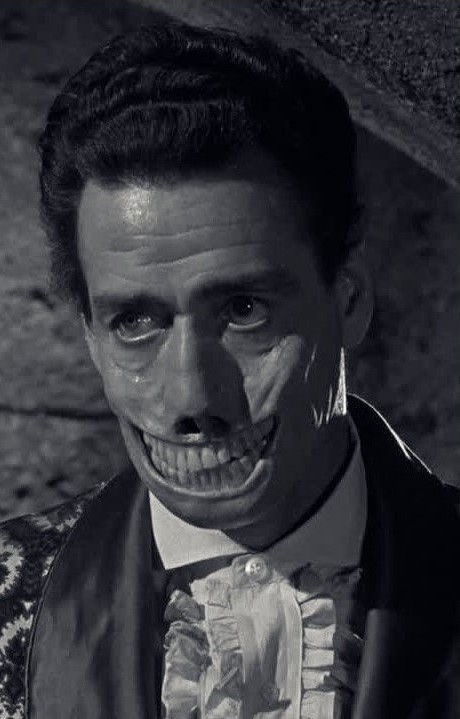
    The other film I found particularly disturbing was “Mr. Sardonicus” (1961). A cruel lord of a skull-like castle inflicts terror upon its inhabitants because of his frustrations over a horrible disfigurement. A specialist is summoned from London in a last-ditch effort to find a cure. As incentive, Sardonicus devises further hideous tortures, to be inflicted upon his young wife, whom the specialist transparently loves. Sardonicus’ make-up is impressionable – or at least it would have been to a boy in the ‘70s – as is his over-the-top cruelty. He is a marvelous villain in the melodramatic tradition, and the movie builds to a satisfying twist.

    William Castle was producer and director. Castle was notorious for spicing up his B-movie entertainments with in-theater gimmicks, like electric buzzers installed under the seats, skeletons sent flying over his audiences, and calculated “fright breaks,” or sustained pauses to scream away the “tinglers.”

    For “Mr. Sardonicus,” Castle himself appears toward end of the film to address the audience, asking us to vote for the villain’s punishment or acquittal. In the theater, apparently, glow-in-the-dark ballots were distributed to patrons. Really, though, can there be any other resolution than Sardonicus’ condemnation and death? It’s believed that no other ending was ever filmed. That William Castle was a genius!

    Is this someone you want in charge of an election? In this instance, definitely! Obviously Castle’s films had a high camp quotient. It’s not for nothing that some of the best starred Vincent Price. But at 9 or 10, all I saw was that horrible grin, and Sardonicus’ harsh but wholly deserved fate.

    The screenplay was by Ray Russell, based on his own story. Stephen King once proclaimed “Sardonicus” perhaps the finest example of the modern gothic ever written. In the original, Russell has got his Edgar Allan Poe down pat – as pastiche, it’s virtuosic – and for any fan of this type of fiction, it’s a hell of a lot of fun.

    The story “Sardonicus” actually first appeared in Playboy, believe it or not, in 1961. Anyone who ever wryly remarked that they purchased Playboy for the fiction was not being half as witty as they thought they were. Russell was hired as Playboy’s fiction editor in the 1950s. In that capacity, he championed the work of many science fiction, fantasy, and horror writers. He also attracted cult favorites like Jack Kerouac and Kurt Vonnegut. James Baldwin, Saul Bellow, Nadine Gordimer, Bernard Malamud, Vladimir Nabokov, Joyce Carol Oates, John Updike, and countless others would eventually submit stories to the magazine.

    In 1962, Russell wrote a book called “The Case Against Satan,” which anticipated William Peter Blatty’s “The Exorcist” (which has essentially the same plot) by nearly a decade. He scored another success in 1976 with “Incubus.” Along the way, both he and Matheson padded their bank accounts by writing screenplays for Roger Corman.

    I first encountered the story “Sardonicus” decades ago, before the internet, when I spent much of my time haunting used bookstores in search of supernatural fiction. A lot of the classics that were always being referenced in horror histories were not at all easy to come by. Dover had published many of them in affordable trade paperbacks, but a lot of them had gone out of print. It was during these years that my heart would be set racing by the sudden discovery of any Sheridan LeFanu I had not yet read. Once, I even came across a hardbound volume of H.P. Lovecraft. But my greatest coup in this regard must be the time I purchased an entire set of hardbound Arthur Machen from a homeless man who used to set up a blanket of books next to the old TLA Video, on Locust Street near 16th, in Philadelphia.

    This unlikeliest of booksellers went by the name of Spider. Cities can good places to stumble across abandoned treasures. Many was the time that I would add another bookshelf or bureau to my furnishings, simply because they were left behind in a move. Spider used to patrol streets and dumpsters in search of saleable inventory, and I’ll be damned if he didn’t turn up Machen. None of these were available in any form that I knew of, except perhaps for a few anthologized short stories, and occasionally a secondhand copy of “The Great God Pan.” My heart was pounding and my palms sweating as I forked over the cash.

    Those were different times, my friends. That which was marginalized in the past (specifically science fiction, fantasy, and horror) has since become mainstream. Now Lovecraft can be purchased as a bargain book at Barnes & Noble. What has become truly damaging to the movies – where everything, it seems, is apocalyptic, superheroic, or simply loud, stupid fantasy – has been a boon to lovers of lost supernatural fiction.

    Surely, some sort of tipping point was reached when Penguin Classics, no less, began to embrace authors like M.R. James, Algernon Blackwood, and Lord Dunsany. Of course, some of the romance has been sacrificed along with all the dust and the thrill of the chase, but it’s great to live in an age when these things are now readily available, and at an affordable price. The volume devoted to Russell is titled “Haunted Castles: The Complete Gothic Stories.”

    Interestingly, after serving in the Pacific with the U.S. Army Air Corps during World War II, Russell also attended the Chicago Conservatory of Music. I love that. In “Sardonicus,” there is an exchange about Verdi and a name-drop of Louis Moreau Gottschalk.

    Another story, “Comet Wine,” is a reworking of the Faust tale, as applied to the milieu of the Mighty Handful. In fact, a sizeable portion of the story is set at a salon at the residence of Nikolai Rimsky-Korsakov. Russell works in some amusing details about the Russian Five and their cool regard of Tchaikovsky. Mussorgsky has a colorful bit. Borodin is glimpsed. Cui comes in for a dismissive insult. But there is something downright diabolical in the plight of poor Balakirev. There are also some observations by one of the characters on the negative influence of Pushkin on Russian opera. The story is told in epistolary form, and the year of the letters is established from a reference in one of them to the recent premiere of Tchaikovsky’s “Eugene Onegin” (in March 1879).

    Amusingly, we learn in a framing device that the letters were purchased at auction, from the estate of the late Francis Cargrave. Cargrave is the grandson of Sir Robert Cargrave, the narrator of “Sardonicus!”

    I have yet to read the other stories in the so-called “S” trilogy – which includes, along with “Sardonicus,” “Sanguinarius” – but Guillermo del Toro, who shares my enthusiasm for this type of thing, highly recommends “Sagittarius.” I am looking forward to reading it tonight. These kinds of stories, and this kind of prose – with a marked affection for the language and the storytelling of the 19th century – are the very things I hunger for in October. It takes me back to my childhood. Which one, I am not so sure.

Tag Cloud

Aaron Copland (92) Beethoven (94) Composer (114) Film Music (117) Film Score (143) Film Scores (255) Halloween (94) John Williams (185) KWAX (228) Leonard Bernstein (99) Marlboro Music Festival (125) Movie Music (132) Opera (197) Philadelphia Orchestra (86) Picture Perfect (174) Princeton Symphony Orchestra (106) Radio (86) Ralph Vaughan Williams (85) Ross Amico (244) Roy's Tie-Dye Sci-Fi Corner (290) The Classical Network (101) The Lost Chord (268) Vaughan Williams (101) WPRB (396) WWFM (881)

DON’T MISS A BEAT

Receive a weekly digest every Sunday at noon by signing up here


RECENT POSTS