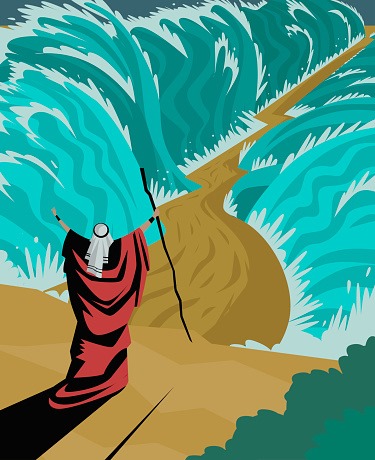
With Passover upon us, last week I was going through my collection, looking for something to listen to, and I was astonished by how many recordings I have of works inspired by Moses, the plagues, the Exodus, and the Ten Commandments. In the oratorio department alone, there’s Handel’s “Israel in Egypt,” Leopold Koželuch’s “Moise in Egitto,” Paul Dessau’s “Haggadah del Pesach,” and R. Nathaniel Dett’s “The Ordering of Moses.” I’m pretty sure somewhere I’ve also got a recording of Anton Rubinstein’s “Moses.”
Here’s another one I picked up from Princeton Record Exchange for $2 in 2022 and, like the Rubinstein, never got around to listening to it – until now. And it’s been in my player more or less all week. Max Bruch’s “Moses” is no Mendelssohn’s “Elijah,” but it’s agreeable enough, and it has its own rewards as entertainment, even if it never quite seems to achieve the lift – that level of transcendence – you experience when everything comes together in the greatest masterworks.
“Elijah” invites the most obvious comparison for several reasons. Aside from the fact that Elijah’s cup is present and filled at the Passover Seder, Mendelssohn’s dynamic, moving rendition of the prophet’s story was the most successful Biblical oratorio of the 19th century, and it’s the only one that still seems to get performed with any frequency.
Also, taking into account Bruch’s most popular works, most people I think would classify him as a composer of the Mendelssohnian variety, a conservative Romantic, as opposed to a radical, Wagnerian one. It’s not for no reason that in the glory days of the LP, Bruch’s evergreen Violin Concerto No. 1 was always on the flip side of recordings of Mendelssohn’s own masterpiece in the genre.
So imagine my surprise to discover that Bruch’s “Moses” contains at least as much Wagner as it does Mendelssohn. Perhaps even more so. The irony of classical music’s most notorious antisemite (i.e. Wagner) being mentioned in connection with an oratorio about the most revered of Jewish prophets is not lost on me. I hasten to add, I am speaking more of the Wagner of “Tannhäuser” and “Lohengrin” than of “The Ring” and “Tristan.” You won’t find any of the harmonic innovation, but you will find leitmotif and certainly a Wagnerian influence in the choral writing and in the dramatic vocal parts for Moses (bass), Aaron (tenor), and the Angel of the Lord (soprano).
All the soloists on this Orfeo recording from 1999, featuring the Bamberg Symphony conducted by Claus Peter Flor, do service to the material, with Michael Volle the standout in the title role.
Interestingly, another work it brings to mind is Josef Rheinberger’s “The Star of Bethlehem.” Different season, different faith, but something about Bruch’s handling of Moses’ inspirational leitmotif recalls – for me, anyway – Rheinberger’s Christmas cult classic, composed in 1890, five years before Bruch’s Passover oratorio. Again for this listener, Bruch’s “Moses” never achieves the same lift or touching sincerity.
Another widely-held assumption, of course, is that Bruch himself was Jewish. It’s easy to understand why, as his treatment of the Yom Kippur chant “Kol Nidre” for cello and orchestra is easily the most popular of the classical music settings. Bruch handles the tune with great sensitivity and evidently pours his heart into it. So it surprises many (as it did, later, the Nazis) to learn that Bruch was indeed Protestant. He did, however, recognize a good tune when he heard one, and clearly when he took up his pencil he was inspired.
It always knocks me off my pins to be reminded that Bruch was born in 1838 – five years after Brahms and three years before Dvořák – yet he died in 1920. Brahms checked-out in 1897 and Dvořák in 1904. Romanticism was still very much in its glorious twilight. What changes Bruch lived through! For someone who was clearly an heir of Mendelssohn to have experienced the era of “The Rite of Spring” boggles the mind.
Anyway, if you’re interested to hear what Bruch does with the Moses story, here’s a link. Just don’t go into it expecting anything special from the Golden Calf episode, which is nowhere near the level of that in Schoenberg’s “Moses und Aron.” It’s more like the Druid shenanigans of Mendelssohn’s “Die erste Walpurgisnacht” – more apt to amuse than to scandalize or to conjure any sense of genuine transgression or blasphemy.
A nice effort from Bruch, but unlikely to dislodge Elijah from his chariot. Still, someone might consider performing it sometime.