Tag: Movie Soundtracks

  • Romantic Movie Soundtracks Picture Perfect

    Romantic Movie Soundtracks Picture Perfect

    This week on “Picture Perfect,” we bestow a great big red heart, heavy with lovingly refined sugar, in the form of music from beloved screen romances.

    On the program will be selections from “Casablanca,” by Max Steiner, “Doctor Zhivago” by Maurice Jarre, and “Wuthering Heights,” by Alfred Newman.

    John Barry, who wrote many lovely scores for lovers (aside from the music to a good many of the James Bond movies), will be represented by “Somewhere in Time,” a Christopher Reeve-Jane Seymour time travel romance that is lambasted in some circles and remembered with affection in others. I don’t know that I’ve ever seen the whole thing, in its infinite 1980s showings on HBO, but I am willing to give it the benefit of the doubt, since it was written by prolific “Twilight Zone” scribe Richard Matheson (who also wrote “The Incredible Shrinking Man,” “I am Legend,” and “Hell House”). Remember when William Shatner discovered a gremlin on the wing of his plane? Matheson wrote that. ‘Nuff said.

    I hope you’ll join me for a little Friday the 13th romance, on “Picture Perfect” – music for the movies – this Friday evening at 6, with a repeat Saturday morning at 6; or that you’ll listen to it later as a webcast, at http://www.wwfm.org.

    PHOTO: Richard Matheson knows romance

  • Steampunk Movie Soundtracks Picture Perfect

    Steampunk Movie Soundtracks Picture Perfect

    This week on “Picture Perfect,” things get pretty steamy, though not in the way you might think. We’ll have an hour of scores from films exemplifying the science fiction subgenre known as “steampunk.”

    Generally speaking, steampunk employs forward-looking technologies and gadgetry – in many cases literally powered by steam – in incongruous, quasi-Victorian settings.

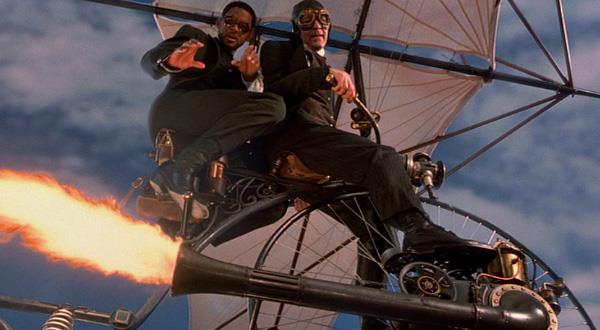
    We’ll hear selections from Martin Scorsese’s “Hugo” (2011), with its abundant gears, steam, and free-writing automaton, with music by Howard Shore; “The Golden Compass” (2007), with its carriages, old-fashioned air ships and vintage arctic gear, with music by Alexandre Desplat; “Wild Wild West” (1999), with its cowboys, proto-James Bond gadgetry and Gustave Eiffel-style iron spider, with music by Elmer Bernstein; and “Time After Time” (1979), with one of the genre’s spiritual fathers, H.G.Wells, as an actual character, who pursues Jack the Ripper to the present day via a time machine of his creation, with music by Miklós Rózsa.

    That’s movies powered by steampunk this week, on “Picture Perfect,” this Friday evening at 6, with a repeat Saturday morning at 6, or listen to it later as a webcast, at http://www.wwfm.org.

    PHOTO: Battling a giant iron spider from a flying bicycle? It must be steampunk!

  • Tall Ships Movie Soundtracks Picture Perfect

    Tall Ships Movie Soundtracks Picture Perfect

    Summer vacation may be over, but it’s never too late to run away to sea. This week on “Picture Perfect,” we listen to music from movies featuring tall ships.

    Though Gregory Peck cuts a dashing figure as “Captain Horatio Hornblower” (1951), the movie itself is a bit episodic, adapted as it was from three of C.S. Forester’s Hornblower novels. Canadian-born master of British Light Music Robert Farnon wrote the music, lending another dimension to this nautical adventure.

    Alan Ladd and James Mason engage in a battle of wills in “Botany Bay” (1953). Ladd plays a doctor wrongly accused of a crime, being transported to a penal colony in New South Wales on a ship under the harsh command of Mason. In perhaps the film’s most memorable sequence, Mason has one of his charges keelhauled. Franz Waxman wrote the score.

    If it all sounds a mite familiar, it’s because the story was by Charles Nordhoff and James Norman Hall, authors of “Mutiny on the Bounty.” The classic film version dates from 1935, with Clark Gable butting up against Charles Laughton’s Captain Bligh. The 1962 version bears a certain notoriety, mostly for Marlon Brando’s eccentric performance, which turns Fletcher Christian into a fop, and the fact that he essentially directed all his own scenes himself. The film was colossal failure, earning back only $13 million of its $19 million budget. Nonetheless, it managed to inspire Bronislau Kaper to compose one of his most monumental scores.

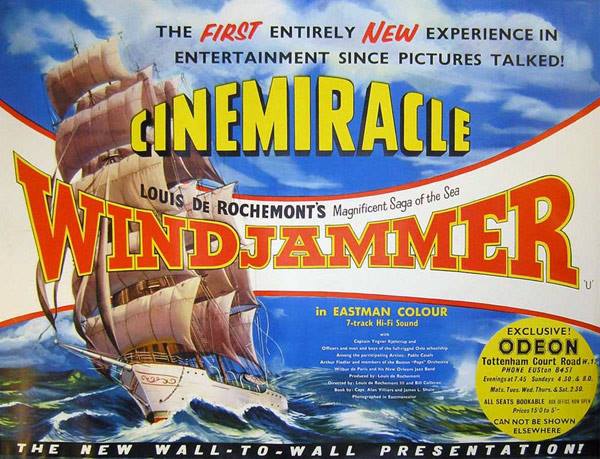
    Finally, we’ll hear music from a recent release, on Sepia Records, of the soundtrack to “Windjammer” (1958), the only film shot using the Cinemiracle process. The film documents the round-trip, transatlantic journey of a Norwegian vessel from from Oslo to the Caribbean to New York to Portsmouth, New Hampshire, and then back home again. Morton Gould wrote the evocative score, which alternates dance rhythms and sea shanties with a recurring melody suggestive of the sweeping romance of the high seas.

    Join me as we recommission these tall ships on “Picture Perfect,” music for the movies. You can enjoy it this Friday evening at 6, or catch it later as a webcast at http://www.wwfm.org,

  • Conan’s Great Movie Music Soundtracks

    Conan’s Great Movie Music Soundtracks

    In “Conan the Destroyer” (1984), one of Conan’s companions speculates, “I suppose nothing hurts you.”

    To which he replies, “Only pain.”

    Discriminating viewers may feel a little pain themselves watching these silly, cheesy and violent films, all of which were inspired by the writings of pulp master Robert E. Howard. Howard created the warrior Conan in 1932. The character became the center of a series of lucrative stories first published in “Weird Tales” magazine.

    In 1982, Conan made the leap to the big screen, under the guidance of director John Milius. The film, “Conan the Barbarian,” made Arnold Schwarzenegger, already a legend in the field of bodybuilding, an international superstar. While “Conan” isn’t exactly “Citizen Kane,” it does have its pleasures. The intensity of the violence can be a little disturbing, but the ponderous tone is a blast. “Conan” is a film that takes itself just seriously enough to make it occasionally hilarious.

    Another thing “Conan” had going for it was the fact that it was made on a blockbuster budget. The first-rate production values extended to the music by Basil Poledouris, who employed a full symphony orchestra to impressive ends. In fact, the “Conan” score is one of the strongest of the decade. It’s amazing that anyone would find so much inspiration in such a mediocre film, but Poledouris’ music intersperses Central Asia-style lyricism with brawny, thrilling action music.

    Sadly, the sequel, “Conan the Destroyer,” showed all-too-evident signs of penny-pinching, so that it often wound up feeling like a direct-to-video production. Poledouris was forced to make do with a smaller orchestra, which at times sounds like a television ensemble. Still, he gave it his all, and there’s something to be said for the fact that it is an original score, rather than a mere retread of the original.

    In 1997, Howard’s Kull of Atlantis was given the big screen treatment as “Kull the Conqueror.” Kevin Sorbo, TV’s Hercules, played the title role. The composer, Joel Goldsmith (son of Jerry Goldsmith), was asked to incorporate heavy metal riffs into his orchestral underscore. I haven’t actually seen this one, but for some reason I don’t feel like I’m missing anything.

    The astoundingly prolific Ennio Morricone – who has more than 500 motion picture and television scores to his name – has an uncanny knack for spinning garbage into gold. His music for “Red Sonja” (1985) lends the film an aura of ‘80s fun, perhaps more so than it deserves. This is the film that introduced Brigette Nielsen as the chain-mailed barbarian beauty. Schwarzenegger appears in the supporting role of Lord Kalidor.

    In the ‘80s, even bad films had great scores. I hope you’ll give “Conan the Barbarian” a chance this week, on “Picture Perfect” – music for the movies – this Friday evening at 6:00 ET, or enjoy it later as a webcast at http://www.wwfm.org.

    By the way, is it pronounced “Co-NAN,” as it was in the 1982 version, or “CO-nin,” as it was in the 2011 remake? Interesting meditation here:

    http://www.vulture.com/2011/08/conan_the_barbarian_has_change.html

    I pronounce it “Co-NAN” in the promo, and “CO-nin” in the show.
  • Independence Day Movie Music

    Independence Day Movie Music

    Tomorrow is Independence Day, so it seems appropriate this week on “Picture Perfect” to treat the subject of music from movies related to the birth of our nation.

    We’ll hear selections from the 2000 Mel Gibson film, “The Patriot,” in which slow-burning pacifist Mel is pushed too far by ruthless British officer Jason Isaacs and reverts to his bloody French and Indian War ways. By the end of the film, he is literally waving the flag to John Williams’ triumphant score.

    Then we’ll hear a suite from the 1942 Jack Benny-Ann Sheridan fixer-up comedy, “George Washington Slept Here,” based on the play by Moss Hart and George S. Kaufman – not really about the Revolution, beyond the fact that the ramshackle Pennsylvania farm house purchased by a transplanted New York couple is alleged to have been the resting place of the Revolution’s most famous general. The music is by Adolph Deutsch.

    The 1985 film, “Revolution,” seemed to have everything going for it. The director was Hugh Hudson, whose “Chariots of Fire” was the big winner at the 1981 Academy Awards; its star was Al Pacino; and its composer was John Corigliano, who went on to win the Pulitzer Prize for Music for his Symphony No. 2 and an Academy Award for “The Red Violin.” Yet “Revolution” bombed horribly – so horribly that Pacino gave up making movies for the next four years. James Galway plays the flute and pennywhistle on the film’s soundtrack.

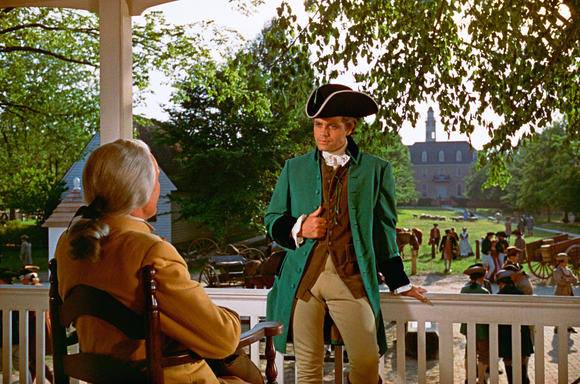
    Finally, we’ll hear music from the longest continuously-shown film in cinematic history, “Williamsburg: The Story of a Patriot,” created exclusively for the tourist attraction of Colonial Williamsburg. The film features future “Hawaii Five-O” star Jack Lord, and the score is by none other than Bernard Herrmann.

    Here’s a clip from “Williamsburg,” with some of Herrmann’s music:

    https://www.youtube.com/watch?v=A0VXfVhenXQ

    We celebrate Independence Day this week, on “Picture Perfect,” music for the movies. You can hear it this Friday evening at 6 ET, or enjoy it later as a webcast at http://www.wwfm.org.

Tag Cloud

Aaron Copland (92) Beethoven (95) Composer (114) Film Music (120) Film Score (143) Film Scores (255) Halloween (94) John Williams (185) KWAX (229) Leonard Bernstein (100) Marlboro Music Festival (125) Movie Music (135) Opera (198) Philadelphia Orchestra (88) Picture Perfect (174) Princeton Symphony Orchestra (106) Radio (87) Ralph Vaughan Williams (85) Ross Amico (244) Roy's Tie-Dye Sci-Fi Corner (290) The Classical Network (101) The Lost Chord (268) Vaughan Williams (103) WPRB (396) WWFM (881)

DON’T MISS A BEAT

Receive a weekly digest every Sunday at noon by signing up here


RECENT POSTS