I devoted one of my posts the other day to news of a limited-time revival of “Ben-Hur,” back on the big screen, courtesy of Fathom Entertainment. The film has been showing at select theaters across the country over the past four days, with today being the last. If you’re at all interested in seeing it in its new 4K restoration, search for theaters in your area by clicking on “get tickets” at https://www.fathomentertainment.com/releases/ben-hur-2026/. Screenings tonight will likely begin sometime between 6:00 and 7:00.
And let me tell you, the film looks great. Also, I don’t know that it’s ever sounded better. Miklós Rózsa’s fanfares and choruses soar, the clatter, thundering horse hoofs, and roar of the crowd during the chariot race thrill, and the earthquake following Jesus’ crucifixion terrifies.
Granted, the film is four hours long (presented with a brief intermission), but it is an absorbing story told on a grand scale. Why, then, was I the ONLY PERSON IN THE THEATER when I saw it last night? I mean, this was the most-decorated film of all-time, with a record-breaking 11 Academy Awards. It was also the highest grossing picture since “Gone with the Wind.” Everything about it is immaculately rendered (no pun intended).
Were people put off because it’s an old movie? By the length? By the religion? Because it was a work night? Here, the film was over by 9:50.
Most likely, they stayed away because it doesn’t have Ryan Gosling in a spaceship. Also, it’s less demanding to stay home and stream “content” as background to scrolling on the phone and texting friends.
If any of these is the case, I feel sorry for those people. But I am also concerned for the future of everything I hold dear. A large segment of the population, it seems, possibly a majority, lacks the curiosity and the attention spans of our parents and grandparents, who might have considered this a deeply satisfying, even transformative night out.
Concerning the religion, “Ben-Hur” is a peculiar movie. On the surface, it has a Christian outlook (Lew Wallace’s book bears the subtitle “A Tale of the Christ”), but the hero, blue-eyed Charlton Heston as the Judean prince Judah Ben-Hur, is proudly Jewish. Of course, the conflict in the film is more political than religious. Ethnic distinctions are drawn mainly along the lines of those in occupied lands who bristle under their Roman conquerors. There’s one scene wherein the Romans make a sneering remark about a proposed chariot race with Judah. “A Jew?” one remarks, incredulously (sponsored by an Arab, no less). But the Romans, in general, are a proud, supercilious lot.
The other day, I mentioned an alleged gay subtext (according to Gore Vidal) in the establishing scene between Judah and his childhood friend, Messala (played by Stephen Boyd), which does exude a certain, unusually ardent quality, though things very quickly go south as the men’s allegiances drive a wedge between them. However, given that Judah’s later relationship with the Roman general Arrius (played by Jack Hawkins) deepens into an equally unguarded affection, it would be easy to chalk it up to simple phileō. This was, after all, the ancient world.
That said, if there’s a more homoerotic mainstream American movie, I can’t think of it. There are half-naked, well-oiled men everywhere. They stop just short of snapping each other with their towels. And if it’s an historical or Biblical epic, you can bet Heston will be standing around in a loin cloth for at least some of it. It must have been in his contract.
The film is adapted from a bestselling novel by Civil War general Lew Wallace, the most-read American novel in the period between “Uncle Tom’s Cabin” and “Gone with the Wind.” Wallace claimed not to be particularly religious at the time he took up his pen, but on completion of the manuscript, he found he had become a believer.
The story is really a mash-up of “The Count of Monte Cristo” and a Jesus movie. Jesus pops in every once in a while, always viewed from the back of the head, as Rózsa’s score strikes a mystic tone. But the film is not really about Jesus, or rather it isn’t JUST about Jesus, as much as it is about getting in touch with your own humanity and embracing your better angels. Yes, the ideals advocated by Jesus point the way, but Judah himself, as a good and thoughtful person, grapples with the complexity and corrupting nature of the impulse to revenge. Heston delivers a nuanced performance, a career best, that conveys much of his character’s conflict and evolution through his thoughts, facial expressions, and physical bearing, as much of it is not explicit in the dialogue, though certainly supported by the compassionate exchanges in Judah’s encounters with Jesus.
Interestingly, Judah recognizes the extraordinary in these silent encounters, but he remains a Jew to the end (as opposed to converting to Christianity). Throughout the film he touches his mezuzah reverently, even tenderly, when entering his house. When his family’s fortunes plummet, still he adjusts the scroll and carefully tends to this symbol of his identity and faith. At a point, he covers his head and prays for forgiveness for his desire to seek vengeance. Whether or not he embraces Christianity beyond the action of the movie is unclear, but I think not. Nevertheless, he is transformed.
In a way, Jesus is an external symbol of Judah’s inner goodness. Or perhaps, putting it another way, Jesus becomes a catalyst for Judah’s self-awareness. A Roman early in the film remarks that Jesus teaches that God exists inside every one of us. (“It’s quite profound, actually,” he adds, with a far-away look.) Whether or not you are a “religious” person, whether you are Jewish or Christian, the film should still work for you. It’s interesting that, for such an earnest, at times histrionic presentation, it manages to satisfy when viewed from multiple perspectives.
Judah’s journey leads him through physical trials and into the emotional abyss. But he does believe in a higher power. He makes it clear several times throughout the film, most especially when he tells Arrius he cannot believe that God would keep him alive in the galleys for three years only to have him drowned at the bottom of the sea.
It’s an inspiring movie, not least of all for all the craftsmanship that went into it. The starfield in the film’s prologue, as the Three Magi travel to Bethlehem to pay homage at the manger, is magical. The kings, captured in profile, are like a Rembrandt brought to life. The stable scene is touchingly reverent, but the chance cavorting of a rambunctious calf saves it from stiffening into sanctimonious kitsch. And then the credits! My god, Miklós Rózsa’s music!
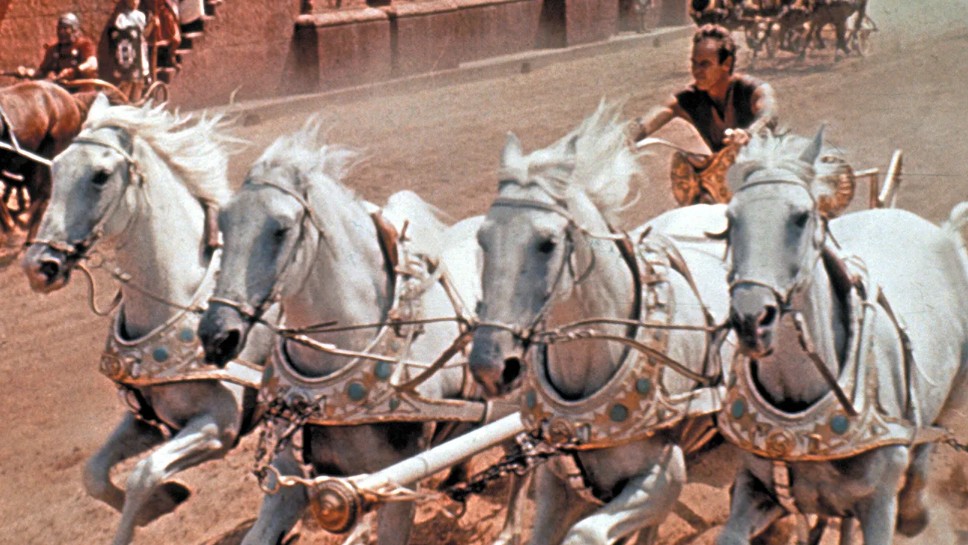
There were no computers back then, remember, so everything you see was made by hand. The sets, the expert matte paintings, the costumes on the cast of thousands. Those nine chariots racing around the arena with their teams of frothing horses are real. Stuntmen risked life and limb, and Heston and Boyd can be seen in some of the shots actually maneuvering their rigs. I know it’s a hackneyed phrase, but they really don’t make ‘em like this anymore!
I should add, the film is not for ironists. It is absolutely in earnest from beginning to end, but as I suggest, it’s open to a range of interpretations. It is the visual equivalent of reading a book. It feels like a literary experience. Whether or not it reflects Wallace’s original in that regard, I cannot say. I have yet to read it, but I’ll get around to it one of these days. For now, and as has been the case for decades, I hold the movie very close.
Heston, Boyd, Hawkins, Finlay Currie (as the king Balthasar), and Frank Thring (who plays Pilate as a consummate politician) have never been better. William Wyler (who was Jewish) was one of the most skilled Hollywood directors of all time. Google him and just look at his credits. He directed all kinds of pictures, from “Wuthering Heights” and “The Heiress” to “Roman Holiday” and “Funny Girl,” with very few of them being less than wholly satisfying. Several of them, including “The Best Years of Our Lives” and “The Big Country,” are among my all-time favorites.
You have one more chance to catch “Ben-Hur” on the big screen in its 4K restoration. I don’t care how good your system is at home. Watching it on your couch with distractions of the phone, the refrigerator, and easy access to a bathroom is not the same experience. Go, and prepare to be overwhelmed.
Tag: Movies
-
Is There Still an Audience for “Ben-Hur”?
-

Jerry Goldsmith: Alchemist Extraordinaire
He was a smith who forged gold from the basest of materials – film music’s alchemist extraordinaire. Once John Williams kickstarted his blockbuster hog, Jerry Goldsmith may have been destined for the side car, but he possessed a refined genius all his own.
Goldsmith was a consummate professional with a rare talent for speed. When Randy Newman was dropped from “Air Force One,” it was Goldsmith who stepped up, writing and recording the music in less than two weeks. He wrote the replacement score for “Chinatown” in ten days.
Unfortunately, not all the films were “Chinatown.” For every “Planet of the Apes,” “Patton,” and “Papillon,” there was “The Mummy” (with Brendan Fraser), “The Haunting” (remake), and “Looney Tunes: Back in Action.”
Williams got “Superman.” Goldsmith got “Supergirl.” Williams got “Raiders of the Lost Ark.” Goldsmith got “King Solomon’s Mines” (with Richard Chamberlain). Williams got “E.T. The Extra-Terrestrial.” Goldsmith got “Baby: The Secret of the Lost Legend.”
But even when the movies were terrible, Goldsmith’s music served as a consolation prize. And nothing can take away the classics. He was one of the last of the greats, and he lived through a great era, so we certainly have enough to cherish. He just had the bad fortune to have had more stamina than the movies themselves, which got weaker and weaker and weaker.
The composer himself expressed frustration at his music being drowned out by ever more-elaborate sound effects, which is why his scores tended to become more streamlined – and less memorable – in the ‘90s. He would have lost his mind in these days of laptop editing, when movies can be trimmed and shuffled within an inch of their lives, virtually right up until the day of distribution.
For television, he wrote music for “Dr. Kildare,” “The Twilight Zone,” “Gunsmoke,” “The Man from U.N.C.L.E.,” “The Waltons,” “Room 222,” and “Barnaby Jones.” He was the recipient of five Emmy Awards.
Incredibly, despite EIGHTEEN nominations, he was honored with but a single Oscar, for his influential score to “The Omen” (1976). Goldsmith died in 2004, at the age of 75. If he were to come back today, he would mop the joint with all the Hans Zimmers of this world.
Happy birthday, Jerry Goldsmith. I sure does miss you.
——–
The Man from U.N.C.L.E.:The Blue Max
Planet of the Apes:
Patton:
Chinatown:
The Wind and the Lion:
The Omen:
The Great Train Robbery
Star Trek: The Motion Picture:
Goldsmith discusses film music, circa 1986
Documentary from 1993
Introducing and conducting his music with the National Philharmonic in 1989
Introducing and conducting his music, and others’, with the BBC Concert Orchestra in 1994
Part 1
Part 2
-

Mars Movies Music Conspiracy & Adventure
This week on “Picture Perfect,” we’re off to Mars – or are we?
“Capricorn One” (1978) posits, in true conspiracy theory fashion, that the first manned mission to Mars is a fabrication, filmed on a sound stage. However, when the actual capsule burns up upon re-entry into the earth’s atmosphere, the government attempts to cover it up, and the astronauts are sent scrambling for their lives. This is the film in which O.J. Simpson eats a rattlesnake. The cast also includes Elliott Gould, James Brolin, Sam Waterston, Hal Holbrook, and Karen Black. Jerry Goldsmith wrote the propulsive score.
The Red Planet is also the destination of the crew of Mars Gravity Probe 1, in “Robinson Crusoe on Mars” (1964). In events which loosely parallel the trajectory of Daniel Defoe’s classic novel, commander Paul Mantee survives a crash on the seemingly desolate planet, along with the mission’s test monkey. Later, he develops a friendship with an escaped alien slave, whom he names Friday. The composer is Van Cleave.
Van Cleave had much in common with Ferde Grofé. Yes, THE Ferde Grofé – he of “The Grand Canyon Suite.” You’ll recall Grofé acted as an orchestrator for the Paul Whiteman Band. His most celebrated achievement in that capacity was his arrangement of George Gershwin’s “Rhapsody in Blue.”
Cleave had also served as an arranger for Whiteman. Later, he pioneered the use of the theremin in his television scores, for series like “The Twilight Zone.”
It was Grofé who allegedly introduced the theremin to outer space, with his music for “Rocketship X-M” (1950). “Rocketship X-M’s” unlikely premise is that the spacecraft of the title overshoots its target, the moon, and inadvertently ends up on Mars – a difference of many, many, many millions of miles! Lloyd Bridges heads the cast.
Sadly, “John Carter” (2012), Walt Disney’s long-overdue adaptation of Edgar Rice Burroughs’ Martian tales, was branded a colossal flop. It’s a sad state of affairs when a 300 million dollar take is considered a disappointment! Though the film failed to live up to box office expectations, and some of the tropes established by Burroughs 100 years ago seem a little overly-familiar in the decades since the release of “Star Wars,” “John Carter” was nowhere near as bad as one was led to believe. It was certainly no worse than any other film of its kind made in recent years, and in fact a good deal better than many. And I would include in that assessment any of the recent Tolkien adaptations.
True, most of the potential magic is lost in the usual over-reliance on computer effects, and the screenplay makes some unnecessary alterations to the books. But all in all, “John Carter” is a satisfying Martian adventure. Edgar Rice Burroughs never aspired to be Joseph Conrad. The film’s epic, evocative score is by Michael Giacchino.
Prepare to see red with music from movies about the fourth planet, when Mars is our destination – whether by design, by accident, by conspiracy, or by unexplained means – on “Picture Perfect,” music for the movies, this Saturday evening at 6:00 EST, on WWFM – The Classical Network and wwfm.org!
-
Why I Still Watch the Oscars Nostalgia & Movies
I don’t know why I keep watching the Academy Awards. The truth is, just about everyone I really like in the entertainment industry is either retired or dead. But every once in a while, a film will come along, like “The Artist” or “The Shape of Water,” that will seize onto my retro sensibility. Or Morricone will finally get an Oscar.
At any rate, watching the Academy Awards has been a life-long tradition that goes back to my childhood, when the family would gather in the living room and feast like guests of Petronius as screen legend after screen legend would take the podium. And the film score nominees were like something out of a second Golden Age.
Sure, there was ample tedium, embarrassing production numbers that bloated the ceremony to eyelid-drooping proportions. You could watch “The Irishman” in the amount of time it would take to get to Best Picture. But it was worth it for the classic film montages and the “In Memoriam” segment.
And yes, there could be a few squirmy episodes of collective self-congratulation and maybe an eye-rolling political digression or two. But it’s the Oscars. When you flip on the tube, you’re giving Hollywood its night.
It’s like going to the circus. Does anyone even like the circus? And yet once you’re there, the impressions are overwhelming. It’s nostalgic. You may want to rant the whole time, but you can’t look away.
So I’ll be there on Sunday night, as I have been for decades, anesthetizing myself with a platter of viands, hoping to see Joe Pesci pick up another Oscar and hating “Joker” (which I still haven’t seen), all the while reflecting on the superstars and better movies of my youth.
Everything about the Academy Awards is like going to the movies anyway. They’re a construct. They’re fantasy. And every once in a while, just maybe, if I’m lucky, there’s still something worth seeing.
-
Is Classical Music More Accessible Than Ever?
Here’s an article by long-time rock critic Paul Morley who, jaded by the safe, slick commercialism of contemporary pop, shares his new-found zeal for the raw undercurrents in much of classical music.
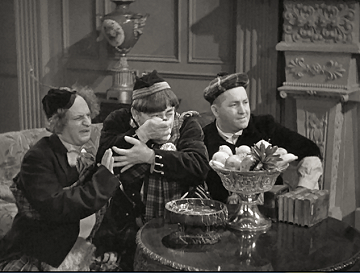
Predictably, but no less depressingly, the backlash from too many of his readers in the comments section is informed by a knowledge of classical music apparently gleaned from Three Stooges shorts. You know, where they flip bananas and grapes into the mouths of histrionic opera singers to scandalize the snooty patrons.
As you probably know if you’re a regular reader, I love love love classic movies, but one thing that disturbs me as a viewer is a recurrent misunderstanding of, if not outright disdain for, classical music. Was it ever as stuffy, inaccessible and exclusive as it is portrayed in movies of the ‘30s and ‘40s (or even today, for that matter?).
Yes, it helps if you have enough money to be able to attend concerts, and the old films are full of anti-populist straw men, the idle rich, all knock-offs of diminutive Uncle Pennybags and dowagers with Thurber builds. But then what about the cab driver in Preston Sturges’ “Unfaithfully Yours,” who is delirious for Rex Harrison’s Delius? It could be argued that the humor in that is that someone holding such a position could be knowledgeable about, let alone capable of appreciating, classical music.
Whatever the reality, today things couldn’t be more accessible. You’ll still get sneers (frequently from me) if you text in the concert hall or wear open-toed sandals and cross your legs to display your untrimmed, fungal toenails, but for the most part I think classical music has become a very democratic pursuit for anyone with half an interest in it. Morley makes a very good point when he indicates that it is now easier than ever to educate oneself – or, if that sounds too pompous, to explore – by following one’s natural curiosity through the privacy and convenience of one’s own laptop.
What a world it would be if people could lose some of the attitude and just listen. Of course, that would apply to anything, not just music.
Tag Cloud
Aaron Copland (92) Beethoven (94) Composer (114) Film Music (116) Film Score (143) Film Scores (255) Halloween (94) John Williams (185) KWAX (228) Leonard Bernstein (99) Marlboro Music Festival (125) Movie Music (131) Opera (197) Philadelphia Orchestra (86) Picture Perfect (174) Princeton Symphony Orchestra (106) Radio (86) Ralph Vaughan Williams (85) Ross Amico (244) Roy's Tie-Dye Sci-Fi Corner (290) The Classical Network (101) The Lost Chord (268) Vaughan Williams (99) WPRB (396) WWFM (881)