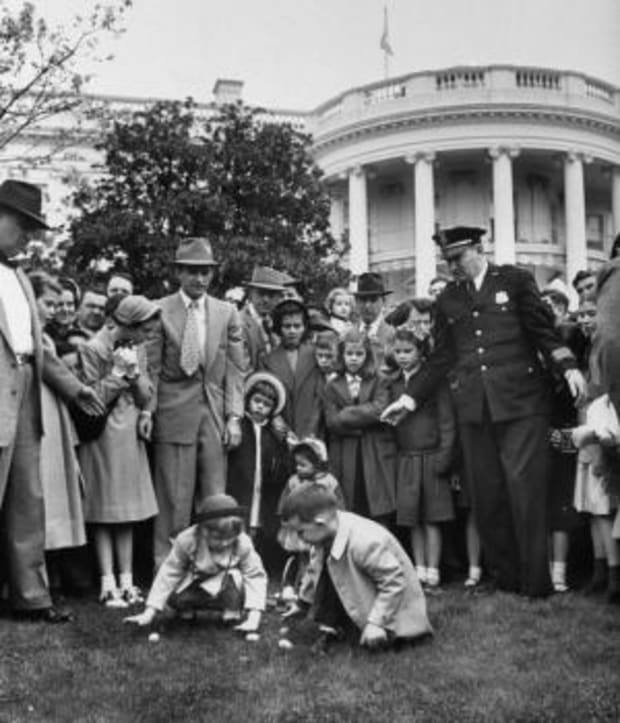
The traditional Easter Monday White House Egg Roll is in progress!
Of course, in this instance “Egg Roll” has nothing at all to do with the deep-fried Chinese appetizer (that’s so, so good with hot mustard sauce). Rather, it’s a race wherein children push an egg through the grass with a long-handled spoon.
By the 1850s, rolling eggs had become something of a mania in D.C and its environs. For a time, the U.S. Capitol became most popular place to do so. However, in 1876, some bad eggs ruined it for everyone, and after an especially rambunctious roll destroyed much of the Capitol lawn, Congress passed a law making it illegal to use the Capitol complex as a children’s playground. In 1878, Rutherford B. Hayes officially transplanted the springtime celebration to the grounds of the White House.
Actually, similar parties had been held in the past. According to tradition, Dolley Madison, wife of President James Madison, hosted the event for the first time in 1814. It’s said that there was also some egg rolling on the premises during the Lincoln administration. Such gatherings were banned, however, under Ulysses S. Grant, again because of their destructive impact on the landscaping.
It was President Hayes who began readmitting doe-eyed kids showing up at the White House gates on Easter Monday to continue their deleterious capers. Benjamin Harrison was the first to enlist the participation of the United States Marine Band. Except for during the two world wars, in 1917 (because of influenza concerns), in 2020 and 2021 (the height of the COVID-19 pandemic), and during restoration efforts, the tradition has continued to the present day.
The celebration includes local marching bands, a talent show, an obstacle course, story-time readings, a history tour, people in costume, snacks, and an exhibition of decorated eggs.
It may be a ludicrous custom, but it hurts no one. Curmudgeons are welcome to stay home and crack their own eggs.
Here’s John Philip Sousa’s “Easter Monday on the White House Lawn,” performed by the United States Marine Band:
Another piece of music appropriate for the day is Thomas Kerr’s “Easter Monday Swagger.” Kerr, who was born in Baltimore, studied at Howard University (he would have preferred the Peabody Conservatory, but Black students were not admitted at that time), then at the Eastman School of Music in Rochester, NY. He later taught at Knoxville University, before returning to Howard, where he served for more than 30 years, until his retirement in 1976.
It wasn’t until 1954 that the White House Egg Roll was opened to Black children, at the insistence of Mamie Eisenhower.
“Easter Monday Swagger” was recorded by Natalie Hinderas, professor of music at Temple University from 1966 to 1987. In 1971, Hinderas became the first Black woman to appear as an instrumental soloist on a regular subscription series of a major symphony orchestra – the Philadelphia Orchestra – when she performed Alberto Ginastera’s Piano Concerto No. 1. This opened the floodgates. After that she received offers from the New York Philharmonic, the Cleveland Orchestra, the Los Angeles Philharmonic, the Atlanta Symphony, the Chicago Symphony, the San Francisco Symphony, and the Pittsburgh Symphony Orchestra.
Her landmark two-record set, “Natalie Hinderas Plays Music by Black Composers,” was released around the time of her Philadelphia Orchestra debut.
You don’t have to roll an egg to enjoy her recording of Thomas Kerr’s “Easter Monday Swagger.”