Tag: Ned Rorem

  • Give a Hand for Gary Graffman

    Give a Hand for Gary Graffman

    Piano legend Gary Graffman has died.

    Graffman had a powerful start as part of Columbia Records’ stable of American pianists that also included Leon Fleisher and Eugene Istomin, and he made some fantastic recordings with George Szell and Leonard Bernstein, until, like Fleisher, a hand injury drove him into semi-retirement as a performer.

    Graffman was instrumental in resurrecting works in the left-handed repertoire, a number of them commissioned by pianist Paul Wittgenstein, who lost his right arm during the First World War. In particular, Graffman was a champion of the works composed for Wittgenstein by Erich Wolfgang Korngold, and I was fortunate (and thrilled) to be able to hear him play these pieces in Philadelphia at a time when they were not widely available on recordings. It’s so easy now to take for granted how spoiled for choice we are in this day of exhaustive recordings and internet access to them. In particular, I got to know Korngold’s Suite for Two Violins, Cello and Piano Left-Hand from Graffman’s concert performances (although it was Fleisher who made the definitive recording of the piece).

    I also attended the world premiere of Ned Rorem’s Piano Concerto for the Left Hand (his fourth piano concerto) at Philadelphia’s Academy of Music, which was recorded live and released on New World Records. Rorem always was a miniaturist at heart, or that is my impression, so even when working in larger forms, as here, it was not unusual for him to construct them out of smaller individual components. The concerto consists of eight brief movements, as opposed to three epic statements in the grand German tradition. The outer movements employ kind of a twelve-tone “scat” – the way it’s handled, it’s not going to leap out and clap you on the ears as “twelve tone music” – but at its core, the concerto shares a French sensibility that might appeal to anyone who enjoys the music of Francis Poulenc. It’s an attractive piece, and I’ve played it on the radio many times.

    It’s one of several works for left hand composed specifically for Graffman. In 1996, William Bolcom wrote a concerto, “Gaea,” for Graffman and Fleisher to perform together. In 2001, Graffman gave the premiere of “Seven Last Words,” by Curtis alum Daron Hagen.

    Graffman’s recording of “Rhapsody in Blue” has enjoyed an especially lucrative existence, thanks to its use in Woody Allen’s “Manhattan.” It’s turned up in numerous film and television productions ever since.

    Graffman found a second career as an influential teacher and administrator at the Curtis Institute of Music, where he joined the faculty in 1980 and became its director in 1986. In 1995, he also became Curtis’ president. He served in all three capacities – teacher, director, and president – for the next 21 years. I never lived more than a few blocks from Curtis, and I was a frequent concertgoer (also, my girlfriend at the time worked there), so of course I saw him all the time. What I didn’t see was his behind-the-scenes instruction of super-pianists like Lang Lang and Yuja Wang, who went on to stunning careers. Graffman’s own teachers included Isabelle Vengerova, Rudolf Serkin, and, informally, Valdimir Horowitz.

    Graffman’s wife, Naomi, predeceased him in 2019. Their marriage spanned some 67 years. Although I did not know them personally, beyond the exchange of a sentence or two at a reception, they seemed like a lovely couple.

    Graffman’s death unexpectedly conjures another era for me. Suddenly, I feel very far away from my 20s.

    Gary Graffman died yesterday at the age of 97. R.I.P.

    ———

    Graffman performing the rarely-heard Prokofiev Piano Concerto No. 4 – another Wittgenstein commission, but never played by him.

    ———

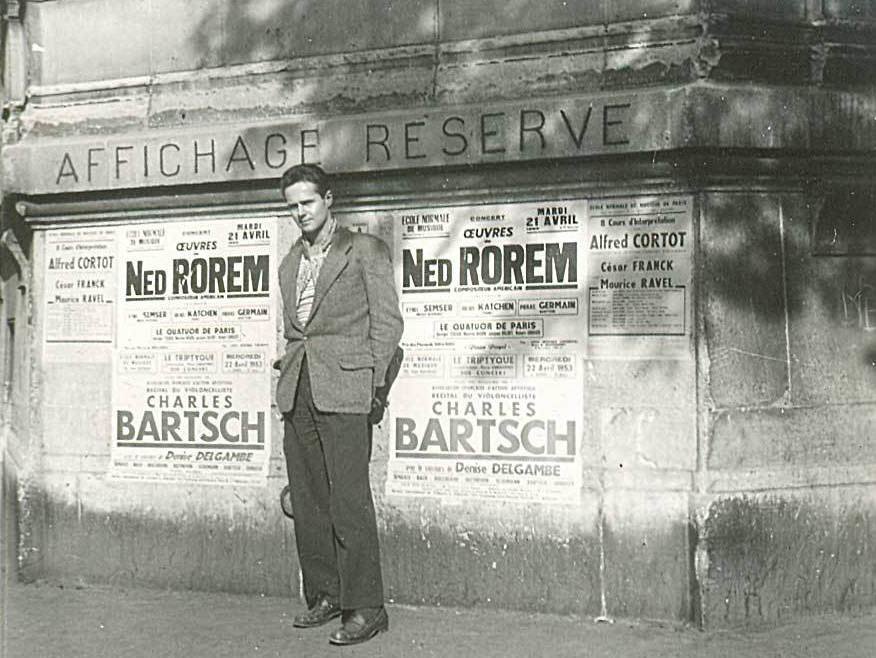
    PHOTO: André Previn, Ned Rorem, and Gary Graffman rehearse Rorem’s Piano Concerto for Left Hand and Orchestra
  • Remembering Ned Rorem: A Centennial Tribute

    Remembering Ned Rorem: A Centennial Tribute

    I’m up to my ears in housecleaning, digging through stacks of old boxes, exhuming all sorts of interesting concert programs and program guides, theater schedules, and personal writings, documents, and artwork, some of them dating back 40 years. The chain I’ve forged in life!

    Leave it to me not to throw anything away…

    But more on that in another post.

    For now, I wanted to quickly acknowledge American composer Ned Rorem, who would have been 100 today. Rorem died last year on November 18.

    I hope you’ll pardon me for stacking up a few links from last year.

    My 99th birthday post from 10/23/22

    Rorem’s obituary, on 11/18

    https://www.facebook.com/photo/?fbid=983194375932959&set=a.883855802533484

    Further reflections on 11/19

    https://www.facebook.com/photo/?fbid=983864249199305&set=a.883855802533484

    Rorem, Virgil Thomson, and William Flanagan for Thanksgiving

    https://www.facebook.com/photo/?fbid=988021188783611&set=a.883855802533484

    The posts include links to samples of Rorem’s music.

    Sorry, Ned, but the house is a wreck!


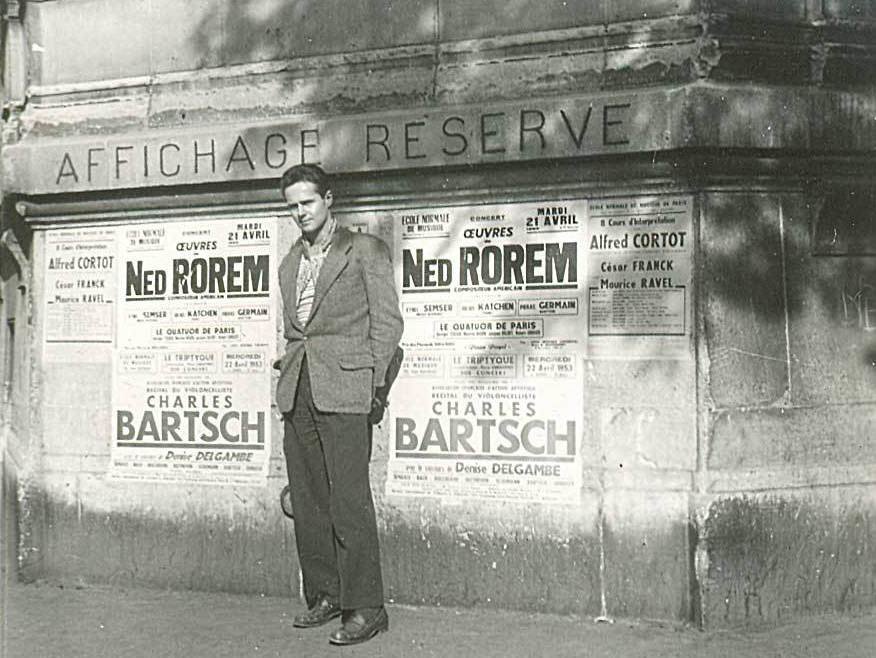
    PHOTO: Rorem in Paris in 1953

  • William Flanagan Rediscovered

    William Flanagan Rediscovered

    I apologize if, when writing about Howard Pollock’s Copland biography the other week, I may have come across as a tad immodest, when stating that, because of my lifelong mania for classical music, I was likely to have a more rounded understanding of the material than your average reader. As always, pride comes before the fall, as I’ve since encountered at least one name in the book that was entirely unfamiliar to me.

    On the anniversary of the birth of Virgil Thomson, here’s a photo of the composer, left, with his assistant and copyist, Ned Rorem, right. New to me is the figure at center, the composer William Flanagan.

    In his day, Thomson was an extraordinarily important figure in American music, both as a composer and as critic at the New York Herald-Tribune. Rorem, who died earlier this month, at the age of 99 (outliving even Thomson, who died at 92), is regarded one of the foremost composers of American art song.

    Rorem provided the entry for Flanagan in the “New Grove Dictionary of Music and Musicians.” In his book, “Music and People,” he described his musical style thusly: “Flanagan yearns… for the more easy communicative style that ripened in America nearly twenty years ago [in the 1940s]…. Flanagan’s musical ‘birth’ is of that time, and in growing he has remained faithful to its premise, if not to the specific mannerisms of the period.”

    Flanagan wrote a lot of music for the plays of Edward Albee, who was his longtime companion, as well as an opera with Albee after Melville’s “Bartleby the Scrivener.” At the time of his death, at 46, he was planning an artists’ colony in Montauk. This is now the William Flanagan Memorial Creative Persons Center (commonly referred to as “The Barn”), maintained by the Edward F. Albee Foundation.

    Flanagan was unusual among composers of his generation in expressing an unqualified and heartfelt enthusiasm for Copland’s music. He was among Copland’s students at Tanglewood in 1947.

    From Pollock’s book:

    “[A]ccording to Ned Rorem, Copland was, along with Ravel, “the twentieth-century musician closest to his heart.” “You know well that I have always been hopelessly addicted to your music,” Flanagan once wrote to Copland. “But addicted or not, I couldn’t be convinced that there is a composer living who could move ME, at any rate, as you do with the music of the mother’s closing song [in ‘The Tender Land’].” He also defended “Connotations” against the widely circulated “Total gloom descriptions” surrounding the work. In 1962, he described Copland as “the guy whose work has been the most important single influence on one’s way of thinking about the profession he has chosen to occupy his life.” Over the years, Copland regularly offered Flanagan advice and guidance; after Flanagan took his life in 1969, Copland eulogized him at a memorial concert.”

    Later in the book, Pollock writes:

    “William Flanagan similarly thought that whatever its strengths and weaknesses, the libretto [for ‘The Tender Land’] “falls into its properly subordinate place and the music moves in – a phenomenon that has occurred with many works in the standard operatic repertory. And this music is almost without question the finest composed for an American opera.”

    Flanagan managed to resist the dueling gravitational forces of both Stravinsky’s neoclassicism and Schoenberg’s dodecaphony. In common with Rorem, though less prolific, he was best-received as a song composer. His songs “Horror Movie” and “The Upside-Down Man” have been recorded, but so far I have been unable to locate any sound files. In fact, the only one of Flanagan’s pieces I’ve been able to find on the internet is “A Concert Ode” (1951):

    Happy birthday, Virgil Thomson; R.I.P., Ned Rorem; and hello, William Flanagan!


    The perfect Thanksgiving music? Virgil Thomson’s “Symphony on a Hymn Tune.”

    Another seasonal work: the Concertino for Harp, Strings and Percussion, “Autumn” – according to Thomson, actually more of a “portrait of an artist aging.”

    A fairly recent production of Thomson’s Susan B. Anthony opera “The Mother of Us All,” on a libretto by Gertrude Stein

    Rorem, “Four Poems of Walt Whitman”

    Rorem, Piano Concerto No. 2

    Copland, Suite from “The Tender Land”

  • Remembering Ned Rorem A Composer’s Legacy

    Remembering Ned Rorem A Composer’s Legacy

    After writing up a little salute to Ned Rorem the other week, on the occasion of his 99th birthday, I happened to read an interview he gave with Bruce Duffie, in which he confessed that it was important to him that his music will be remembered. It made me recollect how, upon hearing of the death of Aaron Copland, I wished I had written him a letter to let him know how much his music meant to me. I easily could have. Copland died in 1990.

    Similarly, Rorem’s remark made me think maybe I should send him a note. But I let the moment pass. In truth, his music never occupied the same kind of place in my heart as does Copland’s, but I am certainly grateful for it.

    Rorem died yesterday at the age of 99. Here’s a sampler of his music, with links to the Duffie interview and my write-up, in case you missed it.

    Leon Fleisher plays “3 Barcarolles” (1949)

    With Thanksgiving right around the corner, here’s a piece for string orchestra, called “Pilgrims” (1958). The composer hastens to point out that it has nothing to do with Plymouth Rock. Rather, it was inspired by a novel of Julien Green called “Le voyageur sur la terre.” The title in turn is borrowed from the Book of Hebrews: “These also died in faith, not having received the promises, but having seen them afar off… and confessed that they were strangers and pilgrims on the earth…” (Hebrews 11:13). Rorem points out that the music is less programmatic than it is a mood of remembrance.

    Typical of many of Rorem’s larger works, his Violin Concerto (1984) eschews a classical three-movement structure in favor of a suite of shorter movements, generally becoming lovelier and more heart-felt the closer you get to the center. In this case, there’s also a programmatic element, in that the movements are supposed to mirror a dusk-to-dawn progression.

    Bernstein conducts the world premiere of Rorem’s Symphony No. 3 at Carnegie Hall (1959)

    Anyone who’s ever read Rorem’s writings knows he definitely had his saucy side. He confessed he was shocked at having been awarded the Pulitzer Prize (for “Air Music” in 1976), since he figured the establishment would prefer to punish him for being such a naughty boy. “But it sort of gives you a certain authority,” he reflected. “My name is now always preceded by ‘Pulitzer Prize-winning composer.’ So if I die in a whorehouse, at least the obit will say ‘Pulitzer Prize-Winning Composer Ned Rorem Dies in Whorehouse.’”

    “Air Music” can be heard at the link, as part of a collection recorded by the Louisville Orchestra. The opening work, “Design for Orchestra” (1953), is certainly attractive.

    Rorem was always most highly-regarded for his art songs. He himself thought his song cycle “Evidence of Things Not Seen” (1998) – 36 songs for voice and piano – his finest work. Here are just a few selections.

    Rorem’s interview with Bruce Duffie

    http://www.bruceduffie.com/rorem.html

    My salute on October 23, with personal recollections of the composer

  • Ned Rorem Remembered American Composer Dies at 99

    Ned Rorem Remembered American Composer Dies at 99

    I am very sorry to learn that the American composer Ned Rorem has died, only weeks after my extensive write-up in celebration of his 99th birthday. If you missed it, hopefully you’ll be able to get there by clicking the link.

    So long, Ned. Thanks for all the music.

Tag Cloud

Aaron Copland (92) Beethoven (95) Composer (114) Film Music (120) Film Score (143) Film Scores (255) Halloween (94) John Williams (185) KWAX (229) Leonard Bernstein (100) Marlboro Music Festival (125) Movie Music (135) Opera (198) Philadelphia Orchestra (88) Picture Perfect (174) Princeton Symphony Orchestra (106) Radio (87) Ralph Vaughan Williams (85) Ross Amico (244) Roy's Tie-Dye Sci-Fi Corner (290) The Classical Network (101) The Lost Chord (268) Vaughan Williams (103) WPRB (396) WWFM (881)

DON’T MISS A BEAT

Receive a weekly digest every Sunday at noon by signing up here


RECENT POSTS