Franz Waxman, of course, was one of the great film composers. His music can be heard in “The Bride of Frankenstein,” “Rebecca,” “The Philadelphia Story,” “Sunset Boulevard,” “A Place in the Sun,” “Rear Window,” “Peyton Place,” “The Spirit of St. Louis,” and dozens of others.
It was customary that Waxman and his family would get together with their neighbors, the Jascha Heifetzes, to welcome the new year with an evening of chamber music. Other guests on these occasions would include violist William Primrose and cellist Gregor Piatigorsky.
Mainstream classical fare would dominate the festivities until the countdown to midnight. With the turn of the year, the musical selections would become a bit more frivolous.
Waxman composed his “Auld Lang Syne Variations” in 1947, for one such gathering. This party piece sends up the traditional New Year’s anthem in the styles of several well-known composers.
Feel free to play along and test your musical knowledge. You’ll find further clues in the work’s subtitles, listed below the video on YouTube. One can only imagine Heifetz stepping out in “Chaconne à Son Gout.”
Happy New Year!
Tag: New Year’s Eve
-

Waxman and Heifetz Toast the New Year
-

Laugh in the New Year with Gerard Hoffnung
It’s been quite a year, hasn’t it? Well, 2026 can only be better. Right? RIGHT?
In any case, it’s been said that laughter is the best medicine. Therefore, this week on “The Lost Chord,” we’ll do our best to laugh in the New Year with highlights from the notorious and uproarious Hoffnung Music Festival concerts.
Gerard Hoffnung was a boy when his family arrived in London, refugees from Nazi Germany. In his new home, he cultivated the persona of an English gentleman, though one with a decidedly impish bent. He attained celebrity through his work as a cartoonist, a sparkling panelist, and a public speaker. He was lauded as a brilliant improviser with a dry wit and a masterly sense of timing. He also played the tuba well enough that he was able to tackle the Vaughan Williams concerto.
Following a successful April Fool’s concert in 1956, Hoffnung embarked on the enterprise which, alongside his cartooning, ensured a kind of immortality – the first of the Hoffnung Music Festival concerts. The concerts brought together representatives of England’s finest musical talent to lampoon what, especially at the time, might have been perceived as a rather stodgy art form.
There would be three Hoffnung concerts in all. Alas, the third was presented posthumously. Hoffnung collapsed at his home in 1959, and died of a cerebral hemorrhage three days later, at the age of only 34. An untimely finish for a character who seemed his entire life to be a brilliant, fully-developed, middle-aged man, always at the peak of his form.
I hope you’ll join me as we celebrate Hoffnung’s whimsical legacy. We’ll hear Sir Malcolm Arnold’s “A Grand, Grand Overture,” for orchestra, organ, electric floor polisher, and three vacuum cleaners – the work was dedicated to President HOOVER – and Franz Reizenstein’s “Concerto populare,” billed as “a piano concerto to end all piano concertos,” among others.
It’s a lighthearted playlist calculated to put a smile on your face and lend a boost to your spirits – to say nothing of your immune system. He who laughs last laughs best. So “Have a Ball,” on “The Lost Chord,” now in syndication on KWAX Classical Oregon!
——–
Clip and save the start times for all three of my recorded shows:
PICTURE PERFECT, the movie music show – Friday at 8:00 PM EST/5:00 PM PST
SWEETNESS AND LIGHT, the light music program – Saturday at 11:00 AM EST/8:00 AM PST
THE LOST CHORD, unusual and neglected rep – Saturday at 7:00 PM EST/4:00 PM PST
Stream them, wherever you are, at the link!
https://kwax.uoregon.edu -
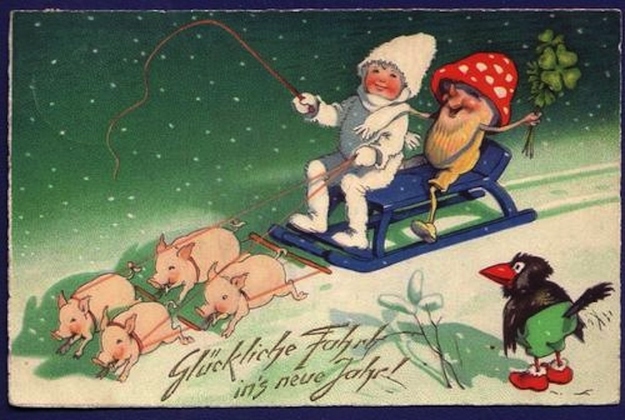
New Year’s Eve in a Single Image
They say a picture is worth a thousand words. I think this one pretty much encapsulates my sentiments and impressions, touching the last 24 hours, better than I could ever express. Happy journey into the new year, everyone!
-
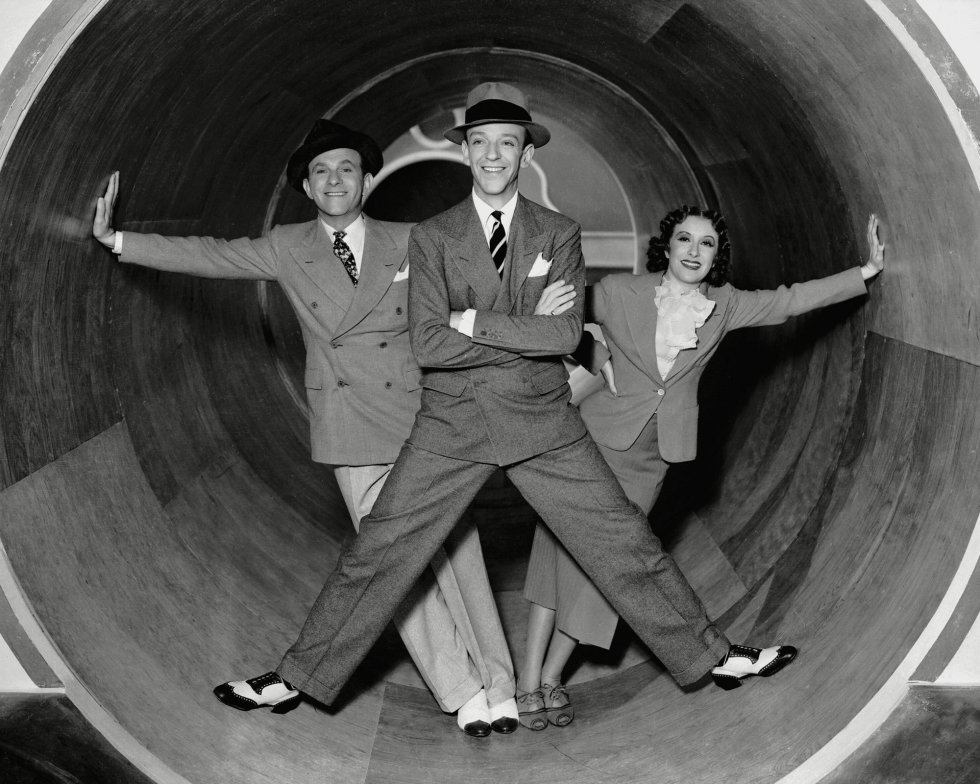
Dance Movie Magic for New Year’s Eve
Slip on your dancing shoes and get ready to welcome the new year! This week on “Picture Perfect,” it’s music from movies with a prominent role for dance.
“The Tales of Beatrix Potter” (1971) was inspired by the popular children’s stories, with anthropomorphized animals in hounds-tooth vests and that sort of thing. Conceived for film by Frederick Ashton, it features a buoyant pastiche score by John Lanchery, drawn from various sources, including works of Sir Arthur Sullivan, Michael Balfe, Leon Minkus and Jacques Offenbach.
Then relive the nightmare vision of “The Red Shoes” (1948). Written, directed and produced by the team of Michael Powell and Emeric Pressburger, this feverish dance film stars Scottish ballerina Moira Shearer. At its center is a story within the story, inspired by the Hans Christian Anderson tale about a girl whose vanity lends demonic power to her ruby footwear, with tragic consequences.
The music is by Brian Easdale, who conducted his own score. However, for the film’s ballet sequence, Easdale specifically requested the services of Sir Thomas Beecham, who leads the Royal Philharmonic Orchestra.
Screenwriter Ben Hecht worked on an astonishing number of Hollywood classics, including “Scarface,” “The Front Page,” “Nothing Sacred,” “His Girl Friday,” and Alfred Hitchcock’s “Spellbound.” Alongside his dozens of screen credits are uncredited contributions for work on films like “Stagecoach,” “Gone with the Wind,” “The Shop Around the Corner,” and “The Thing from Another World.” Because of his versatility, speed, and reliability, he became known as “the Shakespeare of Hollywood.”
Twice, he was given free rein to direct his own projects. One of these was a quirky ballet-noir, called “Specter of the Rose” (1946). The plot concerns an unbalanced ballet superstar, played by Ivan Kirov – who looks all the world like Steve Martin – who is suspected of murdering his first wife, his former dance partner. If so, will history repeat itself, with his new bride? With dialogue stylized to the point of absurdity, it’s a film that has to be seen to be believed. The music is by Trenton-born “Bad Boy of Music” George Antheil.
Much more considered is Luchino Visconti’s adaptation of Giuseppe di Lampedusa’s novel, “The Leopard” (1963). Burt Lancaster stars as a fading aristocrat around the time of Italian unification. The film’s memorable ballroom sequence occupies the last third of its three-hour running time. Nino Rota supplied the music.
Finally, no show which purports to be about dance in the movies would be complete without music representative of Fred Astaire. Therefore, we’ll conclude with the funhouse dance sequence from “A Damsel in Distress” (1937). No Ginger Rogers in this one – rather Joan Fontaine, George Burns, and Gracie Allen. The energetic score is by George Gershwin.
Set the tone for celebration with tunes from movies with dance, on “Picture Perfect,” this Saturday evening – New Year’s Eve – at 6:00 EST, on WWFM – The Classical Network and wwfm.org!
-
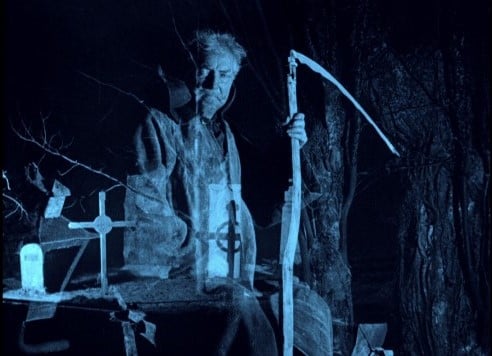
Phantom Carriage A New Year’s Ghost Story
If you can’t stand the whole, stupid Times Square thing – which promises to be even stupider this year, in the middle of a pandemic – you could do a lot worse than to watch “The Phantom Carriage” (1921).
Based on a novel by Selma Lagerlöf (of “Gösta Berling’s Saga” fame), this New Year’s Eve ghost story is like a Swedish cousin to Charles Dickens’ “A Christmas Carol.” The director, Victor Sjöström, plays what must be one of the least sympathetic antiheroes in all of cinema. His character, David Holm, is vindictive and mean-spirited – alcoholic, abusive, and a destructive influence on everyone around him. If there’s one character who’s beyond redemption, you figure it’s got to be Holm, who makes Ebenezer Scrooge look like a charm school graduate.
Holm hits the bottle with a couple of his drinking buddies in a cemetery a few minutes to midnight on New Year’s Eve, as saintly Salvation Army sister Edit calls for him on her deathbed. She’s dying of the consumption she contracted caring for Holm for the first time exactly one year ago. But she clings to life, waiting for confirmation of her belief in Holm’s inherent goodness.
Holm dismisses Sister Edit’s messenger and relates a story to his companions about a former acquaintance, university-educated Georges, who started him down the path of dissolution. It was Georges who introduced him to, among other things, the legend of the Phantom Carriage. The last person to die each year, we’re told, is fated to drive Death’s carriage. In this capacity, very dreary work, the departed must collect all the souls of the dead for the following year. With a sense of foreboding, Georges, the bon vivant, blanches every New Year’s Eve, climbs into his bunk, and stares at the wall.
Wouldn’t you know it, his premonition comes to pass. Georges was the last to die the previous year. And now selfish, belligerent Holm takes a fatal crack on the head just at the stroke of 12:00. Thus begins a strange reunion between master and disciple, with Georges directing Holm’s spirit to the sites of all the misery he’s caused. The rest of the story plays out like the Ghost of Christmas Yet to Come, without the laughs.
The film is fascinating in a way only silent movies are – especially dreamlike in its double-exposure effects of the Phantom Carriage – but the human story is also surprisingly absorbing. There’s one Holm freakout that seems to anticipate Stanley Kubrick’s “The Shining.” For my money “Häxan” (1922), by Danish director Benjamin Christensen, is still the benchmark for silent lurid thrills. “The Phantom Carriage” isn’t really about that. There are no witches’ sabbaths or children being hurled into cauldrons. The power of Sjöström’s film is in its ability to reach across 100 years to engage us with its humanity.
The film opened in Scandinavia on New Year’s Day, 1921. Ingmar Bergman loved this movie, and it’s easy to see parallels between Holm’s conversations with the Grim Reaper and the iconic chess match between the Knight and implacable Death in “The Seventh Seal.” Sjöström himself would later play the lead in Bergman’s “Wild Strawberries.” Bergman first saw “The Phantom Carriage” at the age of 15 and claimed to watch it at least once every year.
It’s not a film that will bring a smile to your face on New Year’s Eve. But then, I never smile on New Year’s. Take that, you filthy Mummers.
Tag Cloud
Aaron Copland (92) Beethoven (94) Composer (114) Film Music (117) Film Score (143) Film Scores (255) Halloween (94) John Williams (185) KWAX (228) Leonard Bernstein (99) Marlboro Music Festival (125) Movie Music (132) Opera (197) Philadelphia Orchestra (86) Picture Perfect (174) Princeton Symphony Orchestra (106) Radio (86) Ralph Vaughan Williams (85) Ross Amico (244) Roy's Tie-Dye Sci-Fi Corner (290) The Classical Network (101) The Lost Chord (268) Vaughan Williams (99) WPRB (396) WWFM (881)