Tag: Niagara Symphony

  • P.T. Barnum & American Composers

    P.T. Barnum & American Composers

    I wrote this on August 10th last year, but I hope you’ll indulge me, as I don’t think it can be improved upon!


    P.T. Barnum is in the center ring today, with two works by American composers born on this date.

    William Henry Fry was born in Philadelphia in 1813. Credited with being the first U.S.-born composer to write music on a large scale, he composed orchestral works and the first opera by an American to be performed publicly in his lifetime (“Leonora,” in 1845). He was an outspoken advocate of American music at a time when German imports ruled the roost. It would be decades before music by our native composers would gain a toehold in the concert halls, which makes Fry an even more remarkable figure.

    Fry studied music with a former bandleader in Napoleon Bonaparte’s army, who went on to become the head of Philadelphia’s Musical Fund Society. Fry himself would become the society’s secretary.

    He was also a journalist, a writer on music, and the first music critic to write for a major American newspaper. He was a foreign correspondent for the Philadelphia Public Ledger and acted as music critic for the New York Herald Tribune.

    He composed seven symphonies, all of them of a descriptive nature. One of his most audacious works was commissioned by Barnum. The “Niagara Symphony” (1854) was conceived for enormous forces, augmented by a mind-blowing eleven timpani. Someone should consider putting this on the same program with Berlioz’s Requiem. Though it is possible all that percussion really would turn out to be too much of a good thing!

    Barnum once tried to buy Niagara Falls, but New York State wasn’t selling. So he constructed a replica, in miniature, “with real water,” for his American Museum (ironically, destroyed by fire in 1865), then located at the corner of Broadway, Park Row, and Ann Street, in Lower Manhattan. Among the other featured attractions was the notorious “Feejee Mermaid.”

    80 years after Fry’s birth, Douglas Moore was born into an established Long Island family. (The family had lived there since the island’s settling in the 17th century.) He attended, among other institutions, Yale University, where he earned two degrees; then he was off to Paris to study with Vincent d’Indy, Ernest Bloch, and Nadia Boulanger.

    Moore went on to serve as president of the National Institute and American Academy of Arts and Letters and director of music at the Cleveland Museum of Art. In 1926, he joined the faculty of Columbia University, where he remained until his retirement in 1962. With Otto Luening and Oliver Daniel, he cofounded the CRI (Composers Recordings, Inc.) label.

    Moore was the recipient of the Pulitzer Prize for Music in 1951 for his opera “Giants in the Earth.” But he is probably best-known for the opera “The Ballad of Baby Doe,” which became such a memorable vehicle for Beverly Sills.

    Moore’s Barnum connection is by way of a concert suite, composed in 1924. “The Pageant of P.T. Barnum” was inspired by the Greatest Showman’s life and outlandish attractions. The work falls into five movements:

    “Boyhood at Bethel”

    “Joice Heth – 161 Year Old Negress” [sic]

    “General and Mrs. Tom Thumb”

    “Jenny Lind”

    “Circus Parade”

    Barnum’s circus may have folded in 2017 (after 146 years in existence), but there’s still a sucker born every minute.


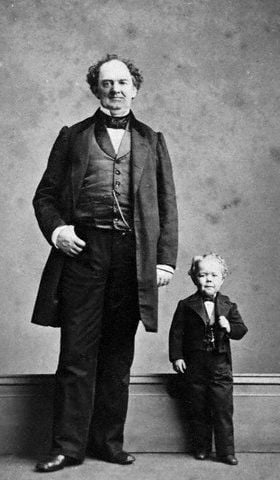
    CLOCKWISE FROM LEFT: Barnum & Tom Thumb, William Henry Fry, and Douglas Moore
  • Barnum & American Composers Fry and Moore

    Barnum & American Composers Fry and Moore

    P.T. Barnum is in the center ring today, with two works by American composers born on this date.

    William Henry Fry was born in Philadelphia in 1813. Credited with being the first U.S.-born composer to write music on a large scale. he composed orchestral works and the first opera by an American to be performed publicly in his lifetime (“Leonora,” in 1845). He was an outspoken advocate of American music at a time when German imports ruled the roost. It would be decades before music by our native composers would gain a toehold in the concert halls, which makes Fry an even more remarkable figure.

    Fry studied music with a former bandleader in Napoleon Bonaparte’s army, who went on to become the head of Philadelphia’s Musical Fund Society. Fry himself would become the society’s secretary.

    He was also a journalist, a writer on music, and the first music critic to write for a major American newspaper. He was a foreign correspondent for the Philadelphia Public Ledger and acted as music critic for the New York Herald Tribune.

    He composed seven symphonies, all of them of a descriptive nature. One of his most audacious works was commissioned by Barnum. The “Niagara Symphony” (1854) was conceived for enormous forces, augmented by a mind-blowing eleven timpani. Someone should consider putting this on the same program with Berlioz’s Requiem. Though it is possible all that percussion really would turn out to be too much of a good thing!

    Barnum once tried to buy Niagara Falls, but New York State wasn’t selling. So he constructed a replica, in miniature, “with real water,” for his American Museum (ironically, destroyed by fire in 1865), then located at the corner of Broadway, Park Row, and Ann Street, in Lower Manhattan. Among the other featured attractions was the notorious “Feejee Mermaid.”

    80 years after Fry’s birth, Douglas Moore was born into an established Long Island family. (The family had lived there since the island’s settling in the 17th century.) He attended, among other institutions, Yale University, where he earned two degrees; then he was off to Paris to study with Vincent d’Indy, Ernest Bloch, and Nadia Boulanger.

    Moore went on to serve as president of the National Institute and American Academy of Arts and Letters and director of music at the Cleveland Museum of Art. In 1926, he joined the faculty of Columbia University, where he remained until his retirement in 1962. With Otto Luening and Oliver Daniel, he cofounded the CRI (Composers Recordings, Inc.) label.

    Moore was the recipient of the Pulitzer Prize for Music in 1951 for his opera “Giants in the Earth.” But he is probably best-known for the opera “The Ballad of Baby Doe,” which became such a memorable vehicle for Beverly Sills.

    Moore’s Barnum connection is by way of a concert suite, composed in 1924. “The Pageant of P.T. Barnum” was inspired by the greatest showman’s life and outlandish attractions. The work falls into five movements:

    “Boyhood at Bethel”

    “Joice Heth – 161 Year Old Negress” [sic]

    “General and Mrs. Tom Thumb”

    “Jenny Lind”

    “Circus Parade”

    Barnum’s circus may have folded in 2017 (after 146 years in existence), but there’s still a sucker born every minute.


    CLOCKWISE FROM LEFT: Barnum & Tom Thumb, William Henry Fry, and Douglas Moore

  • William Henry Fry: American Music Pioneer Died in St. Croix

    William Henry Fry: American Music Pioneer Died in St. Croix

    William Henry Fry died in Saint Croix on this date in 1864.

    Born in Philadelphia in 1813, Fry was pioneering figure in American music, the first native-born composer to write on a large scale. He composed orchestral works and the first opera by an American to be performed publicly during his lifetime (“Leonora,” in 1845). He was also an outspoken advocate of American music – that is to say, music composed by Americans – at a time when German imports ruled the roost. It would be decades before American music would gain a toehold in the concert halls, which makes Fry an even more remarkable figure.

    He studied music with a former bandleader in Napoleon Bonaparte’s army, who went on to become the head of Philadelphia’s Musical Fund Society. Fry himself would become the society’s secretary.

    He was also a journalist, a writer on music, and the first music critic to write for a major American newspaper. He was a foreign correspondent for the Philadelphia Public Ledger and acted as music critic for the New York Herald Tribune.

    Fry composed seven symphonies, all of them of a descriptive nature. My personal favorite is the “Niagara Symphony,” written for P.T. Barnum, conceived for enormous forces augmented by eleven timpani (because ten just won’t do).

    Fry died of tuberculosis, “accelerated by exhaustion,” at the age of 51. Sure, he died in Saint Croix (a.k.a. Santa Cruz), but he lives on in this “Santa Claus Symphony” (1853), more fussily detailed in its program than anything by Richard Strauss. Forget Macy’s. There’s more of Moore in this jolly old elf than there is Coca-Cola.


    NASTY SANTA: Illustration by Thomas Nast (c. 1872)

  • William Henry Fry’s Fry Day Surprise

    William Henry Fry’s Fry Day Surprise

    Raising the false hopes of workers everywhere, Monday is “Fry Day” this week – as today happens to coincide with the birthday of William Henry Fry. Maybe.*

    Fry was born in Philadelphia in 1813. A pioneering figure in American music, he was the first native-born composer to write on a large scale. He composed orchestral works and the first opera by an American to be performed publicly in his lifetime (“Leonora,” in 1845). He was an outspoken advocate of American music – that is, music composed by Americans – at a time when German imports ruled the roost. It would be decades before American music would gain a toehold in the concert halls, which makes Fry an even more remarkable figure.

    Fry studied music with a former bandleader in Napoleon Bonaparte’s army, who went on to become the head of Philadelphia’s Musical Fund Society. Fry himself would become the society’s secretary.

    He was also a journalist, a writer on music, and the first music critic to write for a major American newspaper. He was a foreign correspondent for the Philadelphia Public Ledger and acted as music critic for the New York Herald Tribune.

    He composed seven symphonies, all of them of a descriptive nature. His “Santa Claus Symphony,” after Clement Moore, is more of a Straussian tone poem. My personal favorite, though, is the “Niagara Symphony.” Written for P.T. Barnum, the work is conceived for enormous forces augmented by a mind-blowing eleven timpani.

    Hear this sublime work this afternoon on The Classical Network in a recording on the Naxos label. The album features liner notes by my friend and colleague Kile Smith. For 18 years, Kile was curator of the Fleisher Collection of Orchestral Music at the Free Library of Philadelphia, the world’s largest lending library of orchestral performance materials, where Fry’s scores are housed.

    Kile, of course, is also an entertaining writer, a personable radio presence, and a terrific composer. His latest album, “The Arc in the Sky,” was released last month on Navona Records, a subsidiary of Parma Recordings. The hour-long work was commissioned by the Grammy Award winning choir, The Crossing. It is one of five CDs of Kile’s music to be issued over the past year.

    I’ll further exploit the Fry connection to share some of Kile’s music this afternoon, following on the heels of the “Niagara Symphony.” Out of the Fry and into the Kile, so to speak.

    It will be more fun than going over the falls in a barrel, from 4 to 7 p.m. EDT, on WWFM – The Classical Network and wwfm.org.


    • There is some discrepancy regarding the date of Fry’s birth, with some sources giving August 10, and others August 19. So maybe it is just Monday, after all.

    More about Kile Smith here: kilesmith.com

  • William Henry Fry Birthday Fry Day?

    William Henry Fry Birthday Fry Day?

    When is Saturday “Fry Day?” Why, when it’s the birthday of William Henry Fry, of course!

    Fry was born in Philadelphia in 1813. A pioneering figure in American music, he was the first native-born composer to write on a large scale. He composed orchestral works and the first opera by an American to be performed publicly in his lifetime (“Leonora,” in 1845). He was an outspoken advocate of American music – that is, music composed by Americans – at a time when German imports ruled the roost. It would be decades before American music would gain a toehold in the concert halls, which makes Fry an even more remarkable figure.

    He studied music with a former bandleader in Napoleon Bonaparte’s army, who went on to become the head of Philadelphia’s Musical Fund Society. Fry himself would become the society’s secretary.

    Fry was also a journalist, a writer on music, and the first music critic to write for a major American newspaper. He was a foreign correspondent for the Philadelphia Public Ledger and acted as music critic for the New York Herald Tribune.

    He composed seven symphonies, all of them of a descriptive nature. His “Santa Claus Symphony,” after Clement Moore, is more of a Straussian tone poem. My personal favorite is the “Niagara Symphony,” written for P.T. Barnum, conceived for enormous forces augmented by a mindblowing eleven timpani.

    Fry died of tuberculosis, “accelerated by exhaustion,” in Santa Cruz (Saint Croix) in the Virgin Islands in 1864, at the age of 51.

    There is some discrepancy regarding the date of his birth, with some sources giving August 10, and others August 19. So maybe it’s not Fry Day, after all.

    Happy birthday (perhaps belatedly), William Henry Fry.

    The “Niagara Symphony” (it begins quietly):

Tag Cloud

Aaron Copland (92) Beethoven (94) Composer (114) Film Music (117) Film Score (143) Film Scores (255) Halloween (94) John Williams (185) KWAX (228) Leonard Bernstein (99) Marlboro Music Festival (125) Movie Music (132) Opera (197) Philadelphia Orchestra (86) Picture Perfect (174) Princeton Symphony Orchestra (106) Radio (86) Ralph Vaughan Williams (85) Ross Amico (244) Roy's Tie-Dye Sci-Fi Corner (290) The Classical Network (101) The Lost Chord (268) Vaughan Williams (99) WPRB (396) WWFM (881)

DON’T MISS A BEAT

Receive a weekly digest every Sunday at noon by signing up here


RECENT POSTS