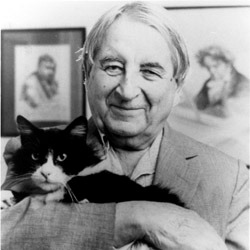
For the birthday of Nicolas Slonimsky (1894-1995), here a few favorites from his sidesplitting 1953 compendium of critical vitriol, “Lexicon of Musical Invective”:
“We recoil in horror before this rotting odor which rushes into our nostrils from the disharmonies of this putrefactive counterpoint. His imagination is so incurably sick and warped that anything like regularity in chord progressions and period structure simply do not exist for him. Bruckner composes like a drunkard!”
(Gustav Dompke, The German Times of Vienna, 1886)
“Heartless sterility, obliteration of all melody, all tonal charm, all music… This reveling in the destruction of all tonal essence, raging satanic fury in the orchestra, this demoniacal, lewd caterwauling, scandal-mongering, gun-toting music, with an orchestral accompaniment slapping you in the face… Hence, the secret fascination that makes it the darling of feeble-minded royalty… of the court monkeys covered with reptilian slime, and of the blasé hysterical female court parasites who need this galvanic stimulation by massive instrumental treatment to throw their pleasure-weary frog-legs into violent convulsion… the diabolical din of this pig-headed man, stuffed with brass and sawdust, inflated, in an insanely destructive self-aggrandizement, by Mephistopheles’ mephitic and most venomous hellish miasma, into Beelzebub’s Court Composer and General Director of Hell’s Music – Wagner!”
(J.L. Klein, “History of the Drama,” 1871)
And of course, who could forget:
“The violin is no longer played; it is pulled, torn, drubbed…. We see plainly the savage vulgar faces, we hear curses, we smell vodka.… Tchaikovsky’s Violin Concerto gives us for the first time the hideous notion that there can be music that stinks to the ear.”
(Eduard Hanslick, New Free Press, Vienna, 1881)
Tchaikovsky could recite from memory every word of Hanslick’s sustained screed, from which this is but an excerpt.
The “Lexicon” is just the tip of the Slonimsky iceberg. Slonimsky conducted first performances of works by Ives and Varèse. He edited “Baker’s Biographical Dictionary of Musicians” from 1940 to 1992. His “Thesaurus of Scales and Melodic Patterns” influenced musicians from John Coltrane to Frank Zappa to John Adams. His sly wit made him a favorite guest on radio and television programs, including “The Tonight Show.” The man had so much vitality, it’s hardly surprising that he lived to be 101.
Happy birthday, Nicolas Slonimsky.
MUST SEE: Slonimsky on “The Tonight Show” with Johnny Carson in 1986, at the age of 92. It was a different world.
His pioneering recording of Varèse’s “Ionisation,” from 1934
Piano improvisation with Frank Zappa in 1981. Zappa introduces him at around 1:50.
“Children Cry for Castoria”
Documentary, “Nicolas Slonimsky: A Touch of Genius,” narrated by Michael York:
“In my lifetime, when I was in the conservatory, in order to hear a Brahms symphony, I had to study the score or actually hear the symphony, because there was no other way! Now, a good Juilliard School student probably knows more about music history than a specialist 100 years ago, because of the availability of recordings and publication of miniature scores. In my time, I would have to go to the library and get a contemporary edition of whatever score I wanted to consult, and the scores were very difficult to obtain. Now, if you want the Haydn Symphony No. 74, it is produced immediately, as are any others!”
A reminder of how fortunate we are, in this modern age, to have so much at our fingertips. And this was before YouTube! Read the rest in Bruce Duffie’s interview, transcribed here:
http://www.bruceduffie.com/slonimsky.html
John Adams’ “Slonimsky’s Earbox,” composed in 1996, after Slonimsky’s death, an attempt to “memorialize his wit and hyper-energetic activity” and to acknowledge Adams’ debt to the scales and harmonies gleaned from Slonimsky’s “Thesaurus.”
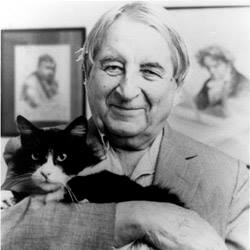
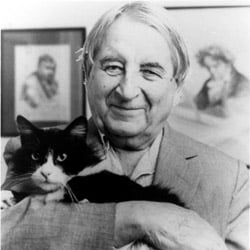
PHOTO: Slonimsky with his cat, Grody-to-the-Max!