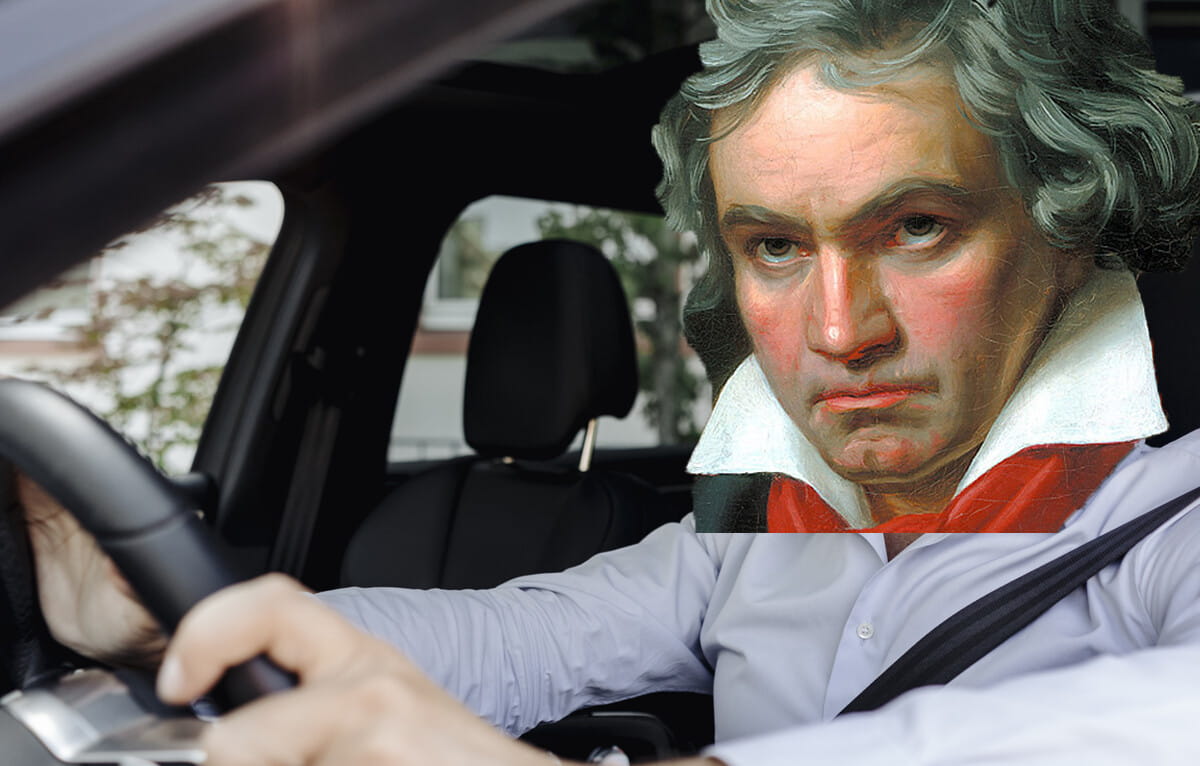
The Beethoven rumble strip in the United Arab Emirates has been getting some press recently.
You know what a rumble strip is, right? They’re those irregularities in the pavement installed to jolt you awake when you’re about to drift off the road, or to warn you to slow down when you’re entering a hairpin turn. I suppose it was only a matter of time before someone would figure out that different rhythms and pitches could be produced by varying the spacing of the strips. When driven over at a certain speed recognizable melodies emerge.
Fujairah has decided to emulate Beethoven’s “Ode to Joy.”
I don’t know how many of these “musical roads” there are in the world, but the number must currently be pushing 50. (The most recent tabulation I could find was 46 in 2022.)
The first known musical road was created in Denmark in 1995. Argentina, Belarus, China, Hungary, Indonesia, Iran, Russia, San Marino, South Korea, and Taiwan followed. Japan, the musical road champ, has at least 30. The U.S. has at least three. France and the Netherlands had some for a while, but they were paved over.
It’s true, musical roads might be considered a nuisance by some, especially those living nearby, who have to contend not only with the incessant repetition of “Ode to Joy,” for instance, but also increased volume of traffic due to curiosity seekers.
Often the melodies can be made out only when the strips are encountered at a correct, consistent speed. In at least one instance, in California, a strip was paved over after residents complained and then reconstructed elsewhere. Unfortunately, the construction workers confused the measurements, so what you get is a badly out of tune “William Tell Overture.”
One post beneath the video suggests that the tune would sound correct if you hit it at 100 m.p.h. I’m not condoning it; just saying.
Hi ho, Silver! Away!
FUN FACT, though hardly surprising: It was New Jersey that installed the earliest-known rumble strips, on the Garden State Parkway, in 1952.
ADDENDUM: Okay, so it looks like Little Alex and his droogs decided to go back and hit the “William Tell” strip at 100 m.p.h. Still pretty wonky, but worth it for the laugh.
In the past, May 7 was a day for frenemies, as I’ve always been fond of emphasizing the uneasy friendship of Brahms and Tchaikovsky on their birthday anniversaries – artists repelled by one another’s creations, who were pleasantly surprised by how well they got along once they met in person (though they still disliked one another’s music). The alcohol they consumed certainly could not have hurt.
However, today, we put all that frenemy business aside, as all men are brothers, when the birthdays of Brahms and Tchaikovsky coincide with the 200th anniversary of the premiere of Beethoven’s Symphony No. 9. The Ninth, of course, is the visionary symphony that climaxes with an ecstatic setting of Schiller’s “Ode to Joy.” Everyone knows the melody, even if they think they don’t. The text proclaims, depending on the translation, “All mankind will become as brothers!”
The tune is demonstrated here by Schroeder, insistently joyous even in the face of Lucy’s hostility:
Beethoven’s revolutionary masterwork, striking for both its scale (oversized orchestra with a quartet of vocal soloists and chorus) and length (running to well over an hour), cast a forbidding shadow. Much ink has been spilled about the struggles of composers throughout the 19th century to come to terms with the Ninth. In fact, I remember reading a book by conductor Felix Weingartner, a renowned Beethoven interpreter (he was the first to record all nine symphonies), titled “On the Performance of Beethoven’s Symphonies and Other Essays,” in which he addresses the successes and failures of all the major symphonic composers that followed.
The story of the legendary first performance of the work, on May 7, 1824, is well-known, but bears repeating. The auditorium of Vienna’s Theater am Kärntnertor (Carinthian Gate Theater) was packed – Schubert was in attendance, and so was Czerny – and the orchestra was staffed by many of the great musicians of the day. No complete roster of performers survives, but as was the case with the all-star team that played in the premiere of Beethoven’s 7th, many of Vienna’s most elite musicians participated.
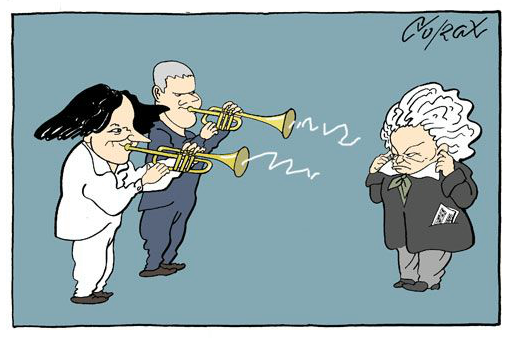
It was Beethoven’s first public appearance in 12 years. By that time, of course, the composer was almost completely deaf. But that didn’t keep him from air-conducting as the ideal interpretation unfurled in his head. The official conductor was the theater’s kapellmeister, Michael Umlauf, and he instructed the musicians to watch him, not the composer, as he had witnessed an earlier disaster with Beethoven in the pit for a dress rehearsal for “Fidelio.”
According to one of the violinists, Beethoven “stood in front of a conductor’s stand and threw himself back and forth like a madman. At one moment he stretched to his full height, at the next he crouched down to the floor, he flailed about with his hands and feet as though he wanted to play all the instruments and sing all the chorus parts.”
When the piece concluded, the hall resounded with applause, but Beethoven was still conducting. The contralto soloist, Karoline Unger, approached the composer and gently turned him around to acknowledge the cheers. Members of the audience, who recognized they could not be heard, waved their handkerchiefs, hats, and hands, so that even in his isolation, the composer knew he had scored a hit.
Mankind never does seem to get its act together, but even as the world teeters on the brink of disaster, the Ninth continues to resonate. Concert halls fill wherever it is programmed. When the compact disc was developed, technicians standardized the length at 74 minutes, so that the format could accommodate a complete recording of the work. (In the days of LP, I recall some rather awkward breaks in the middle of the third movement.) Used as the prototype was Wilhelm Furtwängler’s 1951 recording.
In the history of music, the Ninth stands like the monolith in Stanley Kubrick’s “2001: A Space Odyssey.” (Interesting that Kubrick would use the work to such ironic effect a few years later in “A Clockwork Orange.”) There was music before the Ninth and there was music after the Ninth. From a certain point of view, everything seemed to culminate in its creation, and afterward, all was decadence. It is the Continental Divide of classical music.
For the Romantics, the Ninth changed everything. Every composer for a hundred years had to grapple with its influence. For the rest of the century, experiments with orchestra and chorus became larger and larger, setting all manner of aspirational texts. Mahler pushed 74 minutes to 90 with his Third Symphony. His Eighth is so large, it was dubbed “The Symphony of a Thousand.” In the 20th century, there was nowhere to go but down. Even as composers embraced the leaner textures of neoclassicism they continued to labor in the shadow of Beethoven, whether assimilating his lessons or rejecting them.
The inclusion of the chorus is the most obvious innovation, but Beethoven wouldn’t be Beethoven if there weren’t plenty else to reward a closer look, and musicians and scholars have been dissecting the work and studying its secrets for the past two centuries.
Brahms, who lived from 1833 to 1897, and Tchaikovsky, who lived from 1840 to 1893, were no different from their contemporaries in feeling the heat of the 9th. It is well-known that Brahms experienced enormous pressure in his own mastery of symphonic form, postponing his first symphony for many years, as he continued to hone his skills on works such as the orchestral Serenades and the Piano Concerto No. 1, the latter conceived on a suspiciously symphonic scale. It took him over twenty years to own up to an actual symphony.
At its debut, conductor Hans von Bülow dubbed it “Beethoven’s Tenth,” no doubt because of its excellence, but also because of the perceptible influence of the earlier composer. It was Bülow who also formulated “the three B’s,” grouping Bach, Beethoven, and Brahms in a spontaneously-erected pantheon that music-lovers still invoke. Brahms was surely relieved that the work was so rapturously received, but (being Brahms) he was also annoyed when it was pointed out that the chorale theme that forms the basis of the last movement bears an uncanny resemblance to Beethoven’s “Ode to Joy.” To this, Brahms gruffly responded, “Any ass can see that!”
I’ve cued the theme up for you at the link, but nothing’s stopping you from going back to listen to the entire symphony:
After the First, things came easier for Brahms. The ice broken, he composed his Symphony No. 2, with confidence, in a single summer.
In Tchaikovsky’s case, his own predilection gravitated more toward Mozart. This is evident, of course, in his Orchestral Suite No.4, subtitled “Mozartiana,” but also in the “Variations on a Rococo Theme” for cello and orchestra. He confided to his diary, “I do bow before the greatness of some of his works, but I do not love Beethoven.” That’s not to say he did not respect, or even revere him. His remarks are more nuanced than I make them out to be. You’ll find his complete thoughts here, including the diary entry from which I excerpt, at the bottom of the page:
Fascinating, then, that Tchaikovsky would exhibit such youthful bravado in setting Schiller’s text himself for his graduation examinations at the St. Petersburg Conservatory! This is a stunning display of self-assurance for a composer who frequently struggled with insecurity. He later dismissed the work as immature, but it is certainly worth hearing:
In Beethoven, as in all things, it seems, Brahms and Tchaikovsky were divided. Fortunately, they were united in the brotherhood of drink.
Happy birthday to the Felix and Oscar of classical music, and raise a glass to the most important symphony ever written, with a thought for the brotherhood of man, now to be desired as much as ever.
This brisk performance from 1958 is one of my favorites. Not for every day, perhaps, but thrilling.
Weingartner conducts in 1935
Furtwängler sets the standard length of the CD in 1951
Bernstein celebrates the fall of the Berlin Wall with a multinational ensemble in 1989, substituting “Freiheit” (Freedom) for Schiller’s “Freude” (Joy)
Needless to say, Beethoven’s 250th birthday year experienced something of a damper, thanks to a coronavirus curveball. A year ago, who’d a thunk that 2020 would have brought so few public concerts?
Perhaps more dispiriting is how Beethoven was reduced to a straw man and political punching bag by angry axe-grinders who don’t seem to understand the first thing about the man or his music. Or indeed the very nature of classical music, beyond what is perceived as a kind of “gatekeeper” mentality – basically that there is a tradition of concert etiquette in place, so that people can actually listen to music. Essentially, this involves sitting quietly, which from long experience I assure you is hard to do even for the old white mummies they disdain. It’s a little sad, after all this time – when concertgoing is more open and democratic than ever – to be reminded that the broader perception of classical music is still of a type that believes in the exclusionary, stuffed-shirt, hoity-toity behavior once mocked in Three Stooges comedies.
But this is far from the worst ignorance we’ve had to endure in 2020, so I shouldn’t let it get me down. As long as there are people who love and perform music, Beethoven is not going anywhere. In particular, the grandest of Beethoven’s symphonies, the Symphony No. 9, with its choral finale, has been something of a New Year’s tradition for decades, especially in the Far East.
The practice of playing Beethoven’s Ninth in Japan has its roots in World War I, when German POWs rehearsed and performed the work during their internment. After the war, they carried it with them as they were absorbed into the nation’s orchestras. In an ordinary year, Beethoven’s Ninth now resounds throughout Tokyo, a city with more Western-style orchestras than Berlin.
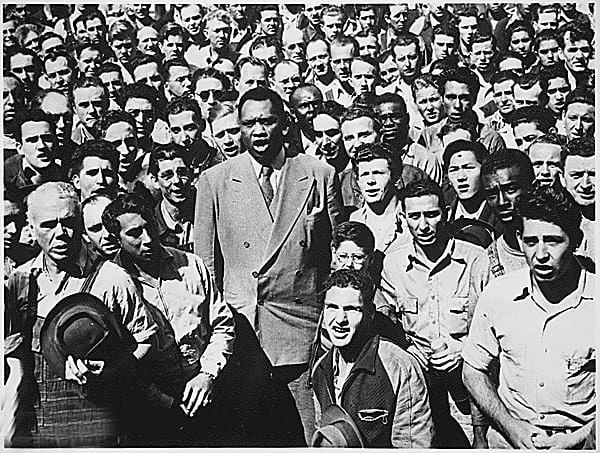
Also forever etched in my memory is an impromptu Christmas Day broadcast of the Ninth, with Leonard Bernstein conducting an international coalition of musicians, following the fall of the Berlin Wall in 1989. For the occasion, Schiller’s climactic text, “Ode to Joy,” was transformed into an ode to freedom – literally, as “freiheit” (freedom) was substituted for “freude” (joy). Schiller’s message, and Beethoven’s, after all, had always been one of universal brotherhood.
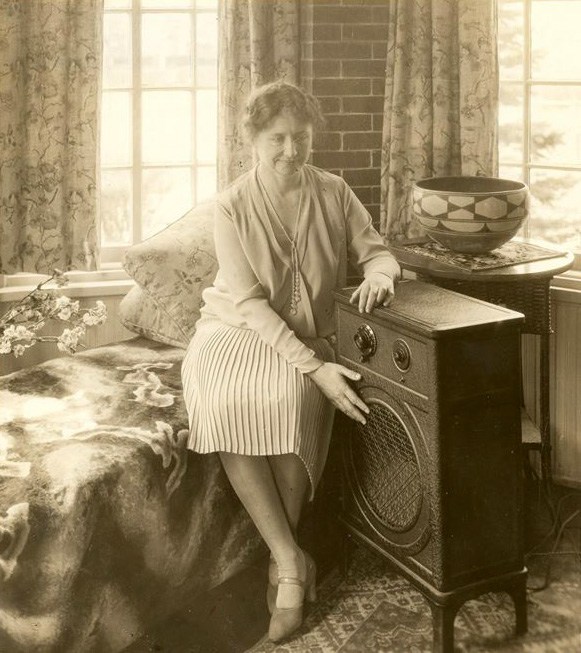
Here is what activist and author Helen Keller wrote to the New York Symphony Orchestra following a Carnegie Hall broadcast of the Ninth in 1924. Keller, blind and deaf since she was a toddler, was able to experience the piece by placing her hands on a radio speaker. Of course, Beethoven never heard it himself, as he was stone deaf at the time of its premiere in 1824. He had to be turned around by one of the performers so that he could witness the audience’s wild applause. Here is Keller’s reaction, one hundred years later, to this inspiring gift that an alleged elitist, dead white male composer-of-privilege left to her and anyone else open to receive it.
Dear Friends:
I have the joy of being able to tell you that, though deaf and blind, I spent a glorious hour last night listening over the radio to Beethoven’s “Ninth Symphony.” I do not mean to say that I “heard” the music in the sense that other people heard it; and I do not know whether I can make you understand how it was possible for me to derive pleasure from the symphony. It was a great surprise to myself. I had been reading in my magazine for the blind of the happiness that the radio was bringing to the sightless everywhere. I was delighted to know that the blind had gained a new source of enjoyment; but I did not dream that I could have any part in their joy. Last night, when the family was listening to your wonderful rendering of the immortal symphony someone suggested that I put my hand on the receiver and see if I could get any of the vibrations. He unscrewed the cap, and I lightly touched the sensitive diaphragm. What was my amazement to discover that I could feel, not only the vibration, but also the impassioned rhythm, the throb and the urge of the music! The intertwined and intermingling vibrations from different instruments enchanted me. I could actually distinguish the cornets, the roil of the drums, deep-toned violas and violins singing in exquisite unison. How the lovely speech of the violins flowed and plowed over the deepest tones of the other instruments! When the human voices leaped up thrilling from the surge of harmony, I recognized them instantly as voices more ecstatic, upcurving swift and flame-like, until my heart almost stood still. The women’s voices seemed an embodiment of all the angelic voices rushing in a harmonious flood of beautiful and inspiring sound. The great chorus throbbed against my fingers with poignant pause and flow. Then all the instruments and voices together burst forth – an ocean of heavenly vibration – and died away like winds when the atom is spent, ending in a delicate shower of sweet notes.
Of course this was not “hearing,” but I do know that the tones and harmonies conveyed to me moods of great beauty and majesty. I also sense, or thought I did, the tender sounds of nature that sing into my hand-swaying reeds and winds and the murmur of streams. I have never been so enraptured before by a multitude of tone-vibrations.
As I listened, with darkness and melody, shadow and sound filling all the room, I could not help remembering that the great composer who poured forth such a flood of sweetness into the world was deaf like myself. I marveled at the power of his quenchless spirit by which out of his pain he wrought such joy for others – and there I sat, feeling with my hand the magnificent symphony which broke like a sea upon the silent shores of his soul and mine.
Happy New Year, everyone, and may 2021 be a better one for music. And may it bring greater harmony and understanding between nations, between Americans, between races, and between all people.