Tag: Opera

  • Kavalier & Clay Opera: Chabon’s Szymanowski Secret

    Kavalier & Clay Opera: Chabon’s Szymanowski Secret

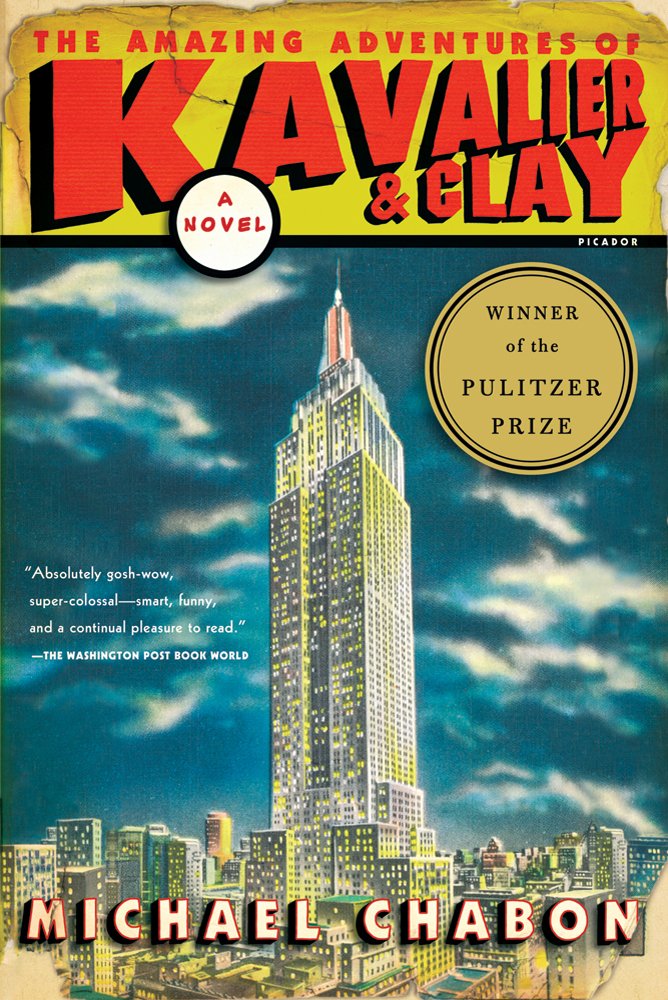
    I’ve been rereading “The Amazing Adventures of Kavalier & Klay” to refresh my memory, in advance of checking out Mason Bates’ new opera at the Met this week. A little while ago, I watched an unrelated interview with the book’s author, Pulitzer Prize winner Michael Chabon, who straddles the worlds of “serious” and pop cultural fiction (i.e. comic books, the pulps, genre pastiche) with the authority of a literary colossus. The interview was geared toward young readers, and one of the things he recommended was making an effort to read outside one’s comfort zone. By that, he means not only reading about subjects to which one wouldn’t ordinarily gravitate, but also getting to know different characters by writers who come from diverse backgrounds, as it can really expand one’s understanding and empathy for other perspectives. It’s clear that Chabon practices what he preaches, as it’s the only explanation for the richness of the world he creates and recalls in “Kavalier & Clay” (much of the book is set during the Great Depression and World War II) and the realistic characters who occupy it.

    For instance, I don’t know what kind of music Chabon enjoys, but clearly he’s an intellectual omnivore. His curiosity about the classics may not extend very deeply into opera (the premiere of “Kavalier & Klay” was the first time he ever set foot in the Met), but it drove him far enough beyond Bach and Beethoven to turn up no less than Karol Szymanowski. Szymanowski, one of Poland’s foremost composers, was born on this date (according to some sources) in 1882. Szymanowski is referenced multiple times throughout “Kavalier & Clay,” and I’m not entirely sure why. It could just be that the author enjoys his music, or perhaps he simply likes the sound of his name (Shim-an-OFF-ski). Or it could be that he is trying to demonstrate, as he lets drop several times throughout the narrative, that many of these characters who are caught up in the pulp, comic, and novelty business are actually very talented people, immigrants who perhaps abandoned their higher aspirations when they settled in the United States and determined to improve their lot. Which would explain why long-suffering publisher Sheldon Anapol is a member of the Szymanowski Society.

    Later in the book, Szymanowski is not mentioned by name when we are told that a portrait of the composer of “Songs of an Infatuated Muezzin” hangs on the wall behind his desk. Holy moly, Chabon! “Songs of an Infatuated Muezzin” isn’t even one of Szymanowski’s better-known works! I wonder if, thematically, the author might also have found the subject matter – a Muslim holy man who, in the execution of his sacred duty to call the faithful to prayer five times a day, finds himself increasingly distracted by erotic thoughts of his beloved – apposite to the situation of one of Chabon’s protagonists, Joe Kavalier, who succumbs to his guilt over the distraction from his primary mission, to get his family out of Nazi-occupied Czechoslovakia. In the meantime, he’s been engaged in a serious affair. Two affairs, actually – one with a free-spirited Greenwich Village bohemian and another, his artistic devotion to comic books – and the reader wonders which passion outstrips the other. In his way, he too is distracted from his sacred duty by a beguiling mistress.

    I don’t know that Chabon had this in mind, but the parallel is there. Or, as I say, it could be that he just likes the music.

    Looking forward to “Kavalier & Clay.” Also, happy birthday, Karol Szymanowski!


    “Songs of an Infatuated Muezzin”

    “The Amazing Adventures of Kavalier & Clay” at the Met

    https://www.metopera.org/season/2025-26-season/the-amazing-adventures-of-kavalier–clay/

    Szymanowski’s Violin Concerto No. 2, recorded by Henryk Szeryng

    Michael Chabon interview geared to young readers


    CLOCKWISE FROM LEFT: The novel, a still from the opera, and Karol Szymanowski

  • Montemezzi’s Lost Opera A Rediscovery

    Montemezzi’s Lost Opera A Rediscovery

    If opera will not come to the middle of the mountain, the middle of the mountain will come to opera!

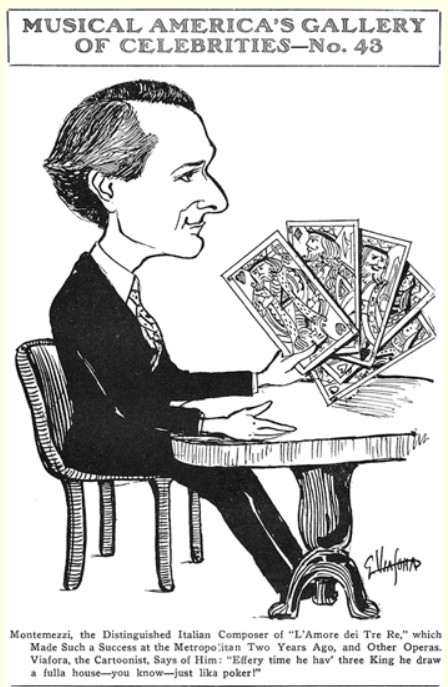
    Today marks the 150th anniversary of the birth of Italo Montemezzi (Montemezzi, if I am not mistaken, literally translating as “half-mountain”).

    A representative of that vast artistic lineage of one-hit wonders, Montemezzi is pretty much known for his opera “L’amore dei tre re” (“The Love of Three Kings”), which one might assume from the title to be a heartwarming Christmas piece about the three Magi, along the lines of Gian Carlo Menotti’s “Amahl of the Night Visitors.” If so, one would be mistaken.

    “L’amore dei tre re” is an overheated historical tragedy, centering around a love triangle – perhaps even a ménage à quatre – in which everyone winds up dead or inconsolable. Another great night at the theater! Only in opera does one set foolish, deadly traps to ensnare the guilty, only to have the scheme backfire horribly.

    “L’amore dei tre re” opened at La Scala in 1913 to mixed reviews. But what do the Italians know about opera? When it made its way abroad, it became an international success. In the U.S., it was hailed as “the best operatic work coming from Italy since Verdi’s ‘Falstaff.’” In 1918, it was sung at New York’s Metropolitan Opera by Enrico Caruso, Claudia Muzio, and Pasquale Amato.

    Alas, the mania for “The Love of Three Kings” proved to be but a flare. The opera had its moment, but after World War II, frequency of performances declined to the point where now, if it’s ever done at all, it’s an event.

    Unabashedly decadent, coyly erotic, dramatic, and dreamlike, “Three Kings” may be Italian, but it was written by a composer who had assimilated broader musical influences. The score cranks up the heat, in kind of a mélange of Wagner, Strauss, and Debussy.

    It won’t turn up very often at your friendly neighborhood opera house. Happily, there’s a fine recording of the work in modern sound (i.e. stereo), featuring Anna Moffo, Placido Domingo, and Cesare Siepi.

    That said, here’s an interesting document from the Met in 1941, with the composer conducting on a broadcast introduced by Milton Cross!

    In 1948, the New York Times described “L’amore dei tre re” as “a tone poem for voices and orchestra,” lauding it as “the most poetic and aristocratic of Italian operas” and declaring of its composer, “He never descends beyond the loftiest level.”

    Not bad! Where is it now?

    We’ll keep a candle in the window for you on your sesquicentenary, Italo Montemezzi.

  • Bard’s “Dalibor” A Rare Smetana Treat

    Bard’s “Dalibor” A Rare Smetana Treat

    I am probably one of the few Americans who owns all of Smetana’s operas, though I confess I have not listened to more than three. Still, I believe I am correct in stating that “Dalibor” is the only one of them that doesn’t have a happy ending. In fact, if I understand correctly, the opera has two endings, both of them tragic. The current production at Bard College– the first fully-staged presentation in the United States – which I attended on Sunday afternoon, surprised me in providing a third. It punctuates the work with a strong and haunting image, to be sure, but I confess I’m still partial to the original, most commonly encountered, in which the hero is at least granted the dignity to take his fate into his own hands.*

    But opera lovers can handle it. We are used to stories in which our heroes are crushed, either by character flaws, political machinations, jealousy, misunderstandings, or just plain cruel fate.

    Bard’s “Dalibor” is an absorbing and at times even transporting experience. I still can’t get one of Smetana’s insinuating musical motifs out of my head. By and large, the production is well-conceived and executed. I always hope for more traditional productions of Romantic operas, setting them in actual medieval castles, the way composers and librettists originally envisioned, but I realize we’re living in an age when it is an unreasonable expectation. I guess after 150 years, the very idea is a little tired. At least the Bard production, directed by Jean-Romain Vesperini, isn’t Regietheater. The knights are not clowns driving around in VW buses. But it is dark and dour throughout. Still, Smetana’s music has enough ceremonial and dance music to remind us that this is also the composer of “The Bartered Bride.”

    The director’s program note cites the inspiration of German Expressionism. To me, it looks more like steampunk-lite, with a kind of double-helix iron staircase dominating the stage on a rotating turntable. I must say, if one were going to conceive of a single set to serve for three lugubrious acts, the solution is quite ingenious. The staircase rotates, giving the director plenty of options for entrances and singers ascending and descending. (The set design is by Bruno de Lavenère.)

    Further transformations are made possible through lighting effects by Christophe Chaupin. I’m not sure what material is draped from the line sets, but it’s made to look like curtains of chain mail that are raised and lowered and reflect the lights.

    Despite the fixed set, it is not a visually stagnant production. I do wish it could have been opened up somehow. It IS a dark story, but the entire thing isn’t set in a dungeon. It is perhaps more a “fault” of the opera itself than it is any interpretative concepts. The entire thing is set in stone, in more ways than one.

    The costumes by Alain Blanchot – at least most of them – are quasi-medieval, at least, and there are swords and spears rather than of lightsabers.

    Basically, the plot concerns a knight, Dalibor, who is on trial for killing a burgrave in revenge for the execution of his friend, the musician Zdeněk. His righteous indignation and noble character stir the populace and there are simmering intimations of rebellion against the king. The burgrave’s sister, Milada, calls for Dalibor’s death. The king assents, until he learns more about the circumstances of Dalibor’s crime and, in his mercy, commutes his sentence to life in prison. Of course, Milada winds up falling for this noble soul and determines to free him.

    Most interesting about the Bard production is the idea to have the specter of Zdeněk (a fabricated, silent role, played gracefully by Patrick Andrews), who is certainly central to the motivations and plot, literally wander the staircase, like Banquo’s ghost, feyly looming over the fates of the various characters. To give him even further emphasis, the decision was made to mirror his attire in the disguise of Milada, when she goes undercover, in drag, in her attempt to spring Dalibor from the bowels of the castle. The fact that Milada is made a kind of reincarnation of the knight’s fallen best friend, whom he mourns and even pines, lends an interesting homoerotic dimension that seems to exceed any concept of knightly brotherhood – never more so than when Zdeněk and Milada are blown up into massive projections (by Étienne Guiol) onto the chain mail curtain. Clearly, the production doesn’t want us to miss that these characters are being paralleled. Thankfully, the effect is more Bergmanesque than “Duck Soup.”

    In the libretto, Dalibor emerges from a dream and mistakes Milada for a reincarnation of his friend – and soon they are engaged in a passionate love duet – so I suppose the germ is already there in the work’s conception. So the interpretive choice is not inappropriate, and it is not ineffective. If anything, it underscores the dominance not only of Dalibor’s affections for his friend, but also the motivating force of music itself as a thematic element. Only in the Czech lands would music be so tied up with patriotism and nationalist identity. (The fallen Zdeněk was a violinist and Dalibor comes into possession of his instrument, even planning to use it to signal the final surge of rebellion against injustice, if not tyranny.) It always makes me envious how strongly the Czech culture embraces its music.

    “Dalibor” was a modest success at its premiere in 1868. It didn’t really take off until it was revived in 1886. Alas, it’s the old tale of an opera being underappreciated until after the composer’s death. (Smetana died two years earlier.) But do not go into it expecting another “Carmen.”

    It is worth seeing, especially if you are a Czech music fanatic. If you’re well-versed in Smetana and Dvořák, I think you pretty much know what to expect. But the sound world is more in line with Dvořák’s darker symphonic poems and “Rusalka” than, say, the Serenade for Strings.

    Hey, if you’re familiar with Smetana’s complete cycle of symphonic poems “Má vlast” (1874-79), you know it’s not just the picture postcards of “Vyšehrad,” “The Moldau,” and “From Bohemia’s Woods and Fields.” There’s plenty of tragedy and slaughter. That’s the Dark Ages for you, but also Romanticism. The Romantics love to dwell on the grim.

    In “Dalibor,” there’s a passage that looks forward to “Má vlast”s “Tábor,” specifically the hammered motto associated with the Hussite Wars that segues into “Blanik,” which recalls the supernatural resurrection of St. Wenceslaus’ army in time of need. There’s also one motive that unavoidably conjures “the Ring.” Wagner is an obvious influence (I mean, come on – castles, knights, troubadours, and warrior maidens!), but the music is always unmistakably Bohemian.

    The cast that Bard assembled for this production is an interesting one. All of the singers acquit themselves very well, even if their approaches aren’t always of a piece.

    Alas, visa difficulties precluded the scheduled participation of Czech tenor Ladislav Elgr and Polish soprano Izabela Matula, but I confess my grasp of Czech is nonexistent, so for all I know the cast could have been singing flawless Klingon. I already knew what to expect from John Matthew Myers, a heroic tenor I was lucky enough to hear in Carnegie Hall last month, when conductor Leon Botstein revived Richard Strauss’ first opera, “Guntram.” Myers was exemplary, if the character this time isn’t giving quite so many opportunities to belt.

    I wonder what his costar on that occasion, Angela Meade, would have made of Milada. Cadie J. Bryan is a small-voiced soprano, who nevertheless rose to the occasion in her duets with Myers and the more animated and extroverted Erica Petrocelli (as the rebel fireband Jitka, raised as Dalibor’s adopted daughter). Bryan was also affecting in her death scene. But early on, I was worried that her characterization was going to be one that was going to be bolstered more by her acting ability than the power of her voice. Physically, her waif-like appearance made her more believable than Meade would have been when the character disguises herself, Fidelio-like, as a boy.

    Petrocelli has charisma to burn, and the bigger voice, commanding attention whenever she was on stage, but her characterization was also the stagiest. Bryan, less so, had the more naturalistic acting style.

    Bass Wei Wu was for me the biggest surprise of the afternoon. As Dalibor’s jailer, Beneš, his voice was top to bottom resonant and awe-inspiring. It made me as happy as a lizard on a hot-rock.

    That said, bass-baritone Alfred Walker, who sang Saint-Saens’ Henri VIII at Bard a few years ago, gave the most rounded performance. He was in great voice, as always. In contrast to many of those around him, who are given plenty of opportunities to storm the ramparts, as it were, his is a more reflective role. He’s regal when he needs to be, but he’s also given a great “uneasy lies the head that wears the crown” scene, in which he deliberates over the duties of the king and his private misgivings at having to condemn Dalibor. Walker’s acting was of a piece with the vocal requirements, which he fulfilled magnificently if undemonstratively, to make his King Vladislav a creation of flesh and blood.

    Bard mastermind Leon Botstein was in the pit with the American Symphony Orchestra. Their rendering, for the most part, allowed the music to speak for itself. The Bard Festival Chorale, prepared by James Bagwell, always sings well. It’s an added joy that its members appear always to be having a good time. To have professional musicians tackle these rare works with such commitment is a blessing not to be underappreciated.

    Today’s matinee, at 2 p.m., will be livestreamed in real time and then repeated on Sunday at 5 p.m. The remaining live performances will be given at Bard College’s Richard P. Fisher Center for the Performing Arts this weekend, on Friday at 4 p.m. and Sunday at 2 p.m.

    The opera, of course, is but an appetizer to the main course of the Bard Music Festival, this year devoted to the Czech master Bohuslav Martinů. The festival, which will take place at Bard College over two weekends, August 8-10 and 14-17, will conclude with a semi-staged performance of Martinů’s opera, “Julietta,” also at the Fisher Center. I am elated to find Erica Petrocelli and Alfred Walker will be among the cast. John Matthew Myers will return to sing “The Epic of Gilgamesh” in a concert on August 16. You’ll find the full schedule at one of the links below.

    Thank you, Bard and Leon Botstein for yet another opportunity to hear interesting, neglected music live, so that we may develop a fuller understanding of the artists, their cultures of origin, their places in, and influence upon, the wider classical repertoire, and allowing us a broader understanding of cultural history. Your services are invaluable.

    *ERRATUM: Having done more research, I learned that there are indeed THREE endings for “Dalibor!”


    Smetana’s “Dalibor” at Bard SummerScape

    https://fishercenter.bard.edu/events/dalibor/

    Bard Music Festival, “Martinů and His World”

    Bard Music Festival

    Some of the past Bard operas are available for streaming here

    SummerScape Opera in HD


    Photos from the Fisher Center at Bard Facebook page

  • Korngold Birthday Rediscovering a Master

    Korngold Birthday Rediscovering a Master

    Today is the birthday of one of my favorite composers, Erich Wolfgang Korngold (1897-1957), in my heart since childhood, thanks to viewings of “The Adventures of Robin Hood. But guess what? I love his concert music and his operas too! Here’s a joyous discovery for a spring afternoon: Korngold at the piano, playing his own themes from opera and the movies, at the home of Ray Heindorf, who worked very closely with the composer as an orchestrator on a number of his classic film scores. By 1951, Korngold had already left Warner Brothers. He would work on only one more film, the Richard Wagner biopic “Magic Fire,” released by Republic Pictures in 1955. Hear Korngold sing (if you can distinguish him from Heindorf) and actually speak, especially during the final minutes, accompanied by some fascinating home movies.

  • Wagner Yannick and Tristan A Mixed Reaction

    May 22. Richard Wagner’s birthday. Anyone else looking forward to this endurance test with the Philadelphia Orchestra? 4 and ½ blissful hours of blood clot-inducing “Tristan und Isolde.”

    This tongue-in-cheek teaser has been receiving a mixed reaction. I happen to think it’s very funny, but on message boards, music chats, and social media, it’s been getting more than its share of vitriol. Evidently, there are some real Yannick haters out there. And I am sorry to have to admit, classical music still does have its stuffed shirts.

    Thankfully, I spend as little time around them as I can. In fact, I’m not sure how close I am to any of them in real life. But you know how it is. These guys can come across as the most unassuming, mildest-mannered people, but give them the anonymity of the internet and they all turn into monsters.

    It’s okay to have opinions – I’ve got plenty of them myself, and by no means am I satisfied with everything Yannick conducts, strictly from an interpretive standpoint – but lighten up. It’s just a teaser, and it’s supposed to be fun!

    This “Tristan” is unlikely to be on a level of Wilhelm Furtwängler’s or Victor de Sabata’s, but it is an opportunity to hear one of the world’s great orchestras play Wagner’s hypnotic, narcotic, viscerally intense, revolutionary score without the distraction of the seemingly-inevitable, nihilistic Regietheater nonsense productions you’re likely to encounter these days at virtually any opera house that’s going to attempt a staging.

    The Everest of “Tristan” is littered with the literal corpses of those who have attempted the climb. Not only have singers destroyed their voices, but conductors have actually died. Felix Mottl and Joseph Keilberth both dropped dead while conducting the second act. The very first Tristan, heldentenor Ludwig Schnorr von Carolsfeld, died suddenly at the age of 29, after only four performances.

    In an interview given shortly before his death, Giuseppe Verdi said that he “stood in wonder and terror” before Wagner’s “Tristan.” Is it any wonder that Yannick is getting himself into shape?

Tag Cloud

Aaron Copland (92) Beethoven (94) Composer (114) Conductor (84) Film Music (106) Film Score (143) Film Scores (255) Halloween (94) John Williams (179) KWAX (227) Leonard Bernstein (98) Marlboro Music Festival (125) Movie Music (121) Mozart (84) Opera (194) Picture Perfect (174) Princeton Symphony Orchestra (102) Radio (86) Ross Amico (244) Roy's Tie-Dye Sci-Fi Corner (290) The Classical Network (101) The Lost Chord (268) Vaughan Williams (97) WPRB (396) WWFM (881)

DON’T MISS A BEAT

Receive a weekly digest every Sunday at noon by signing up here


RECENT POSTS