Tag: Oscars

  • Oscars Disappointment & the Decline of Film Scores

    Oscars Disappointment & the Decline of Film Scores

    This year’s Academy Award nominations were announced on Thursday, and I can’t say that they got me all that excited. Not that I’m one of those people who moans about how their favorite film wasn’t nominated, and this is why no one watches the Oscars anymore, and its very existence is no longer relevant. The awards aren’t about pleasing Joe Blow, or they shouldn’t be; they’re about those in the industry recognizing the achievements of their peers. Unfortunately, the ceremony also happens to be tied to a costly television broadcast, and a healthy swathe of air time at that, so the Academy is sensitive of the need to generate ratings.

    When Hollywood was operating at its peak, with major stars, and major studios backing a nice variety of films in great quantities, it all worked out very well. There was glamour and opulence and a sense of occasion, and viewers were pretty much guaranteed a good show, with excellence eliding with popular taste. Now the majors mostly crank out sausage for the masses and the actors no longer possess a mystique generated by studio-backed PR machines that would have once elevated them to the status of demigods.

    Most of the nominees now are films produced by coalitions of smaller studios, often with limited distribution. If they’re backed by Netflix, they’re often released for a week in New York and L.A. to qualify for Oscar consideration, and then yanked to take their intended place as content on a streaming service that tired people put on over dinner at the end of a long work day. It’s a miracle that any of them can generate any buzz.

    Once upon a time, I would get excited to see a movie, anticipate seeing it in the theater, become immersed in the experience, and then think about it afterwards. Now the streaming service won’t even allow the end credits to play through before it jumps to the next item. We’re living in an era of quick and disposable gratification. Nothing has any sense of resonance or purpose anymore. It comes down to too much technology, too many choices, and too little attention span.

    Last night, I streamed “Emilia Pérez,” without any previous idea of what it was about. For the record, it’s billed as a French musical crime comedy; however, it’s mostly in Spanish, and while it could certainly have played as farce, there is nothing in it that is even remotely funny. Well, perhaps unintentionally so, in some of the musical numbers. Was it a good movie? Ultimately, I think so. I thought moments in the first half hour were laughably bad, but it took me a while to buy into the premise. All the same, it didn’t strike me as Best Picture quality.

    Nor was there any reason I could discern that it should have been a musical. (The screenplay is based on an opera libretto written by the film’s director, Jacques Audiard.) I did find the story compelling, and because of the novelty, the performances too. I’m not sure it would have had the same effect had I read anything about it beforehand, but on its own, it kept me interested for its 2-hour, 10-minute running time. Personally, I had no objection to the content – the history of the movies is full of examples of films that reflect their respective zeitgeists – but I can see how it would be a lightning rod for conservative ire. It’s not exactly the kind of film that would have been made with Glenn Ford!

    What was most depressing to me about this year’s nominees were those for Best Original Score. A few years ago, I was among those who voiced their indignation when the Academy tried to sheer a number of the categories, including that for film-scoring, from its telecast. Now, only a few years later, I wonder what’s the point? And I don’t think it’s just a matter of the nominees not pleasing Joe Blow (in this case, me); it’s a matter of most film scores these days being fairly anonymous. Remember how, once upon a time, there would be albums devoted to the great scores of such and such a year? Now, you couldn’t possibly fill two sides of an LP.

    Think for a moment about “Gone with the Wind,” “Mutiny on the Bounty,” “Lawrence of Arabia,” “Doctor Zhivago,” “Romeo and Juliet,” “The Godfather,” “Star Wars. Countless classic films all tied in people’s memories with their indelible music, an entire branch of the industry left to wither on the vine, as budgetary concerns and lack of viewer discernment have allowed the art of movie scoring to degenerate. Why does the category even exist anymore, as most scores these days are mostly sound design? A bunch of background droning and percussive effects altered or even generated electronically, so that they would be impossible to duplicate by any orchestra performing anywhere under standard concert conditions.

    Of course, historically, most voters and certainly most viewers can’t seem to tell an original score from a song-dominated musical (for example, “The Wizard of Oz” or the more recent classics of Disney’s animation renaissance of the 1990s). So “Wicked” stands a good chance of snagging the award. On the other hand, if the voting members of the Academy want to think they’re supporting something edgy and contemporary, it could go to “Emilia Pérez.” But really, the music in those films is likely better served in the Original Song category.

    Here are this year’s nominees for Best Original Score. The only other one of the films I’ve seen so far is “Conclave.” Volker Bertelmann’s music certainly does attract a lot of attention to itself, and thank God (it is, after all, a Vatican movie), it’s not just sound design, but oh my, it is terribly overbearing…

    • BEST ORIGINAL SCORE *

    “The Brutalist,” Daniel Blumberg

    “Conclave,” Volker Bertelmann

    “Emilia Pérez,” Clément Ducol and Camille

    “Wicked,” John Powell and Stephen Schwartz

    “The Wild Robot,” Kris Bowers

    • BEST ORIGINAL SONG *

    “El Mal” from “Emilia Pérez,” Music by Clément Ducol and Camille, Lyric by Clément Ducol, Camille and Jacques Audiard

    “The Journey” from “The Six Triple Eight,” Music and Lyric by Diane Warren

    “Like a Bird” from “Sing Sing,” Music and Lyric by Abraham Alexander and Adrian Quesada

    “Mi Camino” from “Emilia Pérez,” Music and Lyric by Camille and Clément Ducol

    “Never Too Late” from “Elton John: Never Too Late,” Music and Lyric by Elton John, Brandi Carlile, Andrew Watt and Bernie Taupin


    PHOTOS: When film scores were film scores! Clockwise from left: John Williams, André Previn & Elmer Bernstein, Ennio Morricone, and Dimitri Tiomkin
  • John Williams’ 54th Oscar Nomination

    John Williams’ 54th Oscar Nomination

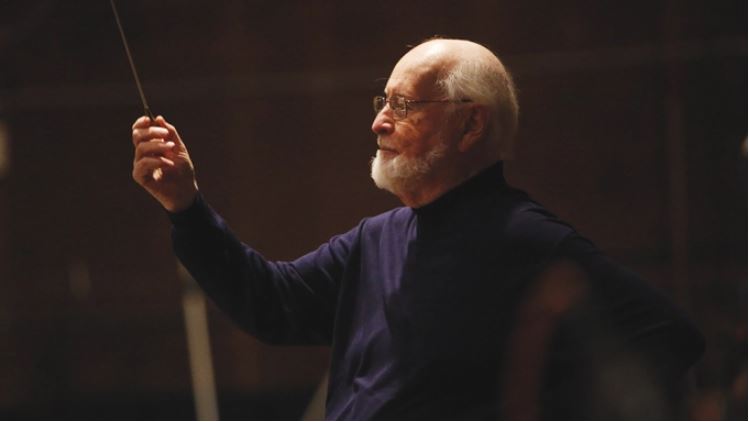
    This year’s Academy Awards nominees were announced this morning, and sure enough, John Williams has earned yet another nod, for his score to “Indiana Jones and the Dial of Destiny.” Going into today, Williams was the most-nominated person alive. Now he’s even MORE the most-nominated (with the tally at 54). He also happens to be the second most-nominated person in Oscar history, after only Walt Disney (at 59).

    The other nominees in the category of Best Original Score are Laura Karpman (“American Fiction”), Robbie Robertson (“Killers of the Flower Man”), Ludwig Göransson (“Oppenheimer”), and Jerskin Fenrix (“Poor Things”).

    There’s a good possibility that whatever wins will do so for more than purely musical considerations. But that seems to be how it’s been for many years. The score for “Oppenheimer” is ludicrously overbearing.

    In any case, it’s nice to see Williams handed another feather for his nest, even though his latest Indiana Jones music will not win. Or at least I hope it won’t. The film itself was godawful, and Disney has done all it can to be sure that your average consumer can’t get a hold of a physical copy of the soundtrack. A limited edition CD was made available for pre-order months in advance of the film’s release. If you didn’t know about it, you were welcome to spend hundreds of dollars for it on the collector’s market.

    Merciful Disney has since decided to give everyone a second chance and make it available again as part of an expensive box set of all the Indiana Jones scores, duplicating the content of the previously-released soundtracks for all the other films. Thanks for nothing.

    Williams should have automatically won for just about every year from at least 1975 to 1982. Nevertheless, he has been the recipient of five Oscars, for “Fiddler on the Roof” (adaptation of the stage musical by Jerry Bock & Sheldon Harnick), “Jaws,” “Star Wars,” “E.T. The Extra-Terrestrial,” and “Schindler’s List.” The last bestowed was in 1994.

    It would be nice for him to get an honorary Oscar at some point – he’ll be 92 next month – but it wouldn’t be televised anyway, and Williams is doing just fine. Oscar needs John Williams more than John Williams needs him.

  • John Williams: Oscar Record & Retirement?

    John Williams: Oscar Record & Retirement?

    More than anyone else in history, John Williams has had the pleasure of scoring the highest-grossing motion picture of the year. Those films remain among the most-successful of all time.

    Now, with his 53rd Oscar nomination, announced today, Williams sets another record, as the oldest person ever to be nominated for an Academy Award. The oldest person ever to win an Oscar is James Ivory who, at 89, was recognized in 2018 for his screenplay to “Call Me by Your Name.”

    Williams is already the second most-nominated person ever – a record he breaks every time he’s nominated – behind only Walt Disney (with 59). He has earned five statuettes, for his work on “Fiddler on the Roof,” “Jaws,” “Star Wars,” “E.T. The Extra-Terrestrial,” and “Schindler’s List.” However, it has been 30 years since his last win.

    What are the odds of this year bringing Williams more Oscar gold? Rather slim, I’m afraid. His work on “The Fabelmans,” while certainly effective and wholly appropriate for one of Steven Spielberg’s most intimate projects, is fairly understated and supplemented by a lot of classical music, including works by Kuhlau, Clementi, Bach, and Haydn. (Spielberg’s mom was a pianist.) The soundtrack album in only 31 minutes long, and at least one of the themes flirts with Satie’s “Gymnopédie No. 3.”

    That said, somebody should campaign for an honorary Oscar for this guy already. For 60 years, the movies would have been so much poorer without him. Not that he’ll be crying himself to sleep for lack of recognition. What a charmed career he’s had!

    At least since “Star Wars: The Rise of Skywalker” in 2019, Williams has teased his retirement from film scoring several times. Most recently, he stated that “Indiana Jones and the Dial of Destiny,” due this summer, would be his last score. Now, however, he intimates that that might not be entirely true.

    “I’ll stick around for a while,” Williams told Entertainment Weekly. “I can’t retire from music.” Which should be fairly obvious, when seemingly not a week goes by that he’s not conducting one of the world’s great orchestras, in between work on his long-anticipated Piano Concerto and fulfilling smaller commissions for occasional works and television themes.

    John Williams will be 91 on February 8.

    This year’s nominees for Best Original Score: “Everything Everywhere All at Once” (Son Lux), “Babylon” (Justin Hurwitz), “Banshees of Inisherin” (Carter Burwell), “All Quiet on the Western Front” (Volker Bertelmann), and “The Fabelmans” (John Williams).


    More details about William’s latest world record here:

    https://deadline.com/2023/01/john-williams-record-for-oldest-oscar-nominee-judd-hirsch-acting-nominee-longest-gap-1235238744/

    A full list of this year’s nominations:

    https://www.hollywoodreporter.com/movies/movie-news/oscar-nominations-2023-nominees-list-1235307974/

    For your consideration: “The Fabelmans”

  • Hans Zimmer’s Bathrobe Oscar Win Explained

    Hans Zimmer’s Bathrobe Oscar Win Explained

    Hans Zimmer accepts his Oscar in a bathrobe. Who can blame him? For all I know, I was in bed by the time Will Smith smacked Chris Rock.

    Actually, Zimmer was in Amsterdam when his victory was announced, and it was 2 a.m.

    That’s got to be a proxy statuette, right? It looks a little smaller than usual – unless Zimmer is a very big man. And anyway, I thought nobody was supposed to know the results prior to the announcement of the winners (if not prior to the actual broadcast, thank you, The Academy).

    If it is the genuine article, how did it wind up in a hotel bar in Amsterdam? Leave your speculations below.

    Congratulations, Hans Zimmer. I’m far from your biggest fan, but as part of the sound design for “Dune,” your score, such that it is, worked wonderfully.

    https://www.dw.com/en/dune-composer-hans-zimmer-wins-second-oscar-in-bathrobe/a-61279737

  • Oscars Decline A Longtime Viewer Bails

    Oscars Decline A Longtime Viewer Bails

    As someone who’s watched the Academy Awards for probably 50 years, I’ve hung on by my fingernails for an awfully long time. Yet somehow, The Academy keeps finding ways to keep tilting the platform and smearing grease under the soles of my feet.

    The Oscars used to at least pay lip-service to the rich history of the industry it celebrates. There were montages assembled from celluloid classics. Iconic stars from yesteryear would take the stage to hand out important awards. And at the end of the night, the credits would roll over a medley of classic movie themes.

    Last year, they squeezed the “In Memoriam” segment, the very soul of the evening, like it was a sponge. This is often the most poignant part of the broadcast, as we’re reminded of all those who devoted decades of their lives to crafting the entertainment that, once upon a time, made our days brighter, or those who were taken from us too soon.

    Instead, each “memory” flashed by so quickly, a rapid succession of images edited with such manic intensity that each of them blew past before a number of them could even register, with jarring cuts that often didn’t even match the inappropriately up-tempo music bed. With the passing of the years, I get the impression that no one involved with the ceremony even knows who most of these people are anymore.

    I have to say, because of COVID and because of what I read about what to expect from the ceremony, for the first time in nearly a half-century, I didn’t even bother to watch. But I caught enough of it on the web the next day to be glad that I didn’t.

    I mean, the Academy has made plenty of boneheaded decisions over the years. Playing people off-stage, a huge pet-peeve of mine. The ones most likely to get played off are the technicians or documentarians or short-filmmakers whose passion and drive for excellence carried them from comparative obscurity to a few minutes at the podium. You know, the little people. The stars can ramble on as long as they want about anything.

    Also, relegating the humanitarian awards and honorary Oscars to a separate ceremony, and then distilling them to soundbites for broadcast. Inexcusably disrespectful. Someone who devotes his or her life to the business, and you’re going to have them accept their award in a room full of technicians? These are the people I want to hear more from, not less! They are the legends, and they have stories to tell.

    Since 2009, recipients dismissed as unworthy of inclusion in the actual, real-time broadcast include (among others) film historian Kenneth Brownlow, Roger Corman, Jean-Luc Godard, James Earl Jones, Angela Lansbury, Maureen O’Hara, Lalo Schifrin, ubiquitous casting director Lynn Stalmaster, Donald Sutherland, Cicely Tyson, Eli Wallach, and Lina Wertmuller. Any one of these is deserving of a sustained standing ovation at the actual, televised awards ceremony.

    This year, The Academy is doubling-down with the announcement, made last month, that certain key categories have been deemed too insignificant, again, to be included in the Academy Awards broadcast:

    Animated short
    Documentary short
    Film editing
    Makeup and hairstyling
    Live-action short
    Original score
    Production design
    Sound

    Some pretty egregious deletions. Editing, sound, production design, make-up and hairstyling, and score are essential components to the overall impact of a film, and music is right up near the top (along with editing).

    This is only the Academy’s latest slap against musicians. Having the orchestra piped-in from offsite was another indignity and a major annoyance for several years. And I thought Julia Roberts addressing Awards music director Bill Conti as “stick man” was embarrassing…

    Furthermore, the new ruling deprives me of the pleasure of rooting against Hans Zimmer.

    As we’ve learned from the Olympics, in the age of social media, our satisfaction is diminished as results are posted as soon as the announcement is made. Which means those “honored” in the hour before the broadcast will be common knowledge by the time of their fleeting mention during the show. It’s like trying to tape a ball game for later enjoyment and then hoping not to hear any mention of the final score.

    The omission of these categories from the ceremony is unconscionable. Yet there’s always plenty of time for inane segments involving people texting in to polls about their favorite jump-scare moments, or the host taking selfies in the audience, or ordering out for pizzas for the stars. If you’re going to waste valuable air time, at least make it entertaining and bring back Billy Crystal.

    And don’t get me started on the red carpet prelude, which makes me despair for the intelligence of the average viewer. Keep your vacuous chatter and tabloid BS out of my Oscars. What good sports these stars must be to be able to run this shallow gauntlet. Imagine if Glenn Ford had climbed out of a limo and someone tried to engage him in this kind of nonsense. It would take them all night to sweep the teeth out of the carpet.

    There has been a sad, inexorable decline in the quality of the ceremony in recent decades and a seeming shift in what the focus of the Oscars should be. I’m not one of these people that dismisses the Awards out of hand as being obnoxiously self-congratulatory, with a bunch of Hollywood types slapping each other on the back. I mean, that’s essentially what the ceremony was created for in the first place – to celebrate excellence in the industry. The television broadcast is an afterthought, or it should be.

    Instead, the Academy keeps casting overboard what it seems to regard as ballast, in a losing bid to retain its dwindling viewership. Forget about it, Academy. It’s over. Not only do you not have a clue about what made the ceremony enjoyable or worthwhile to anyone who loves the movies, but mainstream movies are so terrible now that the only films worth being lauded are those that have become difficult to chase down in a theater and which don’t have as broad an appeal to the average viewer.

    To be clear, I don’t believe one should pander to the audience, but maybe if the major studios still offered a wide variety of high-quality films in different genres, instead of twelve months a year of effing superhero movies and sci-fi dystopias, we wouldn’t be looking at a pallet piled high with Netflix or Amazon originals that only a small segment of the public has bothered seek out on cable, while the masses continue to flock to theaters to watch the latest, grimmest Batman or bloated James Bond.

    As a radio host, for the last number of years, I’ve done my best to use the lemons to make lemonade. Academy Awards weekend became an excuse to celebrate Oscar history, as I continued to program memorable film scores from many of the screen’s great classics. But as the years pass, and one mediocre honoree bleeds into another, that vein is getting smaller and smaller.

    Not having the freedom to do that kind of show anymore, going forward, I choose to celebrate not by watching the Academy Awards, but by ordering a pizza, loading up a playlist of classic film scores for my own enjoyment, and then working through a pile of DVDs of some of my favorite Oscar-decorated films.

    In short, so long, Academy. Thanks for the memory.

Tag Cloud

Aaron Copland (92) Beethoven (95) Composer (114) Film Music (120) Film Score (143) Film Scores (255) Halloween (94) John Williams (185) KWAX (229) Leonard Bernstein (100) Marlboro Music Festival (125) Movie Music (135) Opera (198) Philadelphia Orchestra (88) Picture Perfect (174) Princeton Symphony Orchestra (106) Radio (87) Ralph Vaughan Williams (85) Ross Amico (244) Roy's Tie-Dye Sci-Fi Corner (290) The Classical Network (101) The Lost Chord (268) Vaughan Williams (103) WPRB (396) WWFM (881)

DON’T MISS A BEAT

Receive a weekly digest every Sunday at noon by signing up here


RECENT POSTS