This year’s Academy Award nominations were announced on Thursday, and I can’t say that they got me all that excited. Not that I’m one of those people who moans about how their favorite film wasn’t nominated, and this is why no one watches the Oscars anymore, and its very existence is no longer relevant. The awards aren’t about pleasing Joe Blow, or they shouldn’t be; they’re about those in the industry recognizing the achievements of their peers. Unfortunately, the ceremony also happens to be tied to a costly television broadcast, and a healthy swathe of air time at that, so the Academy is sensitive of the need to generate ratings.
When Hollywood was operating at its peak, with major stars, and major studios backing a nice variety of films in great quantities, it all worked out very well. There was glamour and opulence and a sense of occasion, and viewers were pretty much guaranteed a good show, with excellence eliding with popular taste. Now the majors mostly crank out sausage for the masses and the actors no longer possess a mystique generated by studio-backed PR machines that would have once elevated them to the status of demigods.
Most of the nominees now are films produced by coalitions of smaller studios, often with limited distribution. If they’re backed by Netflix, they’re often released for a week in New York and L.A. to qualify for Oscar consideration, and then yanked to take their intended place as content on a streaming service that tired people put on over dinner at the end of a long work day. It’s a miracle that any of them can generate any buzz.
Once upon a time, I would get excited to see a movie, anticipate seeing it in the theater, become immersed in the experience, and then think about it afterwards. Now the streaming service won’t even allow the end credits to play through before it jumps to the next item. We’re living in an era of quick and disposable gratification. Nothing has any sense of resonance or purpose anymore. It comes down to too much technology, too many choices, and too little attention span.
Last night, I streamed “Emilia Pérez,” without any previous idea of what it was about. For the record, it’s billed as a French musical crime comedy; however, it’s mostly in Spanish, and while it could certainly have played as farce, there is nothing in it that is even remotely funny. Well, perhaps unintentionally so, in some of the musical numbers. Was it a good movie? Ultimately, I think so. I thought moments in the first half hour were laughably bad, but it took me a while to buy into the premise. All the same, it didn’t strike me as Best Picture quality.
Nor was there any reason I could discern that it should have been a musical. (The screenplay is based on an opera libretto written by the film’s director, Jacques Audiard.) I did find the story compelling, and because of the novelty, the performances too. I’m not sure it would have had the same effect had I read anything about it beforehand, but on its own, it kept me interested for its 2-hour, 10-minute running time. Personally, I had no objection to the content – the history of the movies is full of examples of films that reflect their respective zeitgeists – but I can see how it would be a lightning rod for conservative ire. It’s not exactly the kind of film that would have been made with Glenn Ford!
What was most depressing to me about this year’s nominees were those for Best Original Score. A few years ago, I was among those who voiced their indignation when the Academy tried to sheer a number of the categories, including that for film-scoring, from its telecast. Now, only a few years later, I wonder what’s the point? And I don’t think it’s just a matter of the nominees not pleasing Joe Blow (in this case, me); it’s a matter of most film scores these days being fairly anonymous. Remember how, once upon a time, there would be albums devoted to the great scores of such and such a year? Now, you couldn’t possibly fill two sides of an LP.
Think for a moment about “Gone with the Wind,” “Mutiny on the Bounty,” “Lawrence of Arabia,” “Doctor Zhivago,” “Romeo and Juliet,” “The Godfather,” “Star Wars. Countless classic films all tied in people’s memories with their indelible music, an entire branch of the industry left to wither on the vine, as budgetary concerns and lack of viewer discernment have allowed the art of movie scoring to degenerate. Why does the category even exist anymore, as most scores these days are mostly sound design? A bunch of background droning and percussive effects altered or even generated electronically, so that they would be impossible to duplicate by any orchestra performing anywhere under standard concert conditions.
Of course, historically, most voters and certainly most viewers can’t seem to tell an original score from a song-dominated musical (for example, “The Wizard of Oz” or the more recent classics of Disney’s animation renaissance of the 1990s). So “Wicked” stands a good chance of snagging the award. On the other hand, if the voting members of the Academy want to think they’re supporting something edgy and contemporary, it could go to “Emilia Pérez.” But really, the music in those films is likely better served in the Original Song category.
Here are this year’s nominees for Best Original Score. The only other one of the films I’ve seen so far is “Conclave.” Volker Bertelmann’s music certainly does attract a lot of attention to itself, and thank God (it is, after all, a Vatican movie), it’s not just sound design, but oh my, it is terribly overbearing…
- BEST ORIGINAL SCORE *
“The Brutalist,” Daniel Blumberg
“Conclave,” Volker Bertelmann
“Emilia Pérez,” Clément Ducol and Camille
“Wicked,” John Powell and Stephen Schwartz
“The Wild Robot,” Kris Bowers
- BEST ORIGINAL SONG *
“El Mal” from “Emilia Pérez,” Music by Clément Ducol and Camille, Lyric by Clément Ducol, Camille and Jacques Audiard
“The Journey” from “The Six Triple Eight,” Music and Lyric by Diane Warren
“Like a Bird” from “Sing Sing,” Music and Lyric by Abraham Alexander and Adrian Quesada
“Mi Camino” from “Emilia Pérez,” Music and Lyric by Camille and Clément Ducol
“Never Too Late” from “Elton John: Never Too Late,” Music and Lyric by Elton John, Brandi Carlile, Andrew Watt and Bernie Taupin
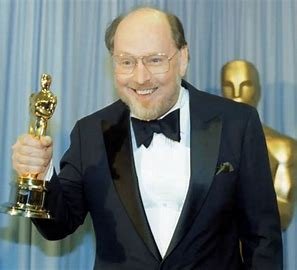
PHOTOS: When film scores were film scores! Clockwise from left: John Williams, André Previn & Elmer Bernstein, Ennio Morricone, and Dimitri Tiomkin
Leave a Reply