Celebrate the “Velvet Gentleman” by testing your knowledge of this quirky, experimental composer – his music, his world, and those he influenced – with another Classic Ross Amico crossword.
To fill it out, follow the link and select “solve online” at the bottom of the puzzle page. You’ll then be able to type directly into the squares. Once you feel you’ve exhausted the puzzle, you’ll find the solutions by clicking on “Answer Key PDF.”
You’re not being graded so, by all means, make it “open book!” No one cares if you google some of the answers. The answers we don’t hold in our heads, we learn.
The Big Top will come down for the last time, metaphorically speaking, on May 21. Ringling Bros. and Barnum & Bailey Circus, an entertainment spectacle that has been part of the fabric of American life for 146 years, will tumble its last acrobat in Uniondale, NY, this weekend.
To mark the end of the era of the traveling circus, a phenomenon with roots reaching back deep into the 19th century, I will be dusting off and refurbishing one of my most popular shows this Thursday morning on WPRB.
Join me as we listen to such works as Douglas Moore’s “The Pageant of P.T. Barnum,” Walter Piston’s “The Incredible Flutist,” Nino Rota’s “La Strada Ballet,” Erik Satie’s “Parade,” and Rodion Shchedrin’s “Old Russian Circus Music.” I’ll also have snappy circus favorites like Julius Fucik’s “Entry of the Gladiators,” Juventino Rosas’ “Over the Waves” (a.k.a. the trapeze music), and Aram Khachaturian’s “Sabre Dance.” Perhaps there will even be a circus-oriented film score or two.
I can’t claim that it will be the Greatest Show on Earth. All I know is that it was a big hit when the circus train first rolled into town, back in August of 2015. I’ll be sprucing up the spandex and spangles, this Thursday morning from 6 to 11 EDT, on WPRB 103.3 FM and at wprb.com. We’ll enjoy peanuts and cotton candy for breakfast, on Classic Ross Amico.
He maintained a filing cabinet filled with drawings of imaginary medieval buildings, the properties of which he would periodically put up for sale in local journals by way of anonymous ads.
He founded his own church – Église Métropolitaine d’Art de Jésus Conducteur (Metropolitan Art Church of Jesus the Conductor) – of which he was the only member, and for which he promptly composed a mass.
He only ate white food: eggs, sugar, shredded bones, the fat of dead animals, veal, salt, coconuts, chicken cooked in white water, moldy fruit, rice, turnips, sausages in camphor, pastry, cheese (only white varieties), cotton salad (whatever that is) and certain kinds of fish.
When he died, his friends produced umbrella after umbrella after umbrella from his room.
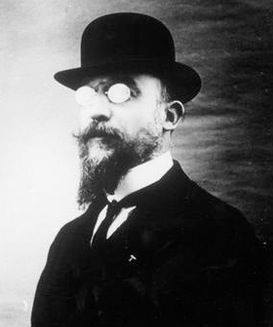
Erik Satie (1866-1925) was an artist whose life was full of enigmas and ambiguities. He is often misclassified as an Impressionist. He was viewed by some (including Maurice Ravel) as a precursor to Debussy, even as he felt a greater affinity with the younger generation of composers who made up Les Six.
In practice, he elevated salon and cabaret music, of which he spoke slightingly. After he went back to school at mid-life in order to bone up on classical counterpoint, he stopped using bar lines in his manuscripts. He blazed trails later rediscovered by Morton Feldman and John Cage. He was a minimalist more than half a century before Minimalism.
Satie rejected the concept of musical development, believing it to be an unconscionable imposition on the public’s time. For him, brevity was the soul of wit. He could be profoundly ironic. Many of his piano pieces bear titles like “Trois Morceaux en forme de poire” (“Three Pieces in the Shape of a Pear”), “Embryons desséchés” (“Desiccated Embryos”), and “Véritables préludes flasques pour un chien” (“Veritable Flabby Preludes for a Dog”).
A friend of Jean Cocteau, the two collaborated on the surrealist curio “Parade,” written for the Ballets Russes, with choreography by Léonide Massine and costumes and set design by Picasso. The scenario involves three circus acts trying to attract an audience to an indoor performance.
It was one of a number of works that were introduced in the ‘Teens that attempted to create a scandal through the incorporation of low-brow elements into what was perceived as a high-brow art form. Hoping for a strong reaction, Cocteau pushed for the inclusion of such provocative “instruments” as a typewriter, a foghorn, a siren, milk bottles, gunshots, and boots sloshing around in a wash tub. The work bore the subtitle “A Realist Ballet.” The opening night audience responded by rioting energetically.
Politically, Satie was a radical socialist, who eventually teetered over into Communism. For a time, his wardrobe consisted of seven identical grey suits. During his quasi-religious phase, he went about in a priest-like habit. Then he became a “velvet gentleman.” Finally, during his communist period, he assumed the appearance of a bourgeois functionary, never to be seen without a bowler and an umbrella.
No one would have guessed that such an impeccable dresser would have lived out his life in clutter and squalor. When Satie died, his friends, who had never been invited back to his place in 27 years, were aghast at the piles of newspapers, the unending collection of umbrellas, and most of all the stacked grand pianos, the uppermost of which had been used by the composer as a repository for papers and parcels. Among these, and in the pockets of Satie’s wardrobe, were discovered a number of manuscripts which the composer had believed long lost.
Happy birthday, Erik Satie! I will have eggs for breakfast in your honor.
“Je te veux” (“I want you”):
Selections from “Parade,” with the Picasso designs. Love the horse!