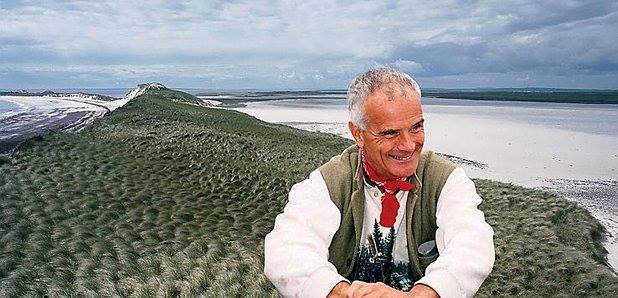
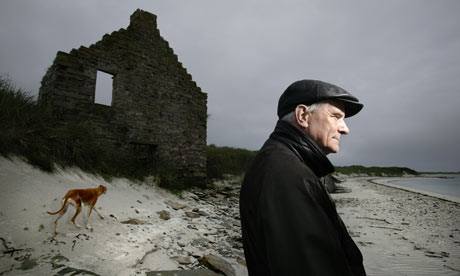
Right now we’re listening to the Symphony No. 5 by Sir Peter Maxwell Davies. The work, cast in a single movement of some 26-minutes, is the composer’s most compact symphonic expression. It’s a far cry from the populist style of “An Orkney Wedding with Sunrise” (heard earlier in this hour), but a good example of how he could emulate the organic processes of Sibelius. Admittedly, his symphonies can be as cold and forbidding as the North Sea churning outside his cottage in the Orkney Islands, but they reward close and repeated listening.
Max would have been 82 today. We’re honoring him with music inspired by Scotland until 11 a.m. EDT on WPRB 103.3 FM and at wprb.com.
Sir Peter Maxwell Davies, the former enfant terrible, who, in his later years, served for a decade in the ultimate Establishment post as Master of the Queen’s Music, died of leukemia on March 14th. He was recognized as one of the leading British composers of his generation.
Max made his home in the Orkney Islands, off the northern coast of Scotland, for the last 45 years of his life. Though he composed in a multiplicity of forms and styles, many of his most attractive and deeply felt works were inspired by the austere seascapes churning outside his cottage and the Celtic folk traditions of his adopted land.
September 8th would have been Max’s 82nd birthday. Tomorrow morning on WPRB, I’ll honor the composer with a number of representative works drawn from his prodigious output.
Since five hours of uninterrupted Maxwell Davies could very well push anyone over the edge, especially when it comes to his more challenging works, I’ll mix things up a bit by interpolating music by other composers who hailed from Scotland, were of Scottish descent, or just plain loved to visit.
The Scotch will be on the rocks, as we travel from the Highlands to the Orkney Islands, tomorrow morning from 6 to 11 EDT, on WPRB 103.3 FM and at wprb.org. It will be more appetizing than a plate full of haggis, on Classic Ross Amico.
He burst onto the British musical scene as a fiery iconoclast. Then late in life he ascended to the ultimate Establishment post of Master of the Queen’s music. He was a passionate advocate both of music education for the young and the importance of music in (and from) the community, yet a good many of his major works could be rather forbidding. He wrote pieces that seem to thumb their nose at centuries-old traditions, lacing them with trifling foxtrots. Yet he embraced and elevated that most standardized of forms, the symphony. He ping-ponged back and forth from irreverence to austerity to genuine popular acceptance with folk-inflected works like “An Orkney Wedding with Sunrise” (which he wrote for the Boston Pops). To say that Sir Peter Maxwell Davies was a man of contradictions is an understatement.
This Sunday night on “The Lost Chord,” we remember Max, who died on March 14 at the age of 81. It was exceedingly difficult to find three works that could encapsulate the most distinctive and disparate aspects of his creative personality, but I believe I’ve finally done so. Part of the challenge is that the symphonies are so blooming long, with all of them (of the ones I know, with the exception the Fifth) running to an hour in length. At last, I struck upon “The Beltane Fire,” which grew out of a ballet commission, but took on a life of its own. The work is meant to suggest the historical conflict between the Reformation clergy and the pagan traditions of the Orkney Islands, located off the northern coast of Scotland. Max enlivens the rather austere sound world of the symphonies with populist interludes in the kind of folk style that worked so well in “An Orkney Wedding.”
We’ll begin with a cheeky little piece from his “enfant terrible” period inspired by Henry Purcell – a “realisation” (so called) of a “Fantasia and Two Pavans.” The Fantasia employs a shrill piccolo, suggestive of a baroque organ, and the “pavans” are actually foxtrots. Listen for some great aural jokes in the second of them, including a simulation of a Victrola winding down and being wound up again, and then of the “white noise” at the end of a record.
We’ll conclude with one of Max’s most beloved pieces, a moving work for piano called “Farewell to Stromness.” It was actually written in protest against a proposed uranium mine, which would have been located not far from the town of the title, again located in the Orkney Islands. Though Max was born in Lancashire, he made his home in the Orkneys since 1971.
A point of local interest: Max, a product of the University of Manchester and the Royal Manchester College of Music (later amalgamated into the Royal Northern College of Music), traveled to Princeton in 1962 to study with Roger Sessions, Milton Babbitt and Earl Kim.
I hope you’ll join me for “Farewell to Max,” as we remember Sir Peter Maxwell Davies, this Sunday night at 10 EDT, with a repeat Wednesday evening at 6; or that you’ll listen to it later as a webcast at wwfm.org.
Thanks to Malcolm Williamson, the appointment of Master of the Queen’s Music (or King’s, as the case may be) is no longer for life. Since the 17th century, musicians have held the post with the expectation of writing music for important milestones in the lives of the Royal Family and for ceremonial occasions.
When Williamson, an Australian by birth, was named the successor of Sir Arthur Bliss in 1975, there was grumbling among his colleagues. Sir William Walton attributed the choice to the need for “cementing the cracks in the Commonwealth.” He wrote to Sir Malcolm Arnold (who most certainly would have brought his own set of problems) that “they had got the wrong Malcolm.” Arnold, a sporadically brilliant composer, was also a manic depressive (and possibly bipolar) who survived alcoholism and multiple suicide attempts.
Williamson’s great sin was that he was very bad with deadlines (and for that, he certainly has my sympathy). Most particularly, he failed to complete a symphony in time for the Queen’s Golden Jubilee in 1977. His ambitious “Mass for Christ the King,” also written for the occasion, was also delivered late. Significantly, he was the first Master of the Queen’s (or King’s) Music in over a century not to be knighted.
After the Jubilee debacle, his output slowed, though he was seldom unproductive. In all, he wrote seven symphonies, concertos for piano, violin, organ, harp and saxophone, and numerous other orchestral, choral, chamber and instrumental works. Like many of his colleagues, he also composed music for the cinema, for films of varying quality. It’s always amusing to find his name in the opening credits of Hammer productions like “The Brides of Dracula” and “The Horror of Frankenstein.”
Williamson suffered from a series of illnesses in his later years. He too turned to the bottle, and it can only be speculated if depression and the stress of trying to hold his head high as a colonial outsider at the court of England contributed to his decline.
Williamson was the first non-Briton to hold the post. Following his death in 2003, the parameters of the appointment were revised so that Master of the Queen’s Music is now a ten-year term. Sir Peter Maxwell Davies was the first Master to serve under the new guidelines. He was succeeded in 2015 by Judith Weir, the first woman to hold the post (and yes, she is still referred to as “Master”).
It seems to be the case that composers’ reputations are at their lowest in the decade or two following their deaths. In the case of Williamson, he seems to be rebounding nicely in the recording studio, though there remain gaping holes in his discography. Still, it’s possible to sample his symphonies, his concertos, his choral and instrumental works, and even his score for the Carol Reed film (starring Alec Guinness) “Our Man in Havana.”
I know there is at least one other person who visits this page that knows a good deal more about Malcolm Williamson than I, and he is invited to flesh out this account if he so chooses.
I wasn’t going to break the news until Sunday, but apparently I’m a week off. Beginning this week, WWFM is rebroadcasting its specialty shows at new, more accessible hours.
Where I’m concerned, that means “The Lost Chord,” first aired Sunday at 10 p.m. ET, will now repeat Wednesday at 6 p.m., and “Picture Perfect,” first aired Friday at 6 p.m., will repeat Saturday at 6 a.m. (!)
It ought to be interesting to hear the reaction when listeners get to enjoy Sir Peter Maxwell Davies’ “St. Thomas Wake” during the dinner hour or Jerry Goldsmith’s “The Mephisto Waltz” on their clock radios.
Speaking of the “Mephisto Waltz,” today is the birthday of Franz Liszt (1811-1886), one of the great pianists, of course, but also one of the most innovative musical thinkers who ever lived.
Among his innumerable achievements, Liszt pioneered a technique known as thematic transformation, in which a basic theme is put through incessant permutations and shifting moods to arrive at a kind of structural unity, as an alternative to traditional classical form. He is also credited with the creation of the symphonic poem.
Without Liszt, there would have been no Wagner as we know him. In fact, Romantic music would have had to find its own way. His later music at times anticipates the experiments of Debussy and Arnold Schoenberg.
It was Liszt’s ambition to “hurl my lance into the boundless realms of future.” In that, he certainly succeeded.
Happy birthday, Franz Liszt!
Georges Cziffra performs “Les jeux d’eaux à la Villa d’Este” (“The Fountains of the Villa d’Este”):
And don’t forget to tune in tonight at 6 to hear a rebroadcast of “Mad Max,” a belated 80th birthday tribute to Sir Peter Maxwell Davies, on “The Lost Chord.” You can find out more about it at http://www.wwfm.org.