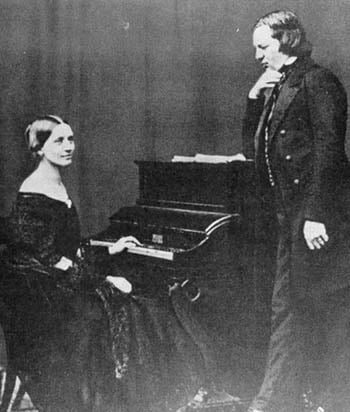
Clara Schumann was a musician of impeccable taste. Her insights and opinions helped mold the artistic development of her husband and also to a great extent that of Johannes Brahms, who frequented the Schumann house from the age of 20 and became a life-long friend. She was also a pianist of genius. She performed publicly to great acclaim for over six decades. It was through concertizing that she supported her unstable husband and eight children. Later in life, she also became a revered teacher.
Her acceptance as performer and pedagogue were highly unusual for a woman of her time. She was a child prodigy, the daughter of Friedrich Wieck, who also taught Robert Schumann. Under her father’s tutelage, she demonstrated a marked facility in composition. She was also a better pianist than Robert, who, according to some accounts, had managed to wreck one of his hands through the use of a finger-strengthening device (an assertion Clara denied.)
Having enjoyed such a promising start, it’s heartbreaking, then, to read Clara’s comment, confided to her diary in 1839, at the age of 20, “I once believed that I possessed creative talent, but I have given up on this idea. A woman must not desire to compose – there never yet has been one able to do it. Should I expect to be the one?”
It’s especially sad, since composing gave her such pleasure. “There is nothing that surpasses the joy of creation,” she wrote. “if only because through it one wins hours of self-forgetfulness, when one lives in a world of sound.”
Fortunately for us, we have her Piano Trio in G minor, and on this week’s “Music from Marlboro,” we’ll have the pleasure of hearing it performed at the 2005 Marlboro Music Festival by pianist Ieva Jokubaviciute, violinist Julianne Lee, and cellist Judith Serkin.
Clara would have been 26 at the time of her Trio’s composition. She passed the summer of 1846 on the isle of Norderney, where she accompanied her husband during his convalescence following an attack of neurasthenia. While there, compounding the Schumanns’ misfortunes, Clara suffered a miscarriage. The completion of her Trio must have seemed like an especially welcome escape. A year later, Robert composed his first piano trio, Op. 63, which bears some striking similarities to his wife’s creation.
We’ll round out the hour with Robert Schumann’s “Andante and Variations,” from 1849. Though written soon after the back-to-back masterpieces of the Piano Quintet and Piano Quartet, both in the key of E flat major, Schumann was less pleased with his new work. Part of the problem was in its unusual instrumentation, which called for two pianos, two cellos, and horn. Early performances in the Schumann home were so loud, it may have contributed to the composer’s disgust with the piece.
Schumann withdrew the work from his catalogue, later revising it for two pianos at the suggestion of Felix Mendelssohn. He also altered the structure of piece, which he ruthlessly cropped. It was Brahms and Clara Schumann who reappraised the value of his original thoughts and resurrected the work in the form he had initially intended, twelve years after the composer’s death, giving it its first public performance in 1868. It is in this version that the piece is now most often heard.
We’ll hear it performed at the 1985 Marlboro Music Festival by husband-and-wife pianists Claude Frank and Lilian Kallir, cellists Melissa Meeli and Peter Stumpf, and hornist Julie Landsman.
It’s an all-Schumann hour, in advance of the Clara Schumann bicentennial (which falls on Friday), on the next “Music from Marlboro,” this Wednesday evening at 6:00 EDT, on WWFM – The Classical Network and wwfm.org.
Marlboro School of Music and Festival: Official Page