Tag: Pierre Boulez

  • Boulez & Composers A Rare 1977 Photo

    Whoaaaaaa! Check out this incredible photo.

    Pierre Boulez (front right), with all the living composers whose works he programmed during his tenure with the New York Philharmonic. The photo was taken in 1977.

    First row (left to right): Milton Babbitt, Lucia Dlugoszewski, Ulysses Kay, George Rochberg, and Mario Davidovsky.

    Second Row: David Gilbert, Stephen Jablonsky, Jacob Druckman, Roger Sessions, William Schuman, and Aaron Copland.

    Third Row: Donald Martino, Donald Harris, Daniel Plante, Morton Gould, Vincent Persichetti, and Roy Harris.

    Fourth Row: Charles Wuorinen, Carmen Moore, Sydney Hodkinson, David Del Tredici, Earle Brown, Harley Gaber, Stanley Silverman, John Cage, and Elliott Carter.

  • Pierre Boulez Celebrates 95th Birthday

    Pierre Boulez Celebrates 95th Birthday

    In his early days, he was the enfant terrible who railed against tradition and even called for the violent destruction of the opera houses. Later, he grew into a revered conductor of Debussy, Stravinsky, Bartók, and even Bruckner. He was music director of the New York Philharmonic, the BBC Symphony, and the Ensemble Intercontemporain – a group he founded – and guest conductor of the Chicago Symphony, the Cleveland Orchestra, the Vienna Philharmonic, and many others.

    Today is the birthday of Pierre Boulez. Boulez would have been 95 today. He died in 2016.

    Here is one of his most famous works, “Le Marteau sans Maître” – “The Hammer without a Master” – settings of surrealist poems by René Char, perhaps most easily digested in live performance. You’ll find translations of the texts posted beneath the video:

    Boulez on Boulez:

    Boulez conducts Bruckner:


    PHOTO: The Hammer finds its Master

  • Boulez: A Corrective Force in Music

    Boulez: A Corrective Force in Music

    Think of Pierre Boulez as a corrective.

    Whether or not you are crazy about Boulez as a composer or a conductor, he certainly had a knack for casting music in a fresh light. No romantic indulgence or fuzzy thinking to be found in his interpretations of Debussy and Ravel. Instead, a kind of neoclassical elegance prevails.

    A similar sense of discipline informs his recordings of the Mahler symphonies (of all things). He transforms what under Leonard Bernstein, for instance, became the ne plus ultra of Romantic excess, into presentiments of the Modern Age – which to some extent actually makes sense. After all, didn’t Mahler himself once declare, “My time will come!”

    As concerns his own music, he actually thought Arnold Schoenberg didn’t take his 12-tone experiments far enough. Boulez was a radical who out-radicaled the radicals. He redrew the boundaries of integral serialism, controlled chance, and electronic music. An aggressive push to the avant garde earned him a reputation as an enfant terrible.

    Ironically, by the time Boulez died last week at the age of 90, his brand of dogma had long come to seem old-fashioned, as pluralism and a new acceptance of tonality have come to dominate the contemporary music scene.

    This Sunday night on “The Lost Chord,” we’ll remember Boulez with a recording of his keystone composition, “Le Marteau sans maître” (“The Hammer without a Master”), written between 1953 and 1957. The piece consists of three cycles, instrumental and vocal, after poems by René Char – one surreal and fantastical; another somber and existentialist; and a third romantic and utopian. The individual movements of the cycles are shuffled and integrated. The titles of the poems: “The Furious Craftsman,” “Stately Building and Presentiments,” and “Hangmen of Solitude.”

    There is a further fascination to be found in the work’s instrumentation, which includes a colorful assortment of percussion, and the use of the instruments, which suggests Southeast Asian and African influences.

    The piece was lauded by Igor Stravinsky as “the only significant work of this new age,” and by György Ligeti as “the chief work of the 1950s.” Furthermore, it is surprisingly listenable, with a kind of hypnotic allure.

    We’ll round out the hour with Maurice Ravel’s evocations of a distant land, his “Chansons madécasses” (“Madegascan Songs”), of 1925/1926, on texts of Evariste-Desiréa de Parny.

    Again, there are three of them: “Nahandove,” the name of the narrator’s beloved, the arrival of whom he anticipates on a sticky, languorous night; “Aoua!,” a violent outcry against white imperialism; and “Il est doux” (“How pleasant to lie”), a portrait of a lazy day, passed beneath a palm tree, waiting for the cool of night.

    I thought this an ideal complement to “Le Marteau sans maître,” with Boulez conducting, of course.

    If there’s one thing Boulez did well it was to force everyone to think – about music, about progress and about the reasons we value the things we hold sacred.

    He once proclaimed, “A civilization that conserves is one that will decay!” Even so, we are very lucky to have his recordings, and music is the healthier for his provocations.

    I hope you’ll join me for “Modern Romance” – Pierre Boulez in poetry and song – tonight at 10 ET, with a repeat Wednesday evening at 6; or that you’ll listen to it later as a webcast, at wwfm.org.

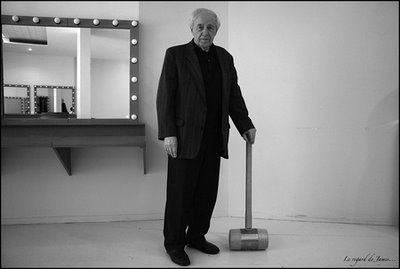
    PHOTO: The Hammer has found a Master
  • Pierre Boulez Radical Avant-Garde Composer

    Pierre Boulez Radical Avant-Garde Composer

    “Blow the opera houses up!”

    “All the art of the past should be destroyed!”

    “A musician who has not experienced… the necessity for the dodecaphonic language is USELESS!”

    “From Schoenberg’s pen flows a stream of infuriating clichés!”

    “The Paris opera is full of dust and crap! Operatic tourists make me want to vomit!”

    Pierre Boulez could be provocative and full of contradictions. The gadfly of modern music died on Tuesday at the age of 90. I hope you’ll join me as we celebrate this radical figure of the avant-garde, who in his later years found value even in the music of Strauss and Bruckner.

    It’s all Pierre Boulez this morning, from 6 to 11 ET, on WPRB 103.3 FM and at wprb.com. We “excite the curiosity of the snobs,” on Classic Ross Amico.

  • Remembering Boulez Provocateur of Music

    Remembering Boulez Provocateur of Music

    He wanted to blow up the opera houses and destroy the Mona Lisa. Sometimes it’s necessary to push hard in order to find equilibrium.

    Pierre Boulez might not be to everyone’s taste, either as a composer or a conductor, but if he did one thing well it was to force everyone to think – about music, about progress and about the reasons we value the things we hold sacred.

    It had originally been my intention to show up for my WPRB shift tomorrow and enjoy a lazy morning of English music, since I really didn’t have any other plans. As soon as I drafted my Facebook announcement, however, I was blindsided by the news that Boulez died yesterday at the age of 90.

    Now, I can’t claim to be passionate about Boulez, but he is too important a figure in the world of classical music simply to ignore. Besides, I do like his recordings of Bartók and Debussy, he made a fine set of Schoenberg’s choral music, and the last time I listened to “Le marteau sans maître,” I thought, you know, this isn’t so bad.

    Boulez proclaimed, “A civilization that conserves is one that will decay!” Just the same, I think he’d be glad to join me tomorrow morning from 6 to 11 ET, on WPRB 103.3 FM and at wprb.com, as I share Boulez records from my collection. It certainly beats the alternative, says Classic Ross Amico.

Tag Cloud

Aaron Copland (92) Beethoven (95) Composer (114) Film Music (119) Film Score (143) Film Scores (255) Halloween (94) John Williams (185) KWAX (229) Leonard Bernstein (99) Marlboro Music Festival (125) Movie Music (134) Opera (198) Philadelphia Orchestra (86) Picture Perfect (174) Princeton Symphony Orchestra (106) Radio (87) Ralph Vaughan Williams (85) Ross Amico (244) Roy's Tie-Dye Sci-Fi Corner (290) The Classical Network (101) The Lost Chord (268) Vaughan Williams (102) WPRB (396) WWFM (881)

DON’T MISS A BEAT

Receive a weekly digest every Sunday at noon by signing up here


RECENT POSTS