Tag: Pierre Boulez

  • Pierre Boulez A Mad Genius at 100

    Pierre Boulez A Mad Genius at 100

    “Blow the opera houses up!”

    “All the art of the past should be destroyed!”

    “A musician who has not experienced… the necessity for the dodecaphonic language is USELESS!”

    “From Schoenberg’s pen flows a stream of infuriating clichés!”

    “The Paris opera is full of dust and crap! Operatic tourists make me want to vomit!”

    Pierre Boulez could be provocative and full of contradictions. Is it any wonder there’s been so much blowback against him and what he came to represent? This gadfly of the avant-garde was born 100 years ago today.

    As a composer and polemicist, he was ever the rebel angel, the archnemesis of tonality and tradition. He studied under Olivier Messiaen at the Paris Conservatory, but in his advocacy of the abstruse, Boulez froze his teacher out. (Boulez characterized Messiaen’s “Turangalîla-Symphonie” as “brothel music.”) He idolized the Igor Stravinsky of “The Rite of Spring;” but in 1945, when Stravinsky unveiled his “Four Norwegian Moods,” a neoclassical pastiche in the style of Edvard Grieg, of all people, Boulez and his classmates booed vigorously.

    As a conductor, he could be a persuasive interpreter of Mahler, Debussy, and Ravel. He enjoyed particular success with a landmark centenary production of Wagner’s “Ring Cycle,” directed by Patrice Chéreau – a triumph scored in one of those very opera houses he was so eager to have destroyed. In his later years, he found value even in the music of Strauss and Bruckner.

    But for the most part, the composers he championed were those who were perceived as revolutionary in their own time and who, as Liszt so memorably put it, had hurled their lances into the future.

    In contemporary music, Boulez was a master. You’re on pretty safe ground if Boulez is conducting Webern, Xenakis, or himself. He even came around to grasping the value of his old mentor, Messiaen.

    It’s as a composer that his reputation hangs in the balance. There’s been a lot of vituperation launched against Boulez’s aesthetic, but it’s hard to deny that he brought it on himself. Passionate acolytes remain, though they live like anchorites in the wilderness, in hovels and on barren cliff-faces, with no friends outside internet chat groups, or perhaps, depending on how closely they emulate the rhetoric of their idol, not even there.

    Myself, I tend to be a little more moderate in my views, at least in this regard. Depending on my mood, I can put on a Boulez record and just go with it. His chamber cantata “Le Marteau sans maître” (1955), which I’ve played on the radio a few times over the years, is a good example of that. I understand what he’s up to, because I’ve done my homework, but it’s not to say I can hear everything any more than I can in any other serial score. But it sure does make some fascinating sounds. Actually, I find it his most approachable piece.

    That’s about as good as it gets, folks. Later in life, when speaking of his “Structures, Book I” for two pianos (1951-52), Boulez described it as a work in which “the responsibility of the composer is practically absent. Had computers existed at that time I would have put the data through them and made the piece that way. But I did it by hand… It was a demonstration through the absurd.” Asked whether it should still be listened to as music, Boulez replied, “I am not terribly eager to listen to it. But for me it was an experiment that was absolutely necessary.”

    Sometimes you have to push hard in order to find equilibrium. Ironically, Boulez makes such a show of breaking with tradition, yet he’s still caught within the tradition.

    Boulez might not be to everyone’s taste, either as a composer or a conductor, but if he did one thing well it was to force everyone to think – about music, about progress, and about the reasons we value the things we hold sacred.

    Boulez once proclaimed, “A civilization that conserves is one that will decay!” Even so, I’m glad we have his records.

    Happy 100th, you mad prodigal.


    Maurizio Pollini plays Boulez’s Piano Sonata No. 2 (1948)

    Serial for breakfast: “Le Marteau sans maître” (1955)

    https://www.youtube.com/watch?v=ljcDXPcWRvI

    Boulez rehearsing “Structures” (Book I, 1952; Book II, 1961) with Messiaen’s second wife, Yvonne Loriod

    Conducting Debussy’s “Images for Orchestra”

    An early “The Rite of Spring”

    Conducting Bruckner’s Symphony No. 8 (live video)

    “Das Rheingold,” from the Chéreau “Ring”


    PHOTO: Put your hands up for Pierre Boulez

  • Bartók’s Ballets: Mandarin & Wooden Prince

    Bartók’s Ballets: Mandarin & Wooden Prince

    Can one of the great masters of modern music really have been born 144 years ago? I can remember hearing Béla Bartók’s Concerto for Orchestra, his most popular work, on the first Philadelphia Orchestra concert I ever attended, at the Mann Music Center in the summer of 1984, and at the time, he was dead not even 40 years. He was still regarded by many as a “contemporary” composer.

    But I’m not really here to talk about that. Instead I’m going to talk about his ballets.

    Of the two, “The Miraculous Mandarin” (1918-24) enjoys all the notoriety, for its decadent scenario and harrowing music. After all, the story essentially involves two hoods who coerce a young woman into luring men to an abandoned room so they can beat and rob them. One of these is the mandarin of the title, who they attempt to suffocate, stab, and hang, but Rasputin-like he stubbornly refuses to die. He finds release only in the woman’s embrace. At last, his wounds begin to bleed, and he passes. This was pretty scandalous stuff, back in the day, and the work was banned on moral grounds. Now it’s one of Bartók’s most-frequently programmed works, though generally shorn of its action.

    For the weak of heart, I offer as an alternative the composer’s other, earlier essay in the form, the ballet-pantomime “The Wooden Prince” (1914-17). This time instead of going for the jugular, Bartók opts to anesthetize everyone with a ponderous fairy tale about true love deferred. Not that I don’t enjoy ponderous fairy tales.

    An ill-natured fairy throws up impediments to the fulfillment of the love of a prince for a princess, turning forest and stream against him and ultimately animating a wooden effigy of the prince the young man has constructed, complete with crown and locks of his own hair, to attract the princess’ attention. When the princess falls for the wooden prince, his flesh-and-blood counterpart falls into despair. The fairy takes pity on him as he sleeps, sets everything to right, and they all live happily ever after.

    Much less frequently performed than Bartók’s subsequent succès de scandale, this fantastic tale for large orchestra bears the influences of Debussy and Strauss, and yes, Wagner too. Never understood why it’s not heard more often. Just because it doesn’t have quite the bite of the composer’s mature masterworks doesn’t mean it isn’t worthwhile.

    On the eve of the centenary of the birth of Pierre Boulez, here he is, at the links, conducting both ballets. I cut my teeth on Boulez’s earlier recording of “The Wooden Prince,” with the New York Philharmonic, but there’s no question the sonics on his remake with the Chicago Symphony Orchestra are superior.

    “The Miraculous Mandarin” (Boulez live)

    “The Wooden Prince” (DG recording)

    Happy 100th (almost), Pierre Boulez, and happy 144th, Béla Bartók!


    1937 production of “The Wooden Prince,” with Gyula Harangozó and Karola Szalay0

  • Pierre Boulez Provocations in Sound

    Pierre Boulez Provocations in Sound

    Think of Pierre Boulez as a corrective.

    Whether or not you are crazy about Boulez as a composer or a conductor, he certainly had a knack for casting music in a fresh light. No romantic indulgence or fuzzy thinking to be found in his interpretations of Debussy and Ravel. Instead, a kind of neoclassical elegance prevails.

    A similar sense of discipline informs his recordings of the Mahler symphonies (of all things). He transforms what under Leonard Bernstein, for instance, became the ne plus ultra of Romantic excess, into presentiments of the Modern Age – which to some extent actually makes sense. After all, didn’t Mahler himself once declare, “My time will come!”

    As concerns his own music, he actually thought Arnold Schoenberg didn’t take his 12-tone experiments far enough. Boulez was a radical who out-radicaled the radicals. He redrew the boundaries of integral serialism, controlled chance, and electronic music. An aggressive push to the avant-garde earned him a reputation as an enfant terrible.

    Ironically, by the time Boulez died on January 5, 2016, at the age of 90, his brand of dogma had long come to seem old-fashioned, as pluralism and a new acceptance of tonality have come to dominate the contemporary music scene.

    And now, here we are, already poised to mark the centenary of his birth on March 26…

    This week on “The Lost Chord,” we’ll remember Boulez with two of his recordings for voice and somewhat intimate ensembles, imaginatively employed.

    We’ll begin with his keystone composition, “Le Marteau sans maître” (“The Hammer without a Master”), composed between 1953 and 1957. The piece consists of three cycles, instrumental and vocal, after poems by René Char – one surreal and fantastical; another somber and existentialist; and a third romantic and utopian. The individual movements of the cycles are shuffled and integrated. The titles of the poems: “The Furious Craftsman,” “Stately Building and Presentiments,” and “Hangmen of Solitude.”

    There is a further fascination to be found in the work’s instrumentation, which includes a colorful assortment of percussion, and the use of the instruments, which suggests Southeast Asian and African influences.

    The piece was lauded by Igor Stravinsky as “the only significant work of this new age,” and by György Ligeti as “the chief work of the 1950s.” Furthermore, it is surprisingly listenable, with a kind of hypnotic allure.

    We’ll round out the hour with Maurice Ravel’s evocations of a distant land, his “Chansons madécasses” (“Madegascan Songs”), of 1925/1926, on texts of Evariste-Desiréa de Parny.

    Again, there are three of them: “Nahandove,” the name of the narrator’s beloved, the arrival of whom he anticipates on a sticky, languorous night; “Aoua!,” a violent outcry against white imperialism; and “Il est doux” (“How pleasant to lie”), a portrait of a lazy day, passed beneath a palm tree, waiting for the cool of night.

    If anything, Ravel’s songs are even more sparsely scored than Boulez’s, for voice, flute, cello, and piano. Yet the composer manages to convey a certain lushness, or at any rate sensuousness, that boils over into violence as the music skirts atonality.

    I thought it an ideal complement to “Le Marteau sans maître,” with Boulez conducting, of course.

    If there’s one thing Boulez did well it was to force everyone to think – about music, about progress and about the reasons we value the things we hold sacred.

    He once proclaimed, “A civilization that conserves is one that will decay!” Even so, we are very lucky to have his recordings, and music is the healthier for his provocations.

    I hope you’ll join me for “Modern Romance” – Pierre Boulez in poetry and song – on “The Lost Chord,” now in syndication on KWAX, the radio station of the University of Oregon!


    Clip and save the start times for all three of my recorded shows:

    PICTURE PERFECT, the movie music show – Friday at 8:00 PM EDT/5:00 PM PDT

    SWEETNESS AND LIGHT, the light music program – Saturday at 11:00 AM EDT/8:00 AM PDT

    THE LOST CHORD, unusual and neglected rep – Saturday at 7:00 PM EDT/4:00 PM PDT

    Stream them, wherever you are, at the link!

    https://kwax.uoregon.edu/


    PHOTO: The Hammer has found a Master

  • Boulez Centenary on The Lost Chord Radio Show

    Boulez Centenary on The Lost Chord Radio Show

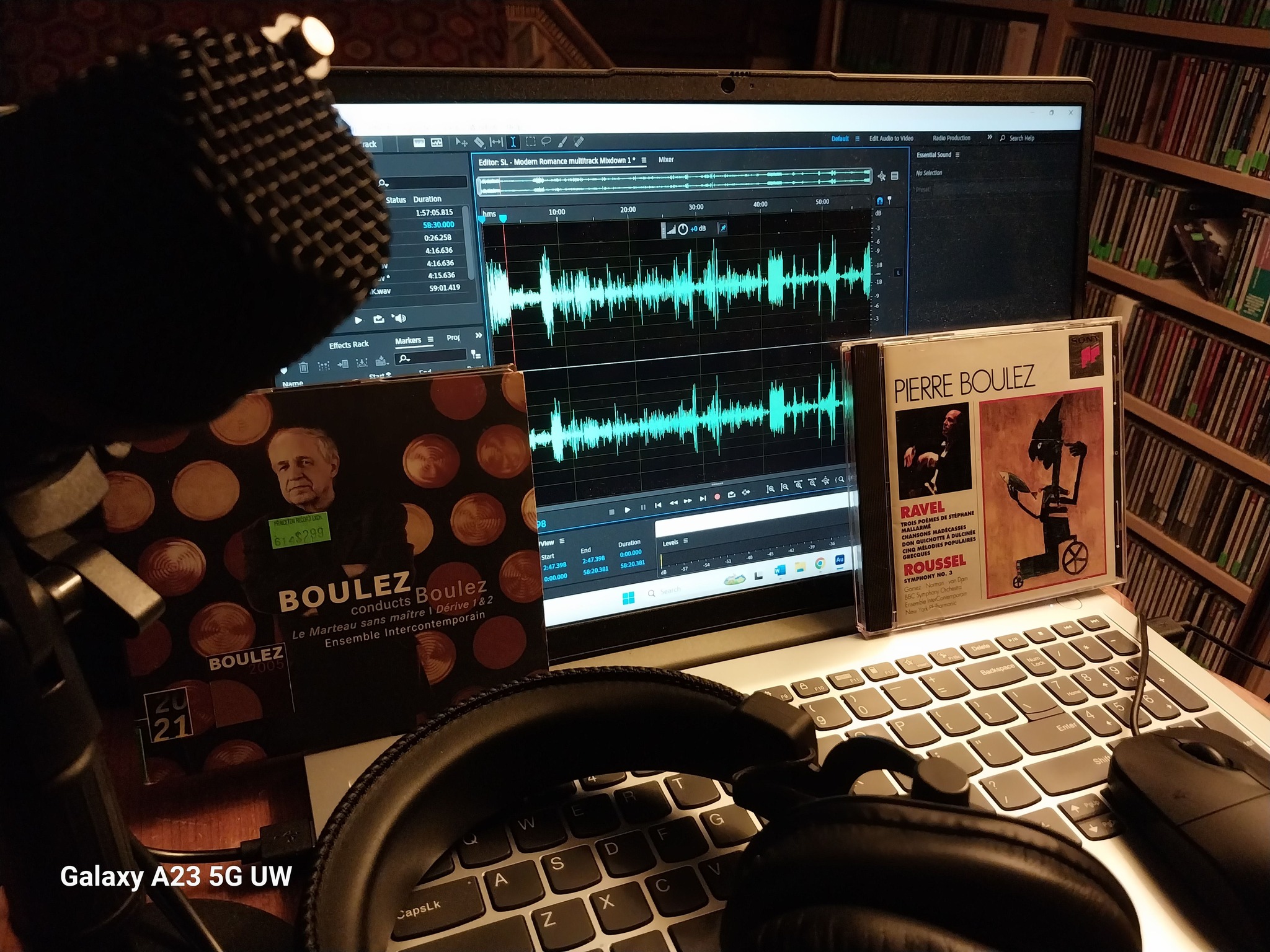
    Just finished recording this week’s edition of “The Lost Chord.” To mark the centenary of the birth of Pierre Boulez on March 26, the program juxtaposes two Boulez-conducted song cycles: Boulez’s own “Le Marteau sans maître” (“The Hammer without a Master”) and Ravel’s “Chansons madécasses“ (“Madagascan Songs”). Hear it on KWAX, this Saturday at 7:00 p.m. EDT/4:00 p.m. PDT. Stream it wherever you are at https://kwax.uoregon.edu/

  • Facebook Fail Correcting Composers Photo

    Facebook Fail Correcting Composers Photo

    Okay, I admit it. I over-edit my posts. I reread them and alter them until I think they read best. I especially edit them if I happen to notice a factual error.

    I was scrolling through some old posts last week, and paused when I came to an amazing photo, taken after a New York Philharmonic concert in 1977, of all the contemporary composers whose works Pierre Boulez programmed during his tenure as music director of the orchestra.

    I had previously identified one of them, in the front row, as Hershy Kay, but glancing at it again, I realize, to my embarrassment, that it is actually Ulysses Kay. So even though the post was committed over a year ago (on April 14, 2020), I hit the “edit” option to correct it. And, wouldn’t you know it, the photo disappeared.

    You see, it’s one of the quirks of “New Facebook” that when you attempt to edit a post with forwarded content as the image, the image goes away. I’ll never be able to get the photo back on the old post, but since it’s a slow news day, I figured I’d plug it in again today.

    I actually discovered it for the first time after it was shared on the Aaron Copland page, from a post by composer Daniel Plante, over at the Pierre Boulez Appreciation Group.

    Here are the names of the subjects (hopefully now correct), with Boulez standing in the foreground, proudly displaying his trophies.

    First row (left to right): Milton Babbitt, Lucia Dlugoszewski, Ulysses Kay, George Rochberg, and Mario Davidovsky.

    Second Row: David Gilbert, Stephen Jablonsky, Jacob Druckman, Roger Sessions, William Schuman, and Aaron Copland.

    Third Row: Donald Martino, Donald Harris, Daniel Plante, Morton Gould, Vincent Persichetti, and Roy Harris.

    Fourth Row: Charles Wuorinen, Carmen Moore, Sydney Hodkinson, David Del Tredici, Earle Brown, Harley Gaber, Stanley Silverman, John Cage, and Elliott Carter.

    It will surprise no one (except me, apparently) that we are living in a disposable world, and that Facebook is no place for perfectionism!

Tag Cloud

Aaron Copland (92) Beethoven (95) Composer (114) Film Music (119) Film Score (143) Film Scores (255) Halloween (94) John Williams (185) KWAX (229) Leonard Bernstein (99) Marlboro Music Festival (125) Movie Music (134) Opera (198) Philadelphia Orchestra (86) Picture Perfect (174) Princeton Symphony Orchestra (106) Radio (87) Ralph Vaughan Williams (85) Ross Amico (244) Roy's Tie-Dye Sci-Fi Corner (290) The Classical Network (101) The Lost Chord (268) Vaughan Williams (102) WPRB (396) WWFM (881)

DON’T MISS A BEAT

Receive a weekly digest every Sunday at noon by signing up here


RECENT POSTS