EIGHT DAYS OF SIBELIUS – DAY 3
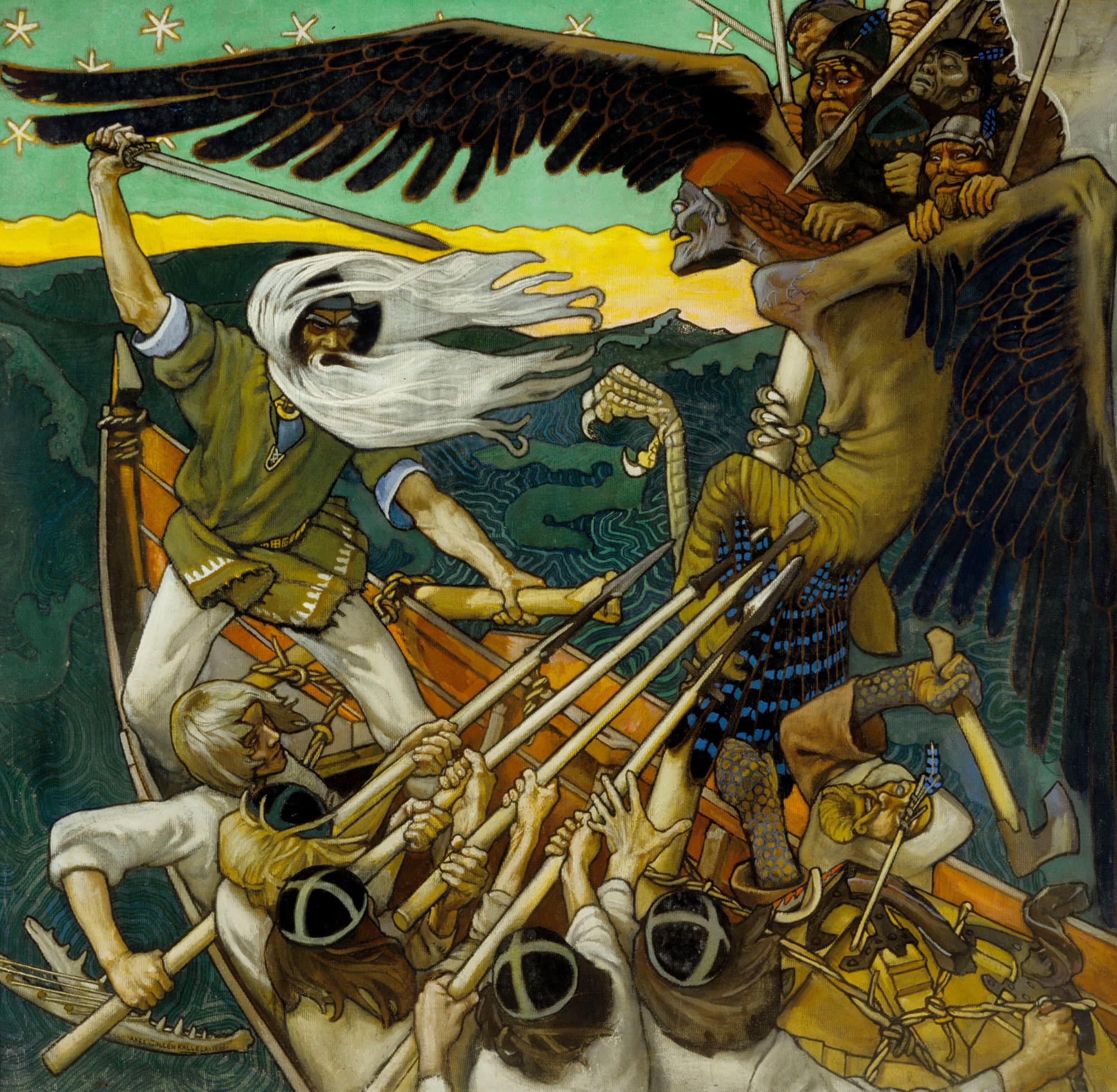
No celebration of Sibelius would be complete without a post dedicated to the influence of the “Kalevala.” This disparate collection of long narrative poems, frequently referred to as the Finnish national epic, tells of the creation of the Earth, the loves, antagonisms, and retaliations of its peoples, and the forging, theft, and attempted recovery of a mysterious talisman called the Sampo.
Its fantastic and heroic tales informed the work of Finland’s greatest artists at a time when the country began its surge toward independence, after 700 years of Swedish rule, and another century as a duchy of the Russian Empire. The “Kalevala” resonated with Finns to an extent it may be difficult for foreigners to comprehend. It has inspired holidays, the naming of cities, and innumerable paintings, books, and pieces of music.
Sibelius, fiercely patriotic, was “Kalevala”-crazy. A significant portion of his output was influenced by this fount of Finnish lore – “Four Legends from the Kalevala,” “Kullervo,” “Pohjola’s Daughter,” “Tapiola,” “The Origin of Fire,” and “Kyllikki,” to name a few. Some of the symphonic poems had their roots in a projected opera, “The Building of the Boat,” which was never completed.
I’ve done several radio shows, over the years, programmed around themes from the “Kalevala.” This one, “Epic Finnish,” last aired on January 6, 2019, on “The Lost Chord,” on WWFM – The Classical Network.
https://www.wwfm.org/post/lost-chord-january-6-epic-finnish
The playlist includes “Aino” by Sibelius champion Robert Kajanus, the “Kalevala Suite” by Uuno Klami, and a Sibelius rarity, “A Song for Lemminkäinen.”
I am also appending, as an added bonus, Leonard Bernstein and the New York Philharmonic in Sibelius’ “Pohjola’s Daughter.” I’m a little mixed on Bernstein’s recordings of the symphonies, but here I think he really excels. The performance is a wonder. Steadfast old Väinämöinen, the wizard, attempts to woo the Daughter of the North, whom he espies seated atop a rainbow, weaving a cloth of gold. She agrees to marry him only if he is able to complete a series of impossible tasks. (My favorite is tying an egg into invisible knots!) Unfortunately, Väinämöinen, always unlucky in love, wounds himself grievously with an axe while attempting to construct a boat from fragments of her distaff.
In addition, I know I posted the link recently, on Eugene Ormandy’s birthday, but here it is again. This is, quite simply, one of my favorite Sibelius recordings of all time. Ormandy conducts the Philadelphia Orchestra in “Four Legends from the Kalevala.” Its four movements evoke the swashbuckling Lemminkäinen and his adventures among the maidens of Saari; the Swan of Tuonela gliding through the realm of the dead; the resurrection of Lemminkäinen, treacherously slain; and finally, Lemminkäinen’s homeward journey.
As an encore, Ormandy raises a ruckus, in an even more hair-raising rendition of the finale, from 1940.
https://www.youtube.com/watch?v=FzQMyCsB8eQ
“The Defense of the Sampo” (1896), by Akseli Gallén-Kallela. Väinämöinen the wizard faces off against the evil witch Louhi.
