Tag: Polyphony

  • Palestrina The Legend Behind the Music

    Palestrina The Legend Behind the Music

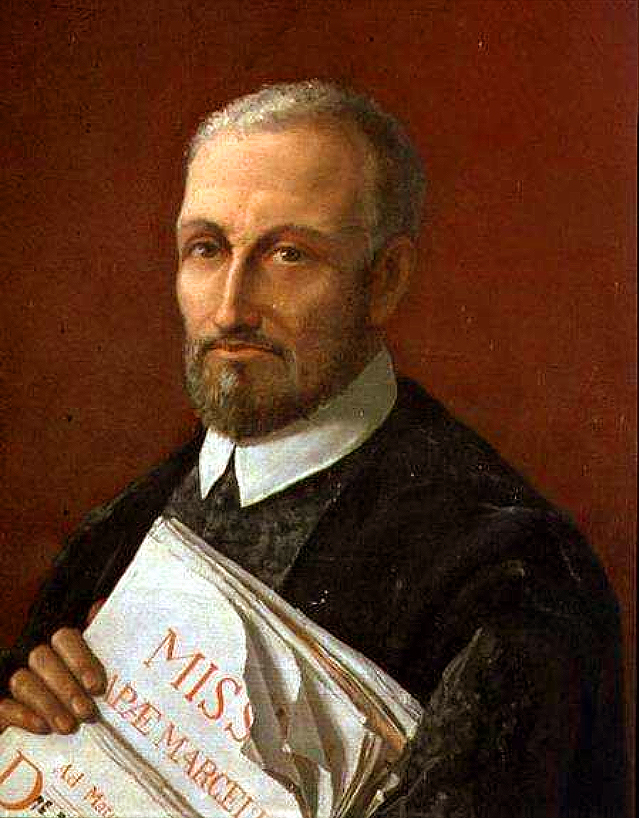
    Okay, so we don’t know exactly when Renaissance master Giovanni Pierluigi da Palestrina was born. I guess nobody wrote anything down back then unless you were really important (i.e. if you were of royal blood), and who would have predicted his achievements?

    A Catholic superstar of the Counter-Reformation, Palestrina is often credited with having persuaded the Council of Trent not to ban polyphonic music. (See, or hear, Hans Pfitzner’s opera “Palestrina” of 1915.) Yes, this was something the Church really debated back in the 16th century. Can’t have that lascivious, impure polyphonic music stirring up the passions.

    Recent scholarship has revealed that Palestrina’s defiance may have been somewhat exaggerated. Nevertheless, this legend of speaking truth to power grew, beginning with a hagiography written in 1607 (13 years after Palestrina’s death), in which composer Agostino Agazzari described him as “the hero of church polyphony.” Hey, any pitchman will tell you, sometimes all it takes to close a sale is one punchy phrase.

    In all, Palestrina composed 104 masses, over 300 motets, 68 offertories, 72 hymns, 35 Magnificat settings, 11 Litanies, four or five sets of Lamentations, and over 140 secular madrigals. He spent most of his career in Rome, serving as maestro di cappella at various churches, including a brief stint at the Sistine Chapel. He got the boot when the Pope decreed that all papal musicians had to be celibate clerics. (Palestrina was married, with four children.) Still, his music continued to be performed there.

    The only reason we’re even in the ballpark concerning Palestrina’s birthday is that a younger colleague specified in his eulogy that, at the time of his death, on February 2, 1594, Palestrina was 68 years-old. That narrows the field to somewhere between February 3, 1525, and February 2, 1526.

    Be that as it may, early music aficionados will be going bananas for Palestrina over the next 12 months, in honor of his 500th anniversary. As was observed in “The Man Who Shot Liberty Valance,” when the legend becomes fact, print the legend!


    Actually, the primary concern the Church had about polyphony was that the sacred texts couldn’t be understood (which might strike some as curious, since the texts were in Latin anyway – but your fault for not having a clerical education!). Palestrina’s simple, sensitive handling of the texts in the “Missa Papae Marcelli” (“Pope Marcellus Mass”), from around 1562, is said to have convinced Cardinal Carlo Borromeo that polyphony could be intelligible and that music such as Palestrina’s was too beautiful to ban from the Church.

    Play that funky polyphonic music, white boy.

  • Persian Polyphony on The Lost Chord

    Persian Polyphony on The Lost Chord

    You might say I’m on a Seemorgh diet. I see ‘Morgh, and I play it!

    This Sunday night on “The Lost Chord,” I hope you’ll join me for an hour of Persian polyphonic music – music written by Persian (or Iranian) composers, based on Persian folk and classical melodies, but written specifically for western instruments.

    We’ll hear two works by Behzad Ranjbaran, recorded in 1994 for the Delos label. I had heard Ranjbaran’s lyrical Piano Concerto at a concert of the Philadelphia Orchestra some time ago, but it did not prepare me for the beauty and opulence of his “Persian Trilogy.”

    Ranjbaran, born in Tehran in 1955, is currently on the faculty of the Juilliard School. Many of his works are influenced by Persian culture and literature. “The Persian Trilogy” was inspired by the “Shahnameh,” the national epic of 11th century poet Ferdowski.

    We’ll hear two of the three pieces, including “Seven Passages,” about the hero Rostam, who undergoes seven trials along the path to rescue the Persian king Kavus; and “Seemorgh,” about the mythical bird that raises the abandoned hero Zaal, who is able to summon her in times of crisis.

    Ranjbaran proves himself a master orchestrator. If you enjoy the music of Rimsky-Korsakov, Debussy, Paul Dukas, or Ottorino Respighi, I think you’ll really enjoy his “Persian Trilogy.”

    We’ll also hear music by Reza Vali, born in Ghazvin in 1952. Vali, currently on the faculty of Carnegie Mellon University, has been called the “Iranian Béla Bartók” for his ability to successfully meld native folk elements with established western classical forms. His “Folk Song (Set No. 9)” is composed for the combination of flute and cello. The flutist switches between various instruments of the flute family, and the cellist plays tuned crystal glass and tom-toms. As you’ll hear, the musicians are also required at various points to sing and whistle.

    I hope you’ll join me for “Roses of Persia,” a bouquet of Persian polyphonic music, this Sunday night at 10:00 EDT, on WWFM – The Classical Networkand wwfm.org.

Tag Cloud

Aaron Copland (92) Beethoven (95) Composer (114) Film Music (120) Film Score (143) Film Scores (255) Halloween (94) John Williams (185) KWAX (229) Leonard Bernstein (100) Marlboro Music Festival (125) Movie Music (135) Opera (198) Philadelphia Orchestra (88) Picture Perfect (174) Princeton Symphony Orchestra (106) Radio (87) Ralph Vaughan Williams (85) Ross Amico (244) Roy's Tie-Dye Sci-Fi Corner (290) The Classical Network (101) The Lost Chord (268) Vaughan Williams (103) WPRB (396) WWFM (881)

DON’T MISS A BEAT

Receive a weekly digest every Sunday at noon by signing up here


RECENT POSTS