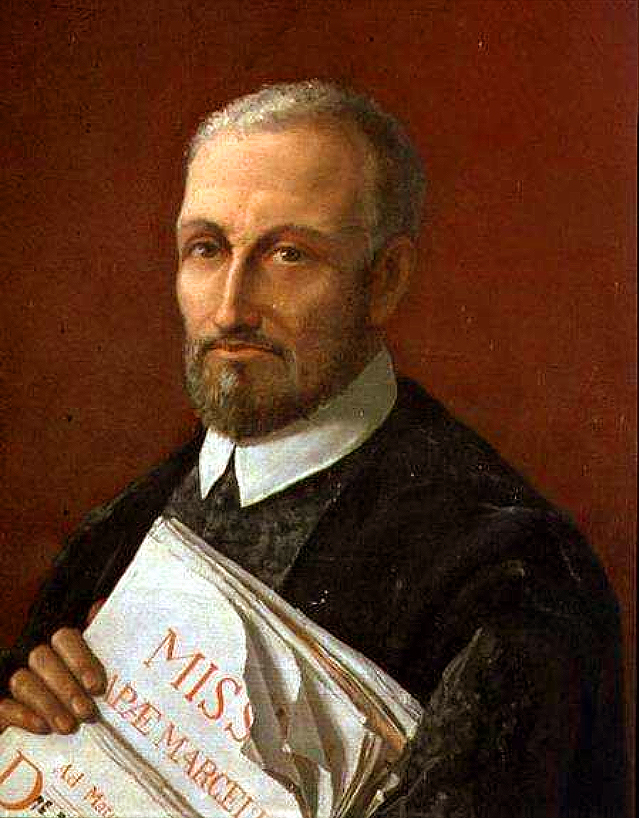
Okay, so we don’t know exactly when Renaissance master Giovanni Pierluigi da Palestrina was born. I guess nobody wrote anything down back then unless you were really important (i.e. if you were of royal blood), and who would have predicted his achievements?
A Catholic superstar of the Counter-Reformation, Palestrina is often credited with having persuaded the Council of Trent not to ban polyphonic music. (See, or hear, Hans Pfitzner’s opera “Palestrina” of 1915.) Yes, this was something the Church really debated back in the 16th century. Can’t have that lascivious, impure polyphonic music stirring up the passions.
Recent scholarship has revealed that Palestrina’s defiance may have been somewhat exaggerated. Nevertheless, this legend of speaking truth to power grew, beginning with a hagiography written in 1607 (13 years after Palestrina’s death), in which composer Agostino Agazzari described him as “the hero of church polyphony.” Hey, any pitchman will tell you, sometimes all it takes to close a sale is one punchy phrase.
In all, Palestrina composed 104 masses, over 300 motets, 68 offertories, 72 hymns, 35 Magnificat settings, 11 Litanies, four or five sets of Lamentations, and over 140 secular madrigals. He spent most of his career in Rome, serving as maestro di cappella at various churches, including a brief stint at the Sistine Chapel. He got the boot when the Pope decreed that all papal musicians had to be celibate clerics. (Palestrina was married, with four children.) Still, his music continued to be performed there.
The only reason we’re even in the ballpark concerning Palestrina’s birthday is that a younger colleague specified in his eulogy that, at the time of his death, on February 2, 1594, Palestrina was 68 years-old. That narrows the field to somewhere between February 3, 1525, and February 2, 1526.
Be that as it may, early music aficionados will be going bananas for Palestrina over the next 12 months, in honor of his 500th anniversary. As was observed in “The Man Who Shot Liberty Valance,” when the legend becomes fact, print the legend!
Actually, the primary concern the Church had about polyphony was that the sacred texts couldn’t be understood (which might strike some as curious, since the texts were in Latin anyway – but your fault for not having a clerical education!). Palestrina’s simple, sensitive handling of the texts in the “Missa Papae Marcelli” (“Pope Marcellus Mass”), from around 1562, is said to have convinced Cardinal Carlo Borromeo that polyphony could be intelligible and that music such as Palestrina’s was too beautiful to ban from the Church.
Play that funky polyphonic music, white boy.
Leave a Reply