
Neat discovery on Francis Poulenc’s birthday! The composer and Jacques Février play Poulenc’s Concerto for Two Pianos. The orchestra is conducted by Georges Prêtre, one of Poulenc’s most authoritative interpreters. Of course, this same team made a classic recording of the work for EMI. I’m just pumped that there’s a film, and that it’s so pristine! While it’s undeniably fun to watch the interplay between the two pianists in the fleeter passages, my favorite part of the piece has always been the second movement, clearly indebted to Mozart, but also touched by Poulenc’s characteristic wistfulness.
Tag: Poulenc
-
Poulenc vs. Fauré: A Musical Feud
Francis Poulenc once described Gabriel Fauré’s music as physically unbearable. Florent Schmitt, who studied with Fauré, hated Poulenc’s Sextet for Piano and Winds. At its premiere, he described it as wandering and vulgar.
Turnabout is fair play, on this week’s “Music from Marlboro.”
Poulenc labored over his Sextet for the better part of a decade. He began work on the composition in 1931, when he was in his early 30s. Then he subjected it to a complete overhaul, so that he came to regard it as a completely different piece. In 1939, with Europe on the brink of war, Poulenc extensively revised it again. The sextet reached its definitive form, with France under Nazi occupation, in 1940.
The outer movements are frantic, but at the work’s core is the soul of the composer, jovial, wistful, and altogether irresistible. Some have regarded it as an affectionate parody of the 18th century divertimento. (It is described by the composer as a divertissement.) In particular, it seems to inhabit a world not all that far from Mozart’s slow movements.
We’ll hear Poulenc’s reviled Sextet, performed at the Marlboro Music Festival in 2015, by flutist Marina Piccinini, oboist Mark Lynch, clarinetist Narek Arutyunian, bassoonist Brad Balliett, hornist Lauren Hunt, and pianist Zoltan Fejérvári.
Then we’ll turn to music by Poulenc’s musical nemesis. Fauré completed his Piano Quartet No. 2 in G minor in 1887, when he was 42, just about a year older than Poulenc was when his Sextet reached its definitive form.
The work may come as something as a surprise to anyone expecting the fairly chaste atmosphere of the Requiem, begun around the same time. In contrast to the Elysian serenity conjured in his great choral opus, the quartet is passionate and personal. The evocative slow movement, which the composer described as “a vague reverie,” was inspired by the memory of evening bells at the village of Cadirac, in the south of France, which he knew as a child.
The quartet was performed at Marlboro in 2001, by pianist Gilbert Kalish, violinist Catherine Cho, violist Melissa Reardon, and cellist Raman Ramakrishnan.
While it’s true that, as a young man, Poulenc had a violent reaction to Fauré’s music, it is one that became tempered with experience. “I hated Fauré until I was 30 and then I realized that he was a very great composer. So I made an effort with myself and began to admire him. It’s an attitude I’ve maintained and built on, but physically it is for me an unbearable kind of music, what can I do about it?”
Um, and things were going so well, until that last little bit…
It’s an uneasy truce, on the next “Music from Marlboro,” this Wednesday evening at 6:00 EST, on WWFM – The Classical Network and wwfm.org.
Marlboro School of Music and Festival: Official Page
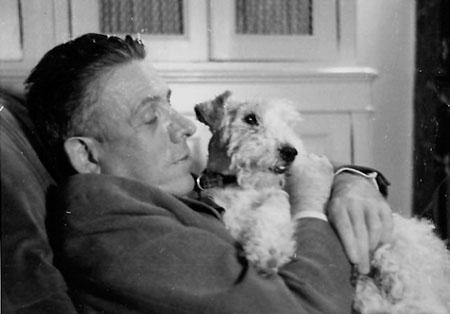
Poulenc: The more I listen to Fauré, the more I love my dog
-

Fauré, Poulenc & More from Marlboro Music Festival
On this week’s “Music from Marlboro,” we get Sharp, as baritone William Sharp performs Gabriel Fauré’s cycle of nine mélodies, “La bonne chanson.”
These settings of poetry by Paul Verlaine were composed in the summers of 1892 and 1893, while Fauré was a guest of banker Sigismond Bardac and his wife (with whom Fauré was in love), soprano Emma Bardac. Fauré would compose the “Dolly Suite” for Bardac’s daughter, but it was Claude Debussy for whom she left her husband and eventually married.
In 1898, Fauré expanded the accompaniment to “La bonne chanson” to include a string quartet. The cycle contains a number of musical themes that recur from song to song. The piece was much admired by Proust, though Saint-Saëns thought the composer had gone mad.
We’ll hear a performance from the 1984 Marlboro Music Festival. Sharp is joined by violinists Carmit Zori and Margaret Batjer, violist John Graham, cellist Ulrich Boeckheler, and pianist Luis Batlle.
Francis Poulenc labored over his Sextet for Piano and Winds for the better part of a decade. The work was given its premiere, in its original version, in 1931. Then it underwent a complete overhaul, so that the composer regarded it as an entirely different piece at its first performance, in this second incarnation, two years later. In 1939, with Europe on the brink of war, Poulenc extensively revised it again. The sextet reached its definitive form, with France under Nazi occupation, in 1940. The outer movements are frantic, but at the work’s core is the soul of the composer, jovial, wistful, and altogether irresistible.
We’ll hear it performed at Marlboro in 2015, by flutist Marina Piccinini, oboist Mark Lynch, clarinetist Narek Arutyunian, bassoonist Brad Balliett, hornist Lauren Hunt, and pianist Zoltan Fejérvári.
Since we’re in midst of a membership campaign, the rest of the program will unfurl as time allows. I would love to share Maurice Ravel’s “Trois Poèmes de Stéphane Mallarmé” – it would be a nice way to round out the hour, and an appropriate bookend to Fauré’s mélodies after Verlaine – but more than likely it will be his “Introduction and Allegro for Harp, Flute, Clarinet and String Quartet.”
Which reminds me, it’s the end of our fiscal year! Please support us by calling 1-888-232-1212, or by contributing online at wwfm.org (click on “donate”).
Then pardon my French. I’ll be talking a sacre bleu streak on the next “Music from Marlboro,” this Wednesday evening at 6:00 EDT, on WWFM – The Classical Network and wwfm.org.
Marlboro School of Music and Festival: Official Page
Incidentally, if you are a William Sharp fan, you’ll want to tune in on Friday at 8 p.m. for a rebroadcast of Bernard Herrmann’s music for the radio play “Whitman.” The concert was given at Washington’s National Cathedral on June 1. Sharp will be heard in the title role, reciting Whitman’s poetry, with the PostClassical Ensemble conducted by Angel Gil-Ordóñez. Also on the program will be Herrmann’s Clarinet Quintet, “Souvenirs de Voyage,” and “Psycho: A Narrative for String Orchestra.”
PHOTOS: The young Fauré (left) and William Sharp, channeling his hair
-

Peter Hurford Organist Remembered
The organist Peter Hurford has died. His Bach, Poulenc, and Saint-Saëns recordings have long been a part of my life. Stop with the deaths of the musical giants already!
PHOTO: Hurford, so young, so dapper, at the console with his wife, Patricia, in 1955
-

Poulenc Beethoven Scherzo? Music from Marlboro
Is it just me, or does Francis Poulenc playfully riff on the scherzo to Beethoven’s “Eroica” Symphony in the third movement of his Trio for Oboe, Bassoon and Piano? Maybe not, but I’m going to go with it, since the potential delusion serves as an excellent excuse for me to juxtapose music of Poulenc and Beethoven on this week’s “Music from Marlboro.”
Poulenc’s Trio, composed in 1926, begins very somberly indeed, before taking off with irrepressible joie de vivre. The central movement is both elegant and wistful in a manner characteristic of this composer, and the cheeky finale is presented with an ironic smile. We’ll hear a 1972 performance featuring oboist Rudolph Vrbsky, bassoonist Alexander Heller, and pianist Seth Carlin.
Then Pablo Casals will preside over a makeshift orchestra consisting of dozens of musicians at the 1969 Marlboro Music Festival for a warm traversal of Beethoven’s Symphony No. 4. (While Casals conducted a number of the Beethoven symphonies at Marlboro, he did not do the “Eroica.”) The legendary cellist was affiliated with the Marlboro festival for the last 13 years of his life, from 1960 to 1973.
Robert Schumann once characterized the symphony as “a Greek maiden between two Norse giants” – certainly a provocative image. We’ll temper this very Teutonic utterance with a splash of Gallic insouciance, on “Music from Marlboro,” this Wednesday at 6 p.m. EDT, on WWFM – The Classical Network and wwfm.org.
Marlboro School of Music and Festival: Official Page
PHOTO: A caricature of Beethoven adorning a dinner plate designed by Jean Cocteau; decades earlier, Cocteau was responsible for promoting Poulenc and five of his composer-colleagues as the collective “Les six”
Tag Cloud
Aaron Copland (92) Beethoven (94) Composer (114) Film Music (116) Film Score (143) Film Scores (255) Halloween (94) John Williams (185) KWAX (228) Leonard Bernstein (99) Marlboro Music Festival (125) Movie Music (131) Opera (197) Philadelphia Orchestra (86) Picture Perfect (174) Princeton Symphony Orchestra (106) Radio (86) Ralph Vaughan Williams (85) Ross Amico (244) Roy's Tie-Dye Sci-Fi Corner (290) The Classical Network (101) The Lost Chord (268) Vaughan Williams (99) WPRB (396) WWFM (881)