Tag: Prince Igor

  • Alexander Borodin Chemist Composer Extraordinaire

    Alexander Borodin Chemist Composer Extraordinaire

    The connection between music and science has been much remarked upon. In the case of Alexander Borodin, he was a doctor and chemist.

    Borodin was born on this date in 1833. As a boy he had had piano lessons, but he received his formal education at the Medical-Surgical Academy in St. Petersburg. He then served as a surgeon in a military hospital before undertaking three years of advanced scientific study in Western Europe.

    In 1862, he returned to his alma mater to teach. There, he managed to establish courses for women. In 1872, he founded a school of medicine for women. He devoted the remainder of his scientific career to research. He is co-credited with the discovery of the aldol reaction, a means of forming carbon-carbon bonds in organic chemistry.

    Around the time of his return to the Academy, he met Mily Balakirev, the persuasive advocate of Russian nationalism in music, who took the chemist under his wing and supervised the composition of his Symphony No. 1. Borodin began work on his Symphony No. 2 in 1869. Since regarded as a particularly successful blend of Slavic drama and lyricism with European classical form, it was not a particular success at its premiere in 1877.

    Borodin became sidetracked while working on the piece by his absorption in an opera on the subject of Prince Igor. This was to become his most significant musical contribution and one of the most important Russian historical operas. Because of his other commitments and repeated distractions, the work was left unfinished at the time of his death. It was completed by his friends and colleagues, Nikolai Rimsky-Korsakov and Alexander Glazunov.

    The big show-stopper, of course, is his “Polovtsian Dances,” which has been used to sell everything from records to cleanser.

    Borodin was yet another beneficiary of the exceeding generosity of Franz Liszt, whose contributions in this regard are not widely enough acknowledged. It was Liszt’s advocacy as a conductor that brought Borodin to the attention of European audiences. In gratitude, the composer dedicated “In the Steppes of Central Asia” to Liszt in 1880.

    Borodin was also embraced by the French Impressionists, who admired his unusual harmonies. Of course, he achieved even greater renown when melodies from his works became the basis for the musical “Kismet” in 1953. In 1954, he was honored with a posthumous Tony Award!

    Since for Borodin music was basically an avocation, something to which he devoted himself mostly during holidays or when he was otherwise unable to report to work, it became a running gag among his friends that they’d wish him poor health.

    “In winter I can only compose when I am too unwell to give my lectures,” he wrote. “So my friends, reversing the usual custom, never say to me, ‘I hope you are well’ but ‘I do hope you are ill.’”

    He had plenty of experience with illness. The composer survived cholera and suffered several heart attacks. He finally dropped dead during a ball at the Academy in 1887.

    Happy birthday, Alexander Borodin!


    PHOTO: Alexander Borodin: chemistry to burn
  • Rediscovering Glazunov’s Genius

    Rediscovering Glazunov’s Genius

    Okay, I admit it, I have a sweet tooth. And perhaps, at a time when I have no intention of getting a haircut, much less going to the dentist, that predilection could cost me. But damn it, here it is, dental health to the dogs: I do like the music of Alexander Glazunov!

    Glazunov is one of those composers I’ve always felt a little sheepish about liking. I remember sitting at a listening bar at a record shop in Philadelphia and asking to preview a recording of Glazunov ballet music. “I know I’m not supposed to like this stuff,” I offered, apologetically.

    Admittedly, at the time, other than the Violin Concerto, I didn’t really know a lot of great recordings of his music. I found the Marco Polo releases that I had heard, with the Hong Kong Philharmonic, to be underwhelming, and these prejudiced me against the composer for years. But Neeme Järvi’s performances on Chandos were revelatory. Then of course I eventually got my hands on the Melodiya issues with Gennady Rozhdestvensky and Evgeny Svetlanov. I know it’s going to make somebody cry to read this, but I currently have in my collection four complete cycles of Glazunov’s symphonies. Not even I know how that happened.

    Okay, so he isn’t Beethoven. Who is? But at his best, his music is well-crafted, attractive (to me, anyway), and marked by an abundance of memorable melodies that would make any honest composer jealous.

    As a person, he was not without his faults. He had a real problem with alcohol, which may have contributed to his disastrous performance as conductor at the premiere of Rachmaninoff’s First Symphony, a real train-wreck that elicited a savage review from Cesar Cui and plunged the younger composer into creative paralysis.

    But Glazunov was also generous, almost to a fault. As director of the Petrograd Conservatory, he was in a position to pull strings so that a young Dmitri Shostakovich didn’t have to deal with preparatory theory and instead could plunge right into the business of composition.

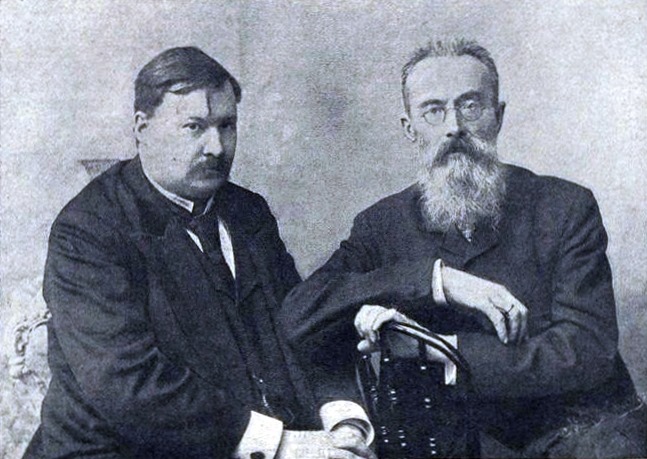
    Also, after the death of Alexander Borodin, Glazunov stepped up (with Rimsky-Korsakov) to help complete Borodin’s unfinished masterpiece, the opera “Prince Igor.” Legend has it that he wrote out the overture from memory, having heard Borodin play through it a couple of times on the piano.

    So maybe you don’t want this guy on the podium during a performance of your music, but put him on a piano bench with a bottle of vodka, and you’re in good hands.

    Glazunov’s own music can be full of serene lyricism, generously melodic, and, yes, often quite beautiful.

    Happy birthday, Alexander Glazunov! You won’t catch me going to a custard stand during COVID, but surely this is the next best thing.


    Symphony No. 4

    String Quintet in A major

    Violin Concerto

    The symphonic poem “Stenka Razin”

    “Raymonda” (selections)
    https://www.youtube.com/watch?v=nAs9mcGhtgg

    PHOTO: Glazunov (left), hanging out with Rimsky-Korsakov

  • Met Opera Streams Bel Canto Borodin Week

    Met Opera Streams Bel Canto Borodin Week

    Bel canto and Borodin bookend this week’s offerings from The Metropolitan Opera.

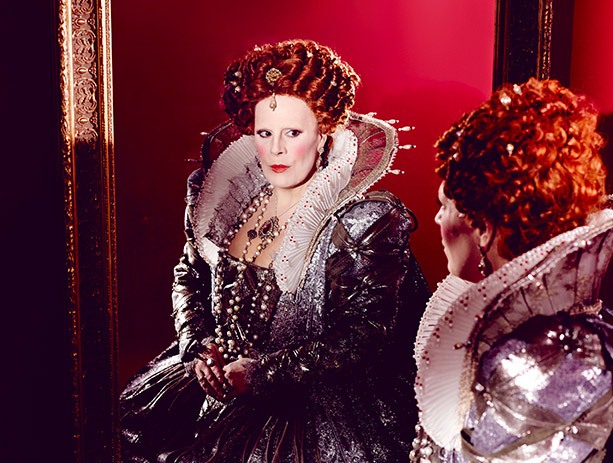
    Now entering its seventh week, the Met’s “Live in HD” encore series will include Donizetti’s “Three Queens” trilogy (Monday-Wednesday), Nico Muhly’s adaptation of the book that also inspired Alfred Hitchcock’s “Marnie” (Thursday), Verdi’s “Aida” with Leontyne Price (Friday), Verdi’s “Luisa Miller” (Saturday), and Alexander Borodin’s “Prince Igor” (Sunday).

    The operas stream free, for 23 hours, beginning each day at 7:30 p.m. (“La Cenerentola” is available until 6:30 this evening.) You’ll find teasers and bonus materials when following the link.

    https://www.metopera.org/user-information/nightly-met-opera-streams/week-7/

  • Glazunov’s Birthday & Prince Igor’s Legacy

    Glazunov’s Birthday & Prince Igor’s Legacy

    Today is the birthday of Alexander Glazunov (1865-1936), a prodigious musician whose talent unfortunately was all too often compromised by drink. It was Glazunov the conductor who, under the influence, derailed the first performance of Rachmaninoff’s Symphony No. 1.

    On a more positive note, he accomplished minor miracles in the completion of Alexander Borodin’s magnum opus, the opera “Prince Igor.” The oft-told story is that Glazunov jotted the overture down from memory, having heard Borodin play through it once at the piano. By Glazunov’s own admission, the feat wasn’t quite as impressive as all that – he had found a few fragmentary sketches Borodin left behind and simply allowed his imagination to vault off of those, honoring Borodin’s intended structure. Still, it was Glazunov who did the heavy lifting, and if not for him and Rimsky-Korsakov, “Prince Igor” would have never become the icon of Russian music that it has.

    Earlier in the hour, we heard the overture in Glazunov’s completion and orchestration of the work. We also had a chance to listen to music by Glazunov’s star pupil, Dmitri Shostakovich – his Concertino for 2 Pianos, written for performance by Shostakovich and his son. Right now we’re enjoying Glazunov’s lovely and languid Symphony No. 4, in a recording with Gennadi Rozhdestvensky conducting.

    In the 5:00 hour, we’ll be celebrating the birthday of American composer Douglas Moore (1893-1969) with selections from his opera, “The Ballad of Baby Doe,” with Beverly Sills in the title role, and his delightful suite, “The Pageant of P.T. Barnum” in a classic recording conducted by Howard Hanson.

    The 6:00 hour will be all-Brazilian, including a piece for string orchestra by Clarice Assad, the daughter of guitarist Sergio Assad, as we continue to play off of the Olympic Games in Rio de Janeiro.

    Our trajectory takes us from Russia to Brazil today, until 7:00 EDT, on WWFM – The Classical Network and at wwfm.org.

Tag Cloud

Aaron Copland (92) Beethoven (94) Composer (114) Film Music (117) Film Score (143) Film Scores (255) Halloween (94) John Williams (185) KWAX (228) Leonard Bernstein (99) Marlboro Music Festival (125) Movie Music (132) Opera (197) Philadelphia Orchestra (86) Picture Perfect (174) Princeton Symphony Orchestra (106) Radio (86) Ralph Vaughan Williams (85) Ross Amico (244) Roy's Tie-Dye Sci-Fi Corner (290) The Classical Network (101) The Lost Chord (268) Vaughan Williams (101) WPRB (396) WWFM (881)

DON’T MISS A BEAT

Receive a weekly digest every Sunday at noon by signing up here


RECENT POSTS