Tag: Prix de Rome

  • Florent Schmitt Rediscovered on The Lost Chord

    Florent Schmitt Rediscovered on The Lost Chord

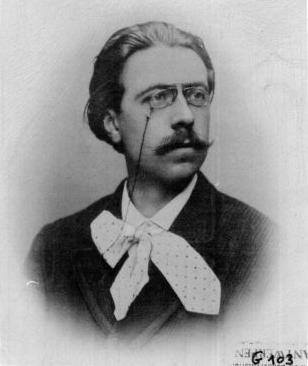
    This Sunday night on “The Lost Chord,” we bask in the opulent Orientalisms of Florent Schmitt.

    Florent Schmitt, who lived from 1870 to 1958, studied at the Paris Conservatory, where Gabriel Fauré, Jules Massenet, and Théodore Dubois were among his teaches. He befriended Frederick Delius while Delius was in Paris and prepared the vocal scores of a number of his operas.

    Schmitt was also a music critic, who attained a degree of notoriety for shouting out his assessments from the audience. As a composer, he was remarkably successfully, his works among the most frequently performed French music during the early decades of the 20th century.

    His reputation plummeted in the years following the Second World War, and it wasn’t really until the past few decades that his music began to be revived in any significant manner, with a number of fine compact disc recordings of his work currently on the market.

    One of the most recent of these was issued on the Naxos label, with the Buffalo Philharmonic, conducted by JoAnn Falletta. The disc features the symphonic etude, “The Haunted Palace,” after Edgar Allan Poe, and incidental music written for a production of Shakespeare’s “Antony and Cleopatra.” We’ll be listening to the first of the two suites.

    Schmitt was a winner of the Prix de Rome in 1900. The later neglect of his music may have been in part due to his willingness to cooperate with the Vichy regime during the Nazi occupation of France, as well as a marked change in musical fashion from the kind of opulence characteristic of his music, with one foot in the world of Debussy and the other in the world of Wagner and Richard Strauss.

    Even so, Stravinsky was an early admirer, saying of Schmitt’s ballet, “The Tragedy of Salome,” that the work gave him greater joy than any he had heard in a long time. Certain elements of the ballet anticipate analogous experiments in Stravinsky’s “The Rite of Spring.”

    One of Schmitt’s most celebrated works is his setting of “Psalm XLVII.” Despite its Biblical source, the work has little to do with ecclesiastical matters. Rather, the composer was chiefly inspired by ceremonial acclamations of the Ottoman Sultan, which he had witnessed himself in Istanbul in 1903. He appropriates, and interprets, the text as an expression of Oriental triumph, in the opening and closing “O Clap your hands all ye people,” and languor, with a soprano soloist singing, “He hath chosen our inheritance for us, the beauty of Jacob whom He loved.” We’ll hear the BBC National Orchestra and Chorus of Wales conducted by Thierry Fischer.

    I hope you’ll join me for “Schmitt Happens” – recordings from the Florent Schmitt revival – this Sunday night at 10 ET, with a repeat Wednesday evening at 6; or that you’ll listen to it later as a webcast at wwfm.org.


    Exhaustive website devoted to all things Florent Schmitt: http://florentschmitt.com/
  • Debussy’s Clair de lune and André Caplet

    Debussy’s Clair de lune and André Caplet

    “Clair de lune” – Debussy, right?

    The work began as a piano piece, one of the movements from Debussy’s “Suite bergamasque.” However, the lovely orchestral version was produced by André Caplet.

    One of the reasons superior sorts tend to look down their noses at film music is that the composers frequently work with orchestrators (though the better composers are very meticulous about notating their requirements). However, the practice is not exclusive to Hollywood.

    The Dutch masters were not always responsible for all the elements in the paintings attributed to them. For a famous example, see Rubens’ “Prometheus Bound” (which you can view in person, if you are reading this locally, at the Philadelphia Museum of Art). Similarly, successful authors sometimes set up studios, kind of like architects, with anonymous collaborators doing a lot of the heavy lifting. The practice dates back to at least Alexandre Dumas, who churned out novels at a dizzying rate.

    In classical music, many of the orchestral works of Grieg and Liszt received ample assistance from others (though Liszt gained confidence – and autonomy – as time went on). Charles Koechlin worked behind the scenes with Debussy and Gabriel Fauré.

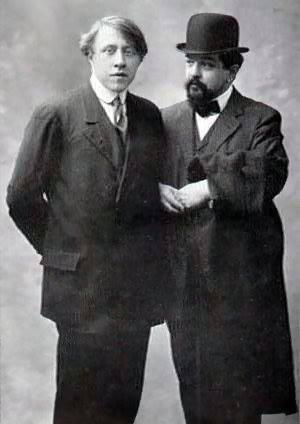
    Caplet, a winner of the esteemed Prix de Rome, provided orchestrations for Debussy’s “Children’s Corner,” “Clair de lune,” “The Martyrdom of Saint Sebastian” and “La Boiîte à joujoux.”

    He directed the Boston Opera from 1910 to 1914. While serving in the First World War, he was caught in a gas attack, which resulted in the pleurisy that plagued him for the remainder of his short life. Caplet died in 1925, at the age of 44.

    Why is it so important to us, I wonder, that a work of art emerge seemingly from a single source – the “auteur,” as it were? While most of Caplet’s own music languishes in obscurity, his work for Debussy lives on.

    Happy birthday, André Caplet!


    Caplet’s orchestration of “Clair de lune”:

    His own “Septuor” for string quartet and three female voices:

    Rubens’ “Prometheus Unbound”:

    http://www.philamuseum.org/collections/permanent/104468.html

    PHOTO: Caplet (left) with Debussy

  • Paul Gilson: Celebrating Belgium’s Overlooked Composer

    Paul Gilson: Celebrating Belgium’s Overlooked Composer

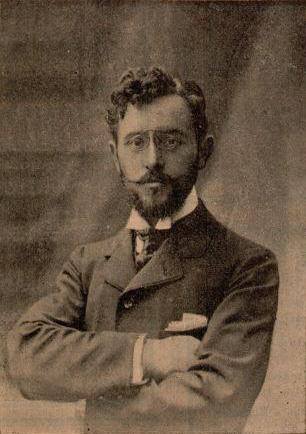
    You know, I adore Grieg (who was born on this date in 1843). But I can’t ignore Paul Gilson on the 150th anniversary of his birth.

    Gilson was born in Brussels in 1865. He received his formal musical training there, at the Brussels Conservatory. However, prior to that, he was already composing works for orchestra and chorus. In 1889, he became a recipient of a Belgian Prix de Rome, which allowed him to travel to Bayreuth, Paris and Italy. You can hear the influence of Wagner in his music. He was also fond of the Russians.

    He later taught at the conservatory, and in Antwerp. He resigned his professorships when he was appointed inspector of music education, a post he held for over two decades. He began to diversify by the age of 40 (about four years before his appointment). He composed less and wrote more ABOUT music. Still, over the course of his career, he managed to amass some 500 scores.

    He is probably best known for his symphonic sketches known as “De Zee” (or, often, “La mer”). Gilson’s work predated Debussy’s masterpiece by a decade. Did Debussy know Gilson’s work? He had to. Follow the link, then click on the openings of the third and fourth movements.

    https://www.youtube.com/watch?v=TjyorpKlqcg&list=PLfvNU__5CDp2824kFI_xzJYkRl9kTRyG3

    There’s no question who created the stronger piece. Still, it’s an instructive reminder that masterworks are not created in a vacuum, and that even lesser composers often have more to contribute than may be at first perceived.

    Happy birthday, Paul Gilson!


    PHOTO: Okay at composing; terrible at tying ties

Tag Cloud

Aaron Copland (92) Beethoven (95) Composer (114) Film Music (120) Film Score (143) Film Scores (255) Halloween (94) John Williams (185) KWAX (229) Leonard Bernstein (100) Marlboro Music Festival (125) Movie Music (135) Opera (198) Philadelphia Orchestra (88) Picture Perfect (174) Princeton Symphony Orchestra (106) Radio (87) Ralph Vaughan Williams (85) Ross Amico (244) Roy's Tie-Dye Sci-Fi Corner (290) The Classical Network (101) The Lost Chord (268) Vaughan Williams (103) WPRB (396) WWFM (881)

DON’T MISS A BEAT

Receive a weekly digest every Sunday at noon by signing up here


RECENT POSTS