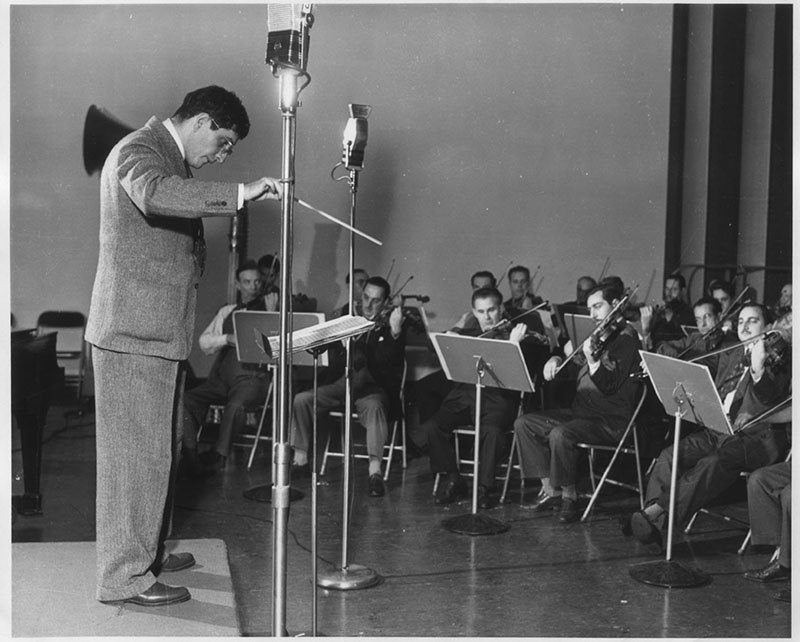
I’m in the process of rereading Steven C. Smith’s biography of Bernard Herrmann, “A Heart at Fire’s Center,” which I first encountered nearly 30 years ago (!!!), shortly after its publication in 1991. Bernard Herrmann, of course, was one of the great film composers, perhaps the greatest, but he really got his start in the medium of radio. He was hired as a conducting assistant by CBS. It wasn’t long before he was providing original music and serving as musical director of its resident orchestra.
It is sobering to recall just how high-minded radio was in its infancy, with the arts very much front and center. Classical music, dramatizations of classic literature, and poetry readings with musical accompaniment – all of these were a regular part of the programming at CBS. In fact, the network, in its original incarnation, had been founded by Arthur Judson, a violinist and concert promoter, who had been laughed out of NBC for his idealistic proposals.
These were not dumbed-down music programs! Toscanini concerts with the New York Philharmonic tended to be a little more conservative (later, of course, the conductor would find a home, with his own orchestra, at NBC), but the programs supervised by Herrmann, then only in his 20s, but already possessed of an encyclopedic knowledge of both music and literature, introduced works by Charles Ives, Henry Cowell, Gian Francesco Malipiero, Alexander Gretchaninov, Nikolai Myaskovsky, Hermann Goetz, Joachim Raff, Niels Wilhelm Gade, Richard Arnell, Lord Berners, Edmund Rubbra, and countless others. Even Schoenberg and Webern could be heard over CBS during those years.
Herrmann had known Ives personally since he was in his teens. He had discovered Ives’ “114 Songs” in the New York Public Library and was instrumental in shopping them around, even introducing them to Aaron Copland. He studied with Percy Grainger at NYU. Together, the two undertook the bass tuba, since Herrmann wanted to include the instrument in one of his orchestrations. He was also best friends with one of his Brooklyn classmates, Jerome Moross, who himself would become a notable film composer. Herrmann and Moross would sneak into rehearsals of the New York Philharmonic together at Carnegie Hall.
Herrmann was unfailingly outspoken. Apparently he had no filter. Once, when CBS president William S. Paley balked at one of his proposals, Herrmann snapped, “You’re assuming the public is as ignorant about music as you are.” That’s just the kind of guy Herrnann was. Totally tactless, but usually right. After that, we’re told, he was given near-unlimited freedom over musical programming at CBS.
Sometimes he would go out of his way to provoke. Once, during a rehearsal, he said to Benny Goodman, “Who told you you could play the clarinet?” Without missing a beat, Goodman responded, “Who told you you could conduct?” Everyone lived in fear of Herrmann’s acid tongue, but no one ever said no, and in fact a great many found his irascible nature to be surprisingly endearing. Often, he would deliberately stir the pot. He routinely provoked the head of the music library, which led to some lively exchanges, but these eventually resulted in a dinner invitation to the librarian’s home.
I venture to guess, few people currently affiliated with CBS, and even fewer in its audience, have any idea of the network’s roots. It’s interesting to look back on the histories of these institutions and note how careful a balance was maintained between art and commerce. Alongside the radio comedies and entertainment music was plenty to educate the mind, enrich the soul, and ennoble the spirit. But gradually the balance shifted, as over the decades more and more ways were found to wring the sponge. Now you switch on cable, and it’s like a visit to the Circus Maximus. Little to nourish, just blood and skin. I’m convinced it has affected people’s patience, contributed to societal aggression and hostility, and impacted the nation’s overall ability to reason. There is no place for the spirit in a world fueled by adrenaline.
In Herrmann’s day, there were those who believed that it was their responsibility to use technology as a tool to disseminate art and culture. It was seen as a civilizing influence. Herrmann himself dreamed of a time when filmed opera – as in, opera rendered cinematically – would be a thing. Good luck with that. In the meantime, he would soon come together with Orson Welles, as musical director for “Mercury Theater on the Air,” participating in the notorious “The War of the Worlds” radio broadcast and following Welles to Hollywood to score “Citizen Kane.” But already in radio, Herrmann was a force to be reckoned with.
Interestingly, it had always been Herrmann’s ambition to be recognized as a great conductor. Leopold Stokowski was his hero. While he never realized that ambition, it was not for want of trying. Here is an audio file I came across this morning of a 1947 concert with Herrmann and the CBS Orchestra performing works by Mozart, Ravel and Cowell.
https://pastdaily.com/2020/08/09/hilde-somer-with-bernard-herrmann-and-the-cbs-symphony-play-music-of-mozart-ravel-and-cowell-1946-past-daily-weekend-gramophone/