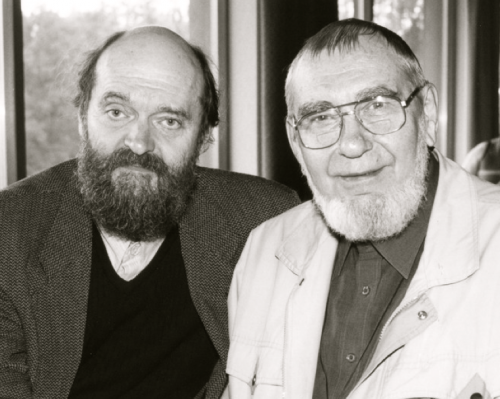
The shaman of Estonian music has died.
Veljo Tormis was bigger at home, allegedly, than even his internationally more famous compatriot, Arvo Pärt. Extremely influential as a composer of choral music, Tormis also wrote orchestral and instrumental works, 35 film scores, and an opera.
Making his name as a kind of neo-classicist, as exemplified by his “Overture No. 2,” he gradually turned to Estonian folk music, which he transformed through the use of modernist techniques. He breathed new life into the Estonian runo song, lending vitality to a dead tradition.
Politically censored during the 1970s and ‘80s, Tormis nevertheless retained his popularity, celebrated throughout the Soviet Union and Eastern Europe. Since Estonia regained its independence in 1991, his music has steadily gained traction in the West. Perhaps his most famous piece is “Raua needmine” (“Curse Upon Iron”), a setting of a text from the Kalevala, which invokes shamanistic ritual as a critique of the evils of war.
“It is not I who makes use of folk music,” Tormis once said, “it is folk music that makes use of me.”
I hope you’ll join me today between 4 and 7:00 p.m., as we remember Veljo Tormis, alongside observances of the birthdays of composers Muzio Clementi and Rutland Boughton, on WWFM – The Classical Network and wwfm.org.
“Raua needmine” (“Curse Upon Iron”):
Overture No. 2:
Live performance of “Curse Upon Iron” with the Netherlands Chamber Choir, completely up my alley!
Veljo Tormis (right) palling around with Arvo Pärt