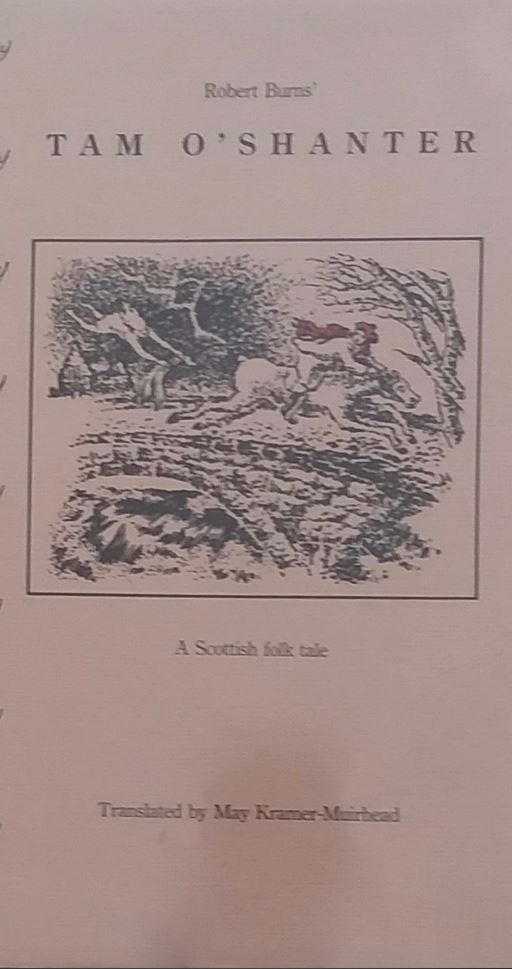
At my bedside this year, as part of my Halloween reading,* is this edition from 1984 of Robert Burns’ “Tam O’Shanter.” It’s a bidialectal edition, the poem given in English translation (by May Kramer-Miurhead), followed by the original, in Burns’ Lowland Scots. I’ve always found Chris Riker’s illustrations amusing. Nothing menacing about them (in keeping with Burns’ tongue-in-cheek tone). In any case, how could I not love that bagpipe-playing devil?
Burns writes of Tam:
“…[T]hou was a skellum,
A blethering, blustering, drunken blellum;
That frae November till October,
Ae market-dae thou was na sober.”
The tone of disapprobation could just as well have applied to composer Sir Malcolm Arnold. Both men were, more or less, fond of the bottle and also driven by demons.
Arnold was born on this date in 1921. He was hired as a trumpeter with the London Philharmonic Orchestra and promoted to principal in 1943.
During World War II, he registered as a conscientious objector. However, following the death of his brother, a pilot in the RAF, he had a change of heart. At least for a time. Though he never saw action beyond service in a military band, he quite literally shot himself in the foot in order to be able to get back to civilian life.
In 1948, he retired from orchestral playing to devote himself exclusively to composition. He had an attractive melodic gift, to be sure, which served him well in the writing of light music and film scores. He won an Academy Award in 1957 for his work on “The Bridge on the River Kwai.”
However, Arnold also had his dark side, as can be detected in passages of his symphonies. He was frequently cantankerous, often inebriated, and also highly promiscuous. He tried to kill himself at least twice. He was treated for depression and alcoholism, overcoming both, but then in the early 1980s he was given only a year to live. He actually survived another 22, during which he completed his Symphony No. 9, among other works.
Arnold died in 2006, one month shy of his 85th birthday. He was a brilliant composer of great facility. After Malcolm Williamson was appointed Master of the Queen’s Music in 1975, Sir William Walton remarked that they had given the job to the “wrong Malcolm.” For a man with so many personal demons, he wrote reams of positively delightful music.
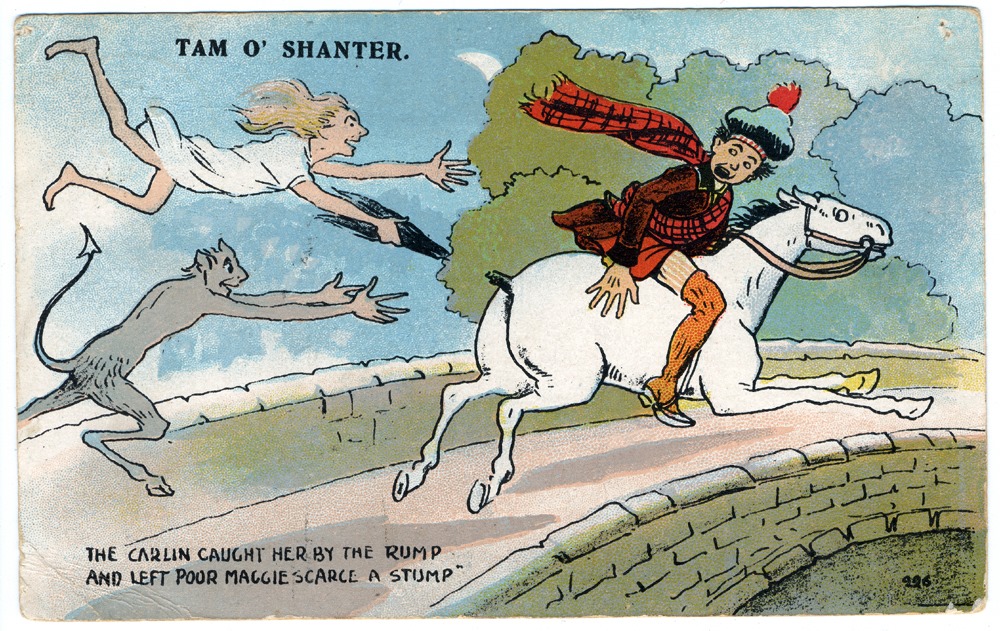
A good example, and one of my favorite Halloween pieces, is the descriptive overture “Tam O’Shanter” (1955), in which Burns’ antihero tarries at a pub, in defiance of his wife, then staggers out into the night. Under ominous skies, he detects the sound of bagpipes emanating from the ruins of an old church. Pressing his face to a chink he espies “Auld Nick,” the Devil himself, “in shape o’ beast,” presiding over a coven of high-stepping witches and warlocks.
When an unusually comely witch catches Tam’s eye, he, in his drunkenness, roars, “Weel done, Cutty-sark!” (in reference to her short skirt). This brings the forces of darkness down upon him, and there is a hell-for-leather sprint by horseback for a nearby river, since spirits are said not be able to cross running water.
If you’re interested in the rest, you can read for yourself here:
http://loki.stockton.edu/~kinsellt/litresources/ayr/tam.html
Then listen to Arnold’s musical response:
And for a bonus, enjoy his “Four Scottish Dances” (1957):
Happy birthday, Sir Malcolm Arnold, you tormented genius.
- More about this year’s Halloween reads in a future post