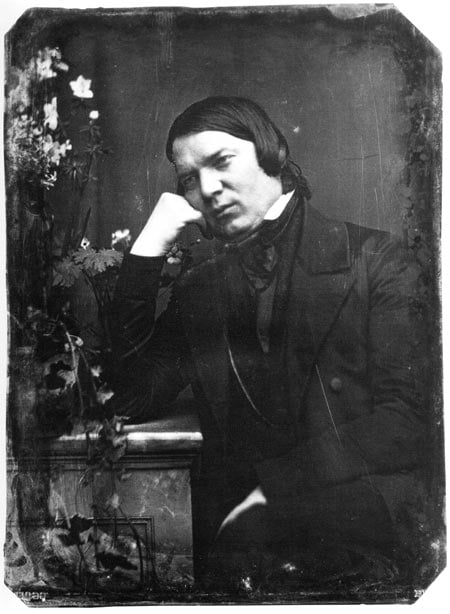
Tag: Romantic composer

  • Robert Schumann Tormented Genius

    Robert Schumann Tormented Genius

    A would-be concert pianist, he’s said to have destroyed his hand through the use of a finger-strengthening device of his own design.

    He took his underage sweetheart’s father – who also happened to be his teacher – to court, to sue for the right to marry, ultimately winning that right the day before she came of age.

    He went mad from syphilis, hurled himself into the Rhine, and spent his final months in an asylum.

    His name was Robert Schumann, and he was one of the most romantic of Romantic composers.

    It’s hardly surprising that such an overheated personality would write such emotionally turbulent music. Whether tender (as per “Kinderszenen,” his reminiscences of childhood) or troubled (the “Nachtstücke,” a premonition of his brother’s death), Schumann was the ne plus ultra of tormented genius.

    Happy birthday, Florestan! Or should that be Eusebius?


    “Kinderszenen” (“Scenes from Childhood”), performed by Clara Haskil

    “Nachtstücke” (“Night Pieces”), performed by Emil Gilels

    “Fantasie in C major,” performed by Valdimir Horowitz

    The “Fantasie” was completed in 1839, during Schumann’s enforced separation from Clara Wieck, his future wife. He wrote to her: “The first movement is the most passionate I have ever composed; it is a profound lament on your account.”

    In the end, he dedicated the work to Franz Liszt. Liszt returned the favor by dedicating his Piano Sonata in B minor to Schumann in 1854. By that time, Liszt had long been persona non grata to the Schumanns. Clara, in particular, loathed him and his music.

    She confided in her diary: “Liszt sent Robert today a sonata dedicated to him and several other things with a friendly letter to me. But the things are dreadful! [Johannes] Brahms played them for me, but they made me utterly wretched … This is nothing but sheer racket – not a single healthy idea, everything confused, no longer a clear harmonic sequence to be detected there! And now I still have to thank him – it’s really awful.”

    In any case, Robert, at 44, was already in the asylum.
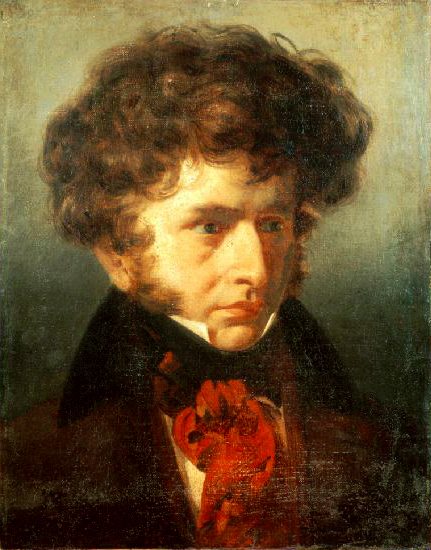
  • Berlioz Love Passion and Revenge

    Berlioz Love Passion and Revenge

    Quite possibly, he is the quintessential Romantic composer, with a capital “R.”

    Hector Berlioz revolutionized art music, even as his personal life practically rolled off the rails with unbridled emotion. My favorite Berlioz anecdote concerns Harriet Smithson, the equally fiery Irish actress who resisted his advances. Then he wooed her with a symphony – the grandest of grand gestures – and they lived miserably ever after, at least for a time. Berlioz could not understand spoken English, and Smithson didn’t know French, but apparently they were both fluent in volcanic passion.

    They married in 1833. (Franz Liszt was a witness at the civil ceremony.) It would prove to be a tempestuous relationship between two strong-willed artists. The couple had a son, but then Berlioz found a mistress and Smithson began to drink. Eventually, they separated, but Berlioz continued to support Smithson until her death in 1854.

    Ostensibly both the “Symphonie fantastique” (1830) – with a program of unrequited love that drives an artist to attempt suicide through an overdose of opium (and the nightmarish visions he experiences as a result) – and its seldom-heard sequel, “Lelio, or The Return to Life” (1831) – in which the artist finds consolation in music and literature, especially Shakespeare – were inspired by Smithson. That was the official story endorsed by the composer.

    However, Berlioz being Berlioz, after writing the symphony, but before Smithson could hear it, he reacted to her indifference by entering into a rebound relationship. This resulted in a quick engagement. Then the composer went to Italy to study, having been awarded a Prix de Rome scholarship. While there, he learned that his recent fiancée, prompted by her mother, had made a more favorable match.

    Berlioz flew into a rage, and he was determined to have his revenge. His plan involved assuming the disguise of a woman and taking a coach back to Paris with a pair of double-barrel pistols in order to put an end to his inconstant lover, her new beau, her mother, and then himself. If the pistols happened to jam, he would poison everyone instead. As luck would have it, he left the costume in the side pocket of the carriage, and this gave him a chance to cool down.

    In his day, much of Berlioz’s music was deemed hopelessly avant-garde and met with confusion, if not outright hostility. We know better now. Right?

    Join me for selections by Berlioz, Miecyszlaw Karlowicz, and Elliot Carter, all birthday celebrants, this afternoon between 4 and 7 p.m. EST, on WWFM – The Classical Network and wwfm.org.


    Berlioz in 1832. Believe it or not, I once had hair like this.

Tag Cloud

Aaron Copland (93) Beethoven (95) Composer (114) Film Music (126) Film Score (143) Film Scores (255) Halloween (94) John Williams (189) KWAX (229) Leonard Bernstein (101) Marlboro Music Festival (125) Movie Music (141) Mozart (87) Opera (203) Philadelphia Orchestra (89) Picture Perfect (174) Princeton Symphony Orchestra (107) Radio (87) Ross Amico (244) Roy's Tie-Dye Sci-Fi Corner (290) The Classical Network (101) The Lost Chord (268) Vaughan Williams (103) WPRB (396) WWFM (881)

DON’T MISS A BEAT

Receive a weekly digest every Sunday at noon by signing up here


RECENT POSTS